
Nanyuki Ebola Quarantine Protests Escalate Into Kenya US Standoff

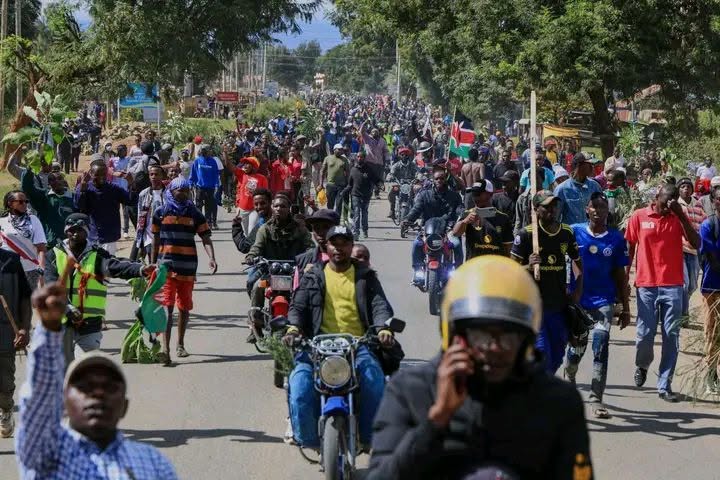
A normally quiet town at the foothills of Mount Kenya has become the center of a national dispute over health security, sovereignty, and trust in foreign-backed infrastructure projects.
In Nanyuki, protests erupted after residents opposed the construction of a medical isolation facility linked to Ebola preparedness efforts inside a military installation. Security forces used tear gas to disperse crowds after tensions escalated during demonstrations.
What began as a public health proposal has now evolved into a broader political and legal confrontation involving local communities, the Kenyan state, and international partners.
Inside the disputed Ebola isolation facility at Laikipia Air Base
The facility under construction is a planned 50-bed isolation unit designed to hold individuals exposed to Ebola but not yet symptomatic.
It is being developed within Laikipia Air Base, a strategically sensitive site located near Nanyuki.
Residents say the location choice was made without meaningful local consultation, while officials argue the site provides controlled conditions suitable for high-risk disease containment.
Also Read: Rio Ferdinand To Open International Doors For Arusha Through AFCON 2027
What is being built on the ground
- Temporary isolation tents and modular medical units
- Controlled access zones within a military perimeter
- Logistical support infrastructure for medical staff
- Rapid deployment capacity for exposure cases
- Security-managed entry and quarantine procedures
Satellite imagery reported by international observers has shown steady expansion of structures inside the base, even as legal questions remain unresolved.
Why residents in Nanyuki are resisting the project
On the streets of Nanyuki, opposition is not just about medicine—it is about trust.
Many residents say they are worried that Kenya is being positioned as a buffer zone for global health risks rather than a direct beneficiary of the facility.
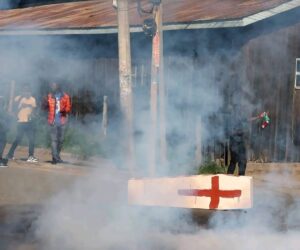
During protests, demonstrators carried symbolic items including white crosses and mock coffins, signaling fears that the project could bring long-term danger to the community.
Key concerns raised by residents
- Fear of imported infection risks from abroad
- Lack of transparency in bilateral agreements
- Use of a military base for civilian health isolation
- Weak local participation in decision-making
- Concerns over long-term environmental and safety impacts
One protester described the situation as “a decision made far away, but lived here every day,” reflecting a sentiment echoed widely in the crowd.
Legal pressure builds as court orders face real-world test
The dispute has also entered Kenya’s judicial system, where courts issued restrictions on further development pending compliance reviews.
Despite this, construction activity has reportedly continued, raising concerns about whether legal directives are being fully observed.
This creates a rare institutional tension between judiciary oversight and executive-level diplomatic coordination.
Institutional positions in conflict
|
Institution |
Position |
Main Concern |
|
Kenyan Judiciary |
Construction pause pending review |
Rule of law and enforcement |
|
Kenyan Government |
Ongoing diplomatic engagement |
Health preparedness and alliances |
|
US partners |
Continued operational planning |
Ebola exposure containment strategy |
|
Local community |
Strong opposition |
Safety, consent, and land use |
The situation has become a stress test for how Kenya balances international partnerships with domestic legal authority.
US health security approach and policy context
The facility is part of a wider international strategy to prevent the spread of infectious diseases beyond outbreak zones in East and Central Africa.
The current policy direction under Donald Trump has emphasized strict prevention of domestic exposure, particularly following lessons learned from past Ebola outbreaks.
Officials have indicated that individuals exposed to the virus would be isolated in controlled environments abroad rather than transported to the United States.
However, US authorities have not fully clarified whether the Kenyan facility would serve only American nationals or a broader group of patients, adding to public confusion.
Regional Ebola risk and why East Africa is on alert
The broader backdrop to this dispute is the persistent threat of Ebola outbreaks across parts of East and Central Africa.
Countries such as Uganda and the Democratic Republic of Congo have experienced repeated flare-ups over the past decade, often in remote but highly mobile border regions.
Regional health preparedness comparison
|
Factor |
Current Reality |
Challenge |
|
Outbreak frequency |
Intermittent but recurring |
Rapid containment needed |
|
Infrastructure |
Limited isolation capacity |
Dependence on external support |
|
Cross-border movement |
High informal trade routes |
Spread risk escalation |
|
Emergency response |
Uneven regional coordination |
Resource gaps |
Public health specialists argue that early isolation capacity can save lives, but only if communities trust and accept its presence.
Security concerns and the military base dilemma
Locating a medical isolation facility inside a military base has added another layer of sensitivity.
While military installations offer controlled access and logistical strength, they also reduce transparency and civilian oversight.
In Nanyuki, this has led to concerns that health infrastructure is being merged with defense operations in ways that are not fully understood by the public.
Security analysts note that this kind of dual-use infrastructure is increasingly common globally, but requires strong communication to avoid mistrust.
Also Read: Ngemi Festival 2026: Theme, Venue, Date and Everything You Need to Know
Economic and diplomatic stakes between Kenya and the United States
Beyond health concerns, the dispute carries diplomatic significance.
Kenya remains a key strategic partner for the United States in East Africa, hosting joint security programs and regional coordination initiatives.
However, the current standoff risks introducing friction into an otherwise stable relationship.
Impact assessment of ongoing tensions
|
Area |
Potential Benefit |
Potential Risk |
|
Public health |
Faster outbreak containment |
Loss of community trust |
|
Diplomacy |
Stronger bilateral cooperation |
Legal and political strain |
|
Local economy |
Short-term construction jobs |
Protest disruptions |
|
Governance |
Infrastructure development |
Institutional credibility pressure |
Economists warn that unresolved disputes of this nature can create long-term hesitation around future foreign-funded health infrastructure.
Trust deficit at the center of the crisis
At its core, the Nanyuki dispute is not only about Ebola preparedness—it is about trust.
Residents are not rejecting healthcare infrastructure itself, but questioning how decisions are made, who benefits, and who carries the risk.
Without stronger engagement, even well-intentioned health security projects risk becoming symbols of exclusion rather than protection.
What happens next in Nanyuki
The outcome now depends on three moving parts: court enforcement, diplomatic negotiation, and public sentiment.
If legal rulings are strictly enforced, construction may be paused or redesigned. If negotiations prevail, the project could continue with revised oversight and community engagement mechanisms.
Either way, the Nanyuki case is likely to influence how future cross-border health security projects are negotiated in Kenya and beyond.