Prof Ndung’u: How Ruto Has Taken Control of State Institutions

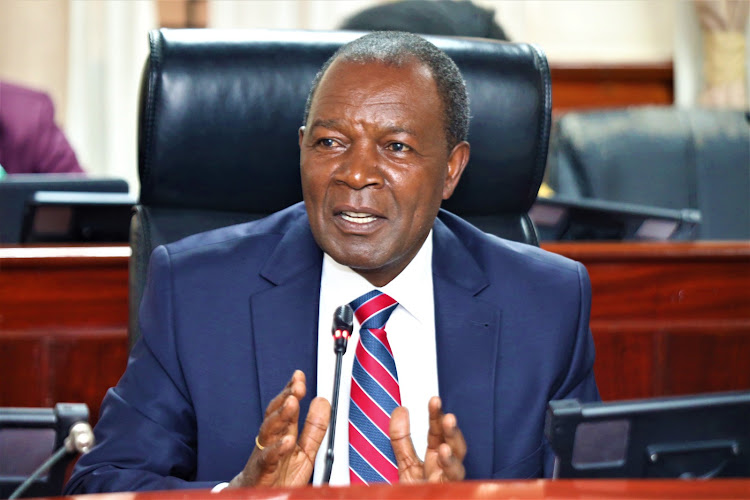
Former National Treasury Cabinet Secretary Njuguna Ndung’u has accused President William Ruto of running a highly centralised administration, arguing that excessive presidential intervention has weakened the independence of government institutions.
Speaking at a conference on aid in Sweden, Prof Ndung’u said institutions often have the capacity to perform their duties but are constrained when political leaders interfere with their work. He described the situation as an “institutional failure problem”, arguing that officials can struggle to act independently when someone seeks to override established structures.
“Right now, the current president (Dr Ruto) overruns all the institutions,” Prof Ndung’u said, inviting the media to quote him directly. He added that officials in institutions were often forced to conform because of fear, before recalling his own experience at the National Treasury.
“And that is why everybody in those institutions has to conform for fear. But I refused to do deals in the Ministry of Finance,” he said.
The remarks offer the clearest public criticism yet from Prof Ndung’u about his experience inside the Kenya Kwanza administration. He was dropped from the Cabinet in July 2024 after President Ruto dissolved most of his Cabinet following the Gen Z-led protests against the Finance Bill 2024.
State House had not responded to questions on Prof Ndung’u’s remarks by the time of publication.
Ndung’u’s Treasury Frustrations
Prof Ndung’u’s comments have reopened questions about the balance between presidential oversight and the independence of ministries, departments and constitutional institutions under the current administration.
President Ruto has previously defended his close involvement in government affairs, presenting it as a necessary part of ensuring that Cabinet Secretaries and Principal Secretaries understand their responsibilities and deliver on government priorities.
During the signing of performance contracts for Cabinet Secretaries and Principal Secretaries at State House in August 2023, the President questioned why he sometimes appeared to have more information about ministries than the officials responsible for running them.
Ruto said Cabinet Secretaries and Principal Secretaries were expected to advise him and should therefore have a better understanding of the operations within their respective dockets. He also acknowledged regularly calling senior officials to establish what was happening in their departments.
The President’s position has helped shape the debate around his management style. Supporters describe him as hands-on and demanding, while critics have interpreted the same approach as excessive involvement in areas that should be handled by ministers and independent institutions.
Prof Ndung’u’s criticism comes from a former insider who spent close to two years at the centre of the government’s economic decision-making. His departure from Treasury followed months of intense public debate over taxation, government spending and the rising cost of living.
The Finance Bill 2024 became one of the defining flashpoints of his tenure. The proposed legislation included a motor vehicle tax, changes to VAT and higher excise duties on some goods and services.
Public opposition to the proposals grew rapidly in June 2024, culminating in nationwide demonstrations led largely by young Kenyans. The protests eventually forced the President to decline to sign the Finance Bill after it had passed through Parliament.
Ruto subsequently dismissed most of his Cabinet, retaining only a few ministers as he sought to respond to the political pressure generated by the protests.
Prof Ndung’u had already faced speculation that he was considering leaving government before the Cabinet changes. His handover remarks offered an indication of some of the difficulties encountered during his tenure.
He said the Treasury had struggled to stabilise the economy amid persistent economic shocks and pointed to what he termed “inconsistencies in terms of internal politics”.
The former minister’s latest comments provide further context to those remarks, particularly his criticism of what he now describes as interference in the work of institutions.
Tax Policy Emerges as Another Point of Friction
Taxation was another major source of tension between Prof Ndung’u’s economic thinking and the direction taken by the administration.
The economist has consistently questioned the assumption that higher tax rates automatically produce higher government revenue. His position predates the Ruto administration and has been reflected in his academic and policy work.
In a 2019 policy brief, Prof Ndung’u argued that increasing tax rates beyond a certain point could eventually reduce tax revenue rather than increase it. The argument challenged the use of repeated tax increases as a primary way of financing government expenditure.
That position became particularly relevant during the Kenya Kwanza administration, which pursued ambitious revenue-raising targets amid pressure to fund government programmes and manage public debt.
Prof Ndung’u later criticised what he called the “notion that high tax rates will raise high tax revenue”.
“The reality is the opposite. I don’t want to mention who drives us there,” he said.
The disagreement reflected a broader challenge facing the government. Kenya entered the Ruto administration with significant debt obligations and a large budget, leaving Treasury under pressure to increase domestic revenue while attempting to protect economic growth.
The government’s tax proposals subsequently became a major political issue. The Finance Bill 2024 became the most prominent example, with public opposition forcing the administration to rethink its approach to revenue collection.
Ruto’s supporters have argued that the government inherited difficult economic conditions and needs stronger revenue collection to finance essential services and reduce dependence on borrowing.
Critics, however, have questioned whether aggressive taxation could further strain households and businesses, particularly during a period of high living costs.
The debate has continued beyond Prof Ndung’u’s tenure at Treasury and remains central to discussions about the government’s economic strategy.
His criticism of presidential influence also comes amid a wider debate about the concentration of decision-making within State House.
During the early years of the Kenya Kwanza administration, a group of influential economic advisers around State House played a prominent role in shaping policy. Economist David Ndii was among the most visible figures associated with that group.
The arrangement attracted scrutiny from political and economic commentators who questioned how much influence advisers outside the formal Cabinet structure should have over government policy.
Prof Ndung’u’s latest remarks now add the perspective of a former Cabinet Secretary who was directly involved in implementing economic policy.
He is also not the first former senior government official to publicly criticise the administration after leaving office.
Former Public Service Cabinet Secretary Justin Muturi has previously made serious allegations about corruption within government following his departure. Those claims have also contributed to wider scrutiny of the administration’s governance record.
President Ruto came to office promising to dismantle what he described as State capture under the previous administration. During his campaign, he argued that institutions including the Kenya Revenue Authority, Directorate of Criminal Investigations, Assets Recovery Agency and the courts had been used against his political allies.
Critics now argue that some decision-making has instead become increasingly concentrated around the presidency.
The debate was particularly visible during the Finance Bill 2024 controversy, when Ruto became the central public figure defending the government’s proposed tax measures.
Another episode emerged in 2025 following the controversy surrounding procurement at the Kenya Medical Supplies Authority. Ruto ordered the removal of the KEMSA board and chief executive, a move that reignited debate over the extent of presidential intervention in State corporations.
Former Prime Minister Raila Odinga also criticised the President’s approach following the KEMSA changes. He argued that Cabinet Secretaries should be allowed to take responsibility for policy decisions within their ministries rather than leaving major announcements to the presidency.
The disagreement reflects a fundamental question about how Kenya’s executive branch should operate: whether a president should maintain close oversight of every major government function or allow ministers and independent institutions greater room to exercise their mandates.
Ruto’s supporters see his involvement as evidence of a president who is deeply engaged in government and unwilling to tolerate poor performance. His critics see the same approach as centralisation that risks weakening institutional accountability.
Prof Ndung’u’s intervention adds weight to that debate because it comes from someone who served inside the administration and had direct responsibility for the country’s finances.
His remarks are likely to fuel renewed discussion over the relationship between the presidency, Cabinet and independent institutions as the Ruto administration moves deeper into its second term.
The question now is whether the government’s institutions can maintain sufficient independence while implementing an agenda that requires strong coordination from the centre.
Prof Ndung’u has made his position clear. He believes institutions can deliver, but only if those charged with running them are allowed to exercise their mandates without undue interference.
That argument places institutional independence at the heart of the continuing debate over Ruto’s leadership style and the direction of governance in Kenya.