
OPINION: Football or Politics? Decoding Governance Struggles Inside Hussein Mohammed’s FKF Executive

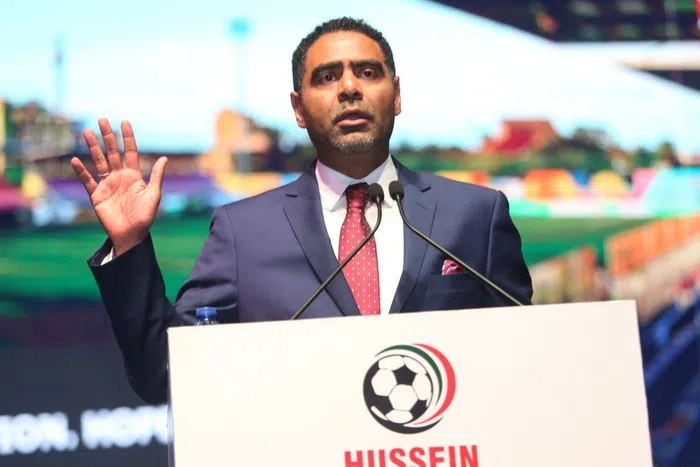
Hussein Mohammed
Football Kenya Federation (FKF) President Hussein Mohammed’s administration entered office promising a fresh approach to Kenyan football, but less than two years into the four-year mandate, the federation is confronting a governance crisis that has placed its leadership structure, political relationships and decision-making processes under intense scrutiny.
Mohammed was elected FKF president on December 7, 2024, alongside former Harambee Stars captain McDonald Mariga as vice president. He secured 42 of the 90 votes in the first round, while Doris Petra and Nick Mwendwa’s ticket received 31. Barry Otieno finished with 10 votes and Cleophas Shimanyula with four. Petra and Otieno subsequently withdrew, clearing the way for Mohammed and Mariga to take office.
Read Also: Pharmacy Board Looks to Shape Future of Pharmaceutical Practice
The result represented a change in leadership after Nick Mwendwa’s long tenure and created expectations that the new administration would combine football experience, commercial expertise and stronger institutional governance.
The reality has proved considerably more complicated.
A leadership built across different networks
Hussein Mohammed arrived at the FKF presidency with experience extending beyond traditional football administration.
Before taking charge of FKF, Mohammed was associated with Extreme Sports, where he served as chief executive, and had been involved with grassroots football and Murang’a Seal. He had also previously worked in corporate leadership, including a senior sales position at Safaricom, and participated in sports and youth initiatives.
That background gave his campaign a different character from administrations built almost entirely around traditional football structures.
His partnership with Mariga added another dimension.
Mariga brought a high-profile playing career and international football experience to the ticket. The former Kenyan international had represented the country at the highest level and had played professional football in Europe. Mohammed publicly presented the partnership as a combination of shared ambition and football experience.
The ticket also pursued commercial and infrastructure themes during the campaign. Mohammed unveiled proposed partnerships involving international sports-development companies, reflecting his argument that Kenyan football needed stronger commercial structures and better facilities.
This combination of corporate, grassroots and elite football networks was central to the administration’s identity.
It also means that the presidency cannot be viewed purely through the traditional lens of football politics.
The political dimension
The relationship between sports administration and politics is particularly important in Kenya because football does not operate in isolation from government institutions.
FKF is an autonomous football governing body, but its activities inevitably intersect with state institutions through stadium development, security, public funding, international tournaments and national-team infrastructure.
That relationship has become particularly significant as Kenya prepares to co-host the 2027 Africa Cup of Nations.
The current administration has therefore had to engage with the Ministry of Sports and other government institutions while maintaining the independence expected of a national football federation.
That balancing act is now being tested.
Read Also: Top Comoros Official Hospitalized in Nairobi Amid Rising Tensions in Moroni
Reports in 2024 alleged that political figures and governors were being drawn into the FKF electoral contest. Such allegations were made by some football stakeholders and delegates during the campaign, although they should be treated as claims rather than established findings.
The broader issue is less about attaching a political label to Mohammed and more about understanding how influence operates around Kenyan football.
Football elections require support from delegates across the country’s regions. Government controls or influences many of the physical and financial environments in which football operates. Clubs depend on public infrastructure, while national teams rely on cooperation between FKF and state institutions.
Those overlapping interests inevitably create opportunities for political relationships to become part of football governance.
Ministry of Sports and FKF: cooperation without control?
The relationship between FKF and the Ministry of Sports has become increasingly visible during the current leadership dispute.
In September 2026, Sports Cabinet Secretary Salim Mvurya directed Mohammed and sections of the FKF National Executive Committee to resolve disagreements that were threatening the start of the domestic league.
That intervention illustrates the difficult line between government involvement and federation autonomy.
The Ministry has a legitimate interest in ensuring that Kenyan sport functions properly, particularly ahead of AFCON 2027. At the same time, FKF operates under its own constitution and within the framework of international football governance.
Neither side can afford a relationship where political authority substitutes for football governance.
The challenge is therefore to maintain cooperation without creating the perception that federation decisions are being determined outside the federation’s constitutional structures.
The Mariga question
Perhaps the most striking development has been the deterioration of relations within the very ticket that brought Mohammed and Mariga to power.
In April 2026, nine FKF NEC members moved to suspend Mohammed, Acting CEO Dennis Gicheru and NEC member Abdallah Yusuf over allegations connected to a roughly Sh42 million CHAN insurance arrangement. Mohammed rejected the accusations.
The Sports Disputes Tribunal subsequently issued interim orders blocking the implementation of the disputed resolutions. Reports also indicated that Mariga had been positioned by the NEC faction as acting president during the attempted leadership change.
The dispute became even more public in May, when Mohammed accused Mariga of knowing about what he described as an attempted “coup” within FKF. That characterization was Mohammed’s, not an independently established description of events.
FIFA later rejected the NEC’s attempted suspension of Mohammed, according to reporting by The Standard, which said the world governing body considered the resolutions inconsistent with FKF’s constitution.
The episode demonstrates how quickly an electoral alliance can become an institutional contest when constitutional authority is disputed.
League continuity becomes the real test
The biggest consequence of the governance struggle is not simply who controls FKF headquarters.
It is what happens to Kenyan football on the pitch.
The 2026/27 top-flight season has already faced delays linked to disputes over promotion, relegation and the applicable competition regulations. The High Court’s orders and subsequent clarification created a legal pathway for FKF to use the 2019 regulations, while disputes continued among federation officials and clubs.
FKF subsequently announced September 19, 2026 as the intended start date for the SportPesa League.
Yet by September, disagreements inside the NEC were still affecting the federation’s ability to operate collectively. Seven NEC members challenged the agenda for an executive meeting, citing consultation, documentation and compliance concerns.
That is where governance becomes tangible for ordinary football stakeholders.
A constitutional disagreement in Nairobi can mean a delayed fixture in Kisumu, uncertainty for a club in Nairobi, disrupted planning for a sponsor or financial pressure for players and coaches.
What the Hussein Mohammed administration now faces
The Mohammed administration entered office promising commercialization, infrastructure development, stronger governance and grassroots investment.
Those ambitions remain significant.
But governance is ultimately tested not only by promises or election victories, but by the ability of institutions to make decisions collectively, transparently and consistently.
Kenyan football’s recent history shows why this matters.
Read Also: Kenyan marathoner remanded over Ksh8 million land fraud case
Gor Mahia’s continental campaign, for example, has demonstrated how clubs need professional structures and commercial stability to compete beyond the domestic game. Kenya Frontline’s analysis of Gor Mahia’s commercial backing ahead of the CAF Champions League examined that connection between administration and sporting ambition.
The same principle applies at federation level.
Harambee Stars are also preparing for AFCON 2027 under Benni McCarthy, with Kenya already guaranteed a place as a co-host. Kenya Frontline’s latest Harambee Stars squad report details the squad-building process now underway.
The federation therefore cannot afford prolonged institutional uncertainty.
Its mandate extends beyond presidential politics to the national team, women’s football, youth development, refereeing, competitions and Kenya’s preparations for hosting AFCON 2027.
A battle bigger than one presidency
The current FKF dispute should not be reduced to a simple contest between Hussein Mohammed and McDonald Mariga.
At its core is a broader question about how Kenyan football should be governed.
Who has authority to make decisions? How should the NEC exercise its constitutional responsibilities? What role should government play? How should public and federation funds be overseen? And how can disagreements be resolved without disrupting competitions?
Those questions will matter regardless of which personalities dominate the headlines.
Mohammed’s corporate background, Mariga’s football profile, government relationships and the competing interests within the NEC have all become part of the wider governance environment.
The administration’s most important challenge now is institutional rather than personal: demonstrating that FKF can withstand internal disagreement while keeping Kenyan football functioning.
The 2026/27 league season provides an immediate measure of that challenge.
If clubs can receive clear regulations, fixtures can proceed, legal disputes can be handled through proper channels and the federation can operate through its constitutional structures, the current crisis may eventually become a chapter in FKF’s institutional development.
If uncertainty continues, the consequences will extend well beyond the boardroom.
Kenyan football ultimately needs governance that survives changes in personalities, political relationships and electoral alliances.
That is the standard against which the Hussein Mohammed era will continue to be examined.

