
5 Things You Should Know About Daniel Ebenyo

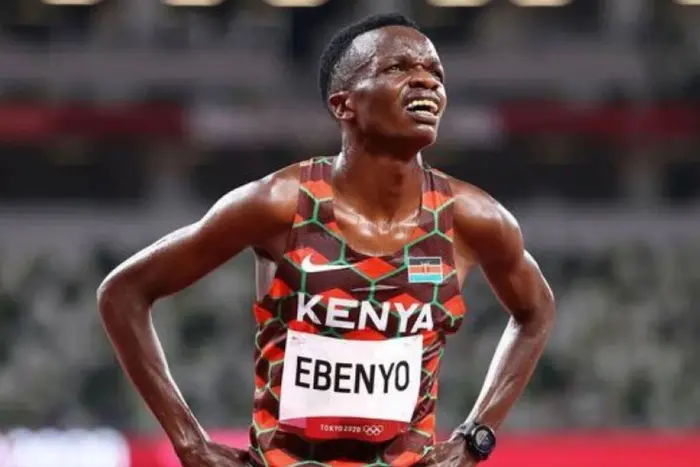
Daniel Simiu Ebenyo is recognized across the running world by his devastating late-stage kick and his stellar collection of global medals including world silver on the track and the roads, alongside a recent bronze at the World Cross Country Championships.
Behind the blistering times and podium finishes lies one of the most compelling, resilient stories in modern athletics.
Ahead of his highly anticipated return to the roads at the Chicago 13.1 Half Marathon on June 7, here are five essential things you should know about the Kenyan distance star.
Read Also: Sammy Henia-Kamau Everything About New Hull City Star In Harambee Stars Squad
Systematic Evaluation of International Track and Road PBs
|
Racing Discipline |
Personal Best Metric |
Event Venue Context |
Official Verification Date |
|
10,000 Metres (Track) |
26:57.80 |
Memorial van Damme, Brussels |
September 8, 2023 |
|
Half Marathon (Road) |
59:04 |
Bahrain Royal Night Half Marathon, Manama |
December 23, 2022 |
|
10 Kilometres (Road) |
26:58 |
10K Valencia Ibercaja, Valencia |
January 9, 2022 |
|
5000 Metres (Track) |
12:54.90 |
Memorial van Damme, Brussels |
September 2, 2022 |
|
Marathon (Road) |
2:06:04 |
Bank of America Chicago Marathon, Chicago |
October 13, 2024 |
1.Daniel Ebenyo Evaded Bandits and Live Bullets to Get to School
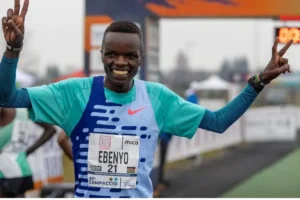
Ebenyo’s legendary lung capacity was forged under conditions no child should ever have to face. Growing up in Baragoi, a highly volatile, rural area in Samburu County, cattle rustling and violent tribal clashes were a part of daily life. To get to Aiyam Day Secondary School, he had to undertake a grueling 24-kilometer daily trek. This extreme environment forced him to develop physical and mental fortitude long before stepping onto a professional tartan track.
The journey was less about fitness and more about survival. Ebenyo frequently had to dodge live bullets from local bandits, taking massive detours through rugged terrain just to avoid active conflict zones. Navigating these perilous mountain passes on foot every morning built an exceptional aerobic foundation. Coping with constant danger instilled a quiet, fearless mindset that now allows him to remain completely unfazed during high-stakes tactical stalemates against the absolute best fields in international distance running.
Developing elite lung capacity under such duress gave him a unique physiological edge. Young athletes in Samburu rarely had access to formal coaching, running tracks, or standardized footwear. Relying entirely on raw determination, he transformed a daily life-or-death commute into an elite training ground. Facing severe adversity early in life reshaped his entire perspective on competitive stress, teaching him that managing pain on a racecourse is nothing compared to surviving the crossfires of his youth.
2.Running Began as an “Escape Plan” Inspired by Magazines
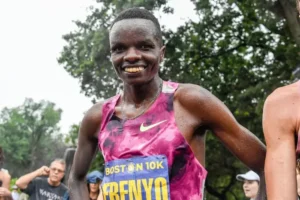
Unlike many Kenyan athletes who grow up dreaming of Olympic stadiums, Ebenyo’s relationship with running began simply as a tool for survival. However, his perspective shifted at the age of 12 when he stumbled upon pictures of professional runners in old sports magazines. Seeing images of successful athletes competing on the global stage opened his eyes to a world beyond the cyclical violence of his home region.
Inspired by those images, he realized his natural speed could be his ticket out of poverty and regional violence. He committed to running his school commutes full-time, a level of dedication his peers initially found strange, but one that ultimately saved his life. Turning his back on localized cattle raiding culture required immense personal discipline. Choosing the lonely path of a distance runner allowed him to carve out a completely different future, transforming isolation into a targeted vehicle for absolute socio-economic transformation.
Read Also: Top Comoros Official Hospitalized in Nairobi Amid Rising Tensions in Moroni
Visualizing success through those weathered pages kept him anchored during his hardest years. Lacking access to television or sports broadcasts, he memorized the names, running stances, and triumphs of the legends who came before him. This deep-seated desire to rewrite his life story fueled his daily workouts. Transforming running from a basic chore into a deliberate, long-term escape plan laid the groundwork for his future transition into a world-class professional athlete.
3.Daniel Ebenyo Fainted in Training Before Getting His Big Break
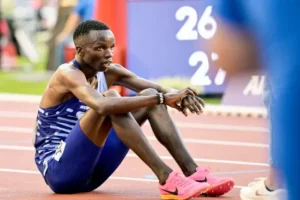
When Ebenyo first arrived in Iten—the world-famous “Home of Champions’, he did not have a sponsor, a manager, or standard running gear. He struggled to buy food and started working as a pacemaker to help train elite female athletes just to get by. Surviving on less than a dollar a day meant confronting severe nutritional deficiencies while simultaneously trying to match the brutal, high-altitude training volumes required to compete at the elite level.
During one particularly grueling training session, extreme physical exhaustion and financial hardship caught up with him, causing him to faint on the track. The incident caught the eye of coach Erik Kogo, who realized the young runner was starving but possessed immense raw talent. Kogo took him under his wing alongside manager Lee-Roy Newton, providing the structured support that launched his professional career. Finding a team that believed in his underlying capabilities completely altered his trajectory, offering the stability needed to turn his raw physical power into calculated racing success.
Overcoming starvation in Iten remains a central chapter in his athletic journey. Collapsing on the dirt track served as a turning point, exposing the stark reality that talent alone cannot survive without proper recovery, nutrition, and institutional backing. Transitioning into a professional setup allowed his body to absorb heavy training loads efficiently. This hard-earned physical baseline ultimately enabled him to drop his times down into the world-class, sub-27 minute territory for the 10,000 meters.
4.An Administrative Debacle Nearly Made Daniel Ebenyo Quit the Track
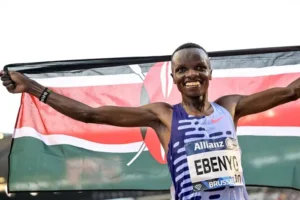
In 2019, Ebenyo looked set to shock the world after finishing an incredible second at the Kenyan World Championship trials. Tragically, he was barred from traveling to Doha because he had not met the mandatory out-of-competition anti-doping test thresholds required for international selection—a technical rule Athletics Kenya had failed to inform him about. Missing out on his global debut due to a bureaucratic failure left him deeply disillusioned with the administrative side of the sport.
Heartbroken and deeply frustrated by the sports federation, a distraught Ebenyo seriously contemplated quitting track entirely. Instead, he channeled that anger into the road circuit, immediately winning the Safaricom Kisii 10k and rewriting the Nairobi Marathon 10k event record in 28:23. He eventually returned to the track, securing 10,000m silver at the 2023 World Championships in Budapest. Returning to the global stage on his own terms proved his resilience, demonstrating an elite ability to transform bureaucratic heartbreak into dominant, podium-level performances.
Bypassing this career-threatening obstacle required an extraordinary level of mental toughness. Watchers of Kenyan athletics know that many promising careers collapse when athletes are sidelined by administrative errors. Choosing to pivot instantly to competitive road racing kept his competitive edge sharp. This strategic flexibility eventually allowed him to secure major global medals across three entirely distinct surfaces: track, road, and cross-country.
5.Daniel Ebenyo is a Serving National Police Officer Sponsored by Kipchoge’s Partner
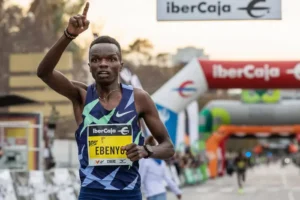
Ebenyo balances his grueling training regimen with his duties as a serving officer in the Kenya National Police Service. This dual role places him in an elite tradition of Kenyan runners who represent law enforcement on the global stage. Balancing the rigid discipline of police work with elite athletic preparation requires precise time management, ensuring he remains grounded and deeply connected to his community.
His stellar career is backed by Global Sports Communication,the highly prestigious sports management agency that handles marathon legend Eliud Kipchoge. He frequently draws inspiration from three-time World Cross Country champion Geoffrey Kamworor, often studying tapes of Kamworor’s tactical movements to perfect his own racing strategy. Operating within a world-class support network gives him access to advanced sports science, top-tier pacing partners, and specialized recovery systems. This comprehensive backing allows him to maintain peak performance across a demanding year-round global racing calendar.
Representing the police force adds a profound sense of purpose to his international campaigns. Donning the national colors in uniform enforces a deep sense of patriotism that guides his racing tactics. Drawing strategic insights from legendary stablemates like Kamworor allows him to execute calculated, high-speed moves mid-race. This structural blend of institutional backing and world-class mentorship ensures he enters the 2026 road season fully equipped to challenge world records and secure historic titles.