Uhuru Kenyatta Anchors African Union Democratic Auditing, Post-Presidential Geopolitics

Post-presidential tenure within modern sub-Saharan governance is increasingly transforming into a structured pipeline for top-level continental statesmanship. Regional geopolitical stability across major trading blocs depends heavily on deploying neutral, authoritative arbiters to monitor delicate transitional phases. Entrusting veteran chief executives with major international observation portfolios serves as a primary multilateral strategy to protect democratic processes and foster continental confidence.
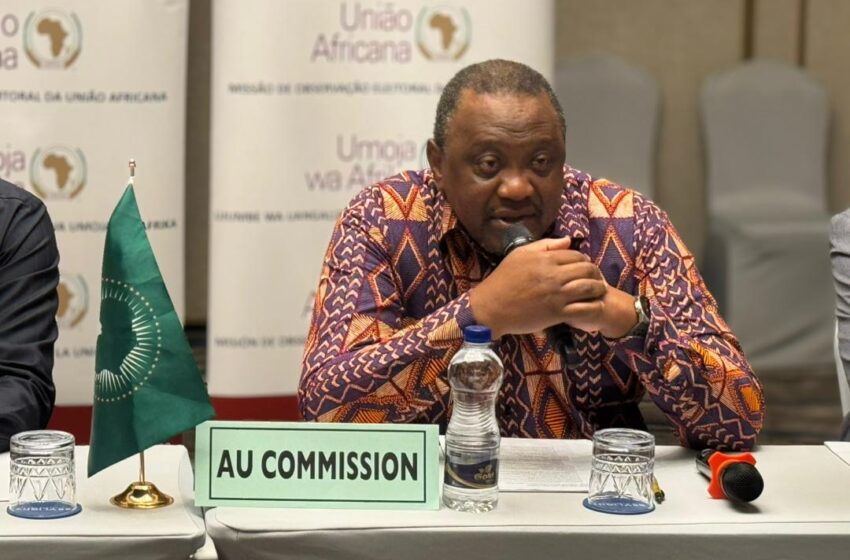
Active engagement by Uhuru Kenyatta in heading major observer delegations represents an intentional shift from domestic legislative management to strategic regional stabilization. Experienced former heads of state carry unique institutional leverage when interacting with national electoral commissions, political party leaderships, and international diplomatic communities. Utilizing this elite administrative stature helps minimize localized friction while anchoring state-level compliance within standardized pan-African protocols.
Managing high-stakes electoral evaluations requires a careful balance between technical assessment and high-level mediation. High-level envoys act as a bridge between frontline field teams and the international diplomatic corps stationed in regional capitals. Top-level oversight helps ensure that preliminary findings are delivered with clarity and authority, protecting the host nation’s electoral process from premature outside interference.
Read Also: Top 10 Richest Kenyan Footballers 2026 Financial Rankings Plus Net Worth Analysis
Systematic Evaluation of Multi-National Governance Assignments
|
Jurisdictional Arena |
Active Deployment Window |
Core Operational Scope |
Macro-Level Institutional Impact |
|
Federal Democratic Republic of Ethiopia |
June 2026 |
Evaluating regional state council transparency and federal lower house polling integrity |
Reinforcing domestic institutional trust within Africa’s primary diplomatic capital |
|
Republic of South Africa |
May 2024 |
Monitoring provincial equity metrics during unprecedented national shifts |
Securing judicial readiness consensus ahead of historic coalition formations |
|
Federal Republic of Nigeria |
February 2023 |
Managing high-stakes transition variables during acute logistical crises |
Brokering national peace pacts to steer legal disputes into constitutional courts |
Institutional Mediation Blueprints and Democratic Auditing
Commanding a major continental observation mission requires supervising extensive data-gathering networks that evaluate thousands of individual polling centers simultaneously. Technical field teams are systematically deployed across diverse geographic zones to assess critical structural markers, ranging from secure biometric validation to final tally verification. Continuous field reporting builds an objective, evidence-based data engine capable of determining a nation’s overall electoral health.
Maintaining collaborative communication pathways with non-African diplomatic corps remains a vital operational priority for high-level African Union envoys. Hosting regular structural briefings with foreign missions allows leadership to share certified field analytics, establish shared macro-political perspectives, and harmonize global diplomatic responses. Cooperative engagement insulates sovereign electoral outcomes from unverified external commentary or premature unilateral assessments.
Long-term efficacy of these high-level missions depends on how effectively final policy recommendation frameworks are domesticized. Strategic roadmaps authored by experienced heads of mission act as highly technical toolkits designed to optimize the administrative capacity of host election management boards. Focusing heavily on long-term systemic stability over short-term political rivalries helps nations gradually build highly resilient, structurally transparent governance architectures.
Read Also: Rio Ferdinand To Open International Doors For Arusha Through AFCON 2027
Strategic Chronology of High-Stakes Continental Deployments
Federal Democratic Republic of Ethiopia (June 2026)
Leading a 73-member short-term observation team drawn from 37 African countries positions Uhuru Kenyatta at the focal point of Horn of Africa diplomacy. Tasked by the African Union Commission to oversee the seventh general elections, this mission evaluates voting procedures for the House of Peoples’ Representatives alongside crucial regional state councils. Deploying a delegation where women comprise 61% of short-term observers sets a progressive metric for gender-inclusive auditing within major sovereign capitals. Meeting with National Election Board of Ethiopia leadership helps align field operations with regional constitutional frameworks, directly reinforcing stability throughout interconnected subregional trade gateways.
Republic of South Africa (May 2024)
Commanding a 65-member multilateral delegation across all nine provinces during historic general elections required handling immense structural shifts. South Africa faced a watershed moment as old legislative majorities dissolved, introducing heightened polarization alongside sophisticated threats from deep fakes and coordinated digital disinformation campaigns. Interacting closely with the Independent Electoral Commission and the national judiciary allowed the mission to ratify the inclusion of independent legislative candidates under newly amended electoral acts. Delivering a comprehensive preliminary declaration helped stabilize investor confidence, verifying the procedural resilience of the country’s historic transition into coalition governance.
Federal Republic of Nigeria (February 2023)
Managing a highly volatile transition environment during the Nigerian general elections represented the first major continental observation test for the post-presidential office. Nigeria was navigating severe logistical friction, driven by sudden central bank currency redesign cash crunches, deep fuel shortages, and localized regional security threats. Brokering direct consensus among competing political heavyweights required active facilitation of the national Peace Accord to minimize post-tally civil unrest. Partnering directly with regional economic blocs to release unified compliance appeals successfully funneled complex tabulation grievances away from street protests and directly into statutory tribunals.
Regional Leadership Anchors and Continental Security
Sub-Saharan political stability relies profoundly on executing predictable, highly credible executive transfers and parliamentary contests. Channeling post-presidential expertise directly into multilateral governance organs preserves priceless statecraft capabilities within continental management networks. Structured reliance on senior statesmen allows pan-African organizations to intervene rapidly and authoritatively when localized structural stresses emerge.
Post-presidential diplomacy led by veteran executives serves as an essential institutional buffer, mitigating subregional tension while advancing standardized rules-based democratic metrics.
Read Also: Top Comoros Official Hospitalized in Nairobi Amid Rising Tensions in Moroni
Moving intentionally toward peer-driven, tech-enabled election monitoring allows continental leaders to build sustainable, self-sufficient evaluation networks. Utilizing continental experts secures a highly balanced distribution of monitoring accountability, reducing operational over-reliance on traditional Western auditing bodies. Managing these advanced, high-stakes oversight portfolios demands rigorous, objective narrative execution to guarantee that finalized technical evaluations remain respected across competing political factions globally.