
Court Orders Sh7.3Million Payout for Kenyan Scam Factory Victim

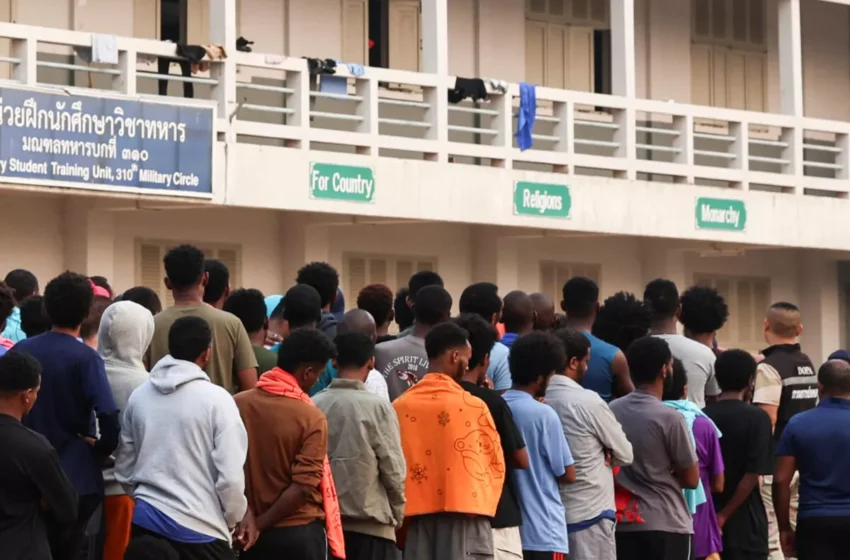
A court has awarded a Kenyan woman more than Sh7.3 million after finding that she was deceived with promises of a lucrative job in Thailand, only to be trafficked into neighbouring Myanmar where she was forced to work in a cybercrime compound under conditions the judge described as slavery, servitude and human trafficking.
The Employment and Labour Relations Court ruled that the victim was recruited through false promises of overseas employment before being delivered into the hands of traffickers operating one of Southeast Asia’s notorious scam centres. The court found that the recruiter orchestrated the journey through deception, leaving the victim trapped for months in a heavily guarded compound where she worked without pay and endured physical and psychological abuse.
The judgment, delivered in Kisumu on July 8, 2026, offers one of Kenya’s strongest judicial condemnations of illegal overseas recruitment schemes that have left dozens of Kenyans stranded in Myanmar’s cybercrime compounds in recent years.
Justice Nzioki wa Makau ruled that the recruitment process amounted to human trafficking under Kenyan law and ordered the recruiter to compensate the victim for the suffering, financial losses and constitutional rights violations she endured.
Promise of a Dream Job Turned Into a Nightmare

Before the ordeal, the victim earned a living selling vegetables at Nyanchwa Market in Kisii County, hoping to save enough money to improve her family’s future.
Everything changed when a friend introduced her to a woman claiming to operate a licensed overseas recruitment agency.
The recruiter presented what appeared to be a life-changing opportunity—a two-year contract as a food packer in Thailand earning $2,000 (about Sh258,000) every month.
The salary far exceeded anything she could earn from her small vegetable business, making the offer difficult to reject.
To secure the position, she was instructed to pay Sh300,000 to cover recruitment, visa processing and travel arrangements.
Believing the opportunity was genuine, she emptied her savings and borrowed the remaining amount from her SACCO before making payments through cash and electronic transfers.
Court documents showed that the deception had already begun long before she boarded a plane.
Although she had been promised employment in Thailand, the travel documents issued to her included only a visitor’s visa rather than the expected work visa.
When she questioned the discrepancy, the recruiter assured her that the visitor’s visa would be converted into a work permit immediately after arriving in Thailand.
Satisfied by that explanation, she proceeded with the journey.
In November 2024, she travelled to Nairobi before departing alongside ten other Kenyans, all believing they had secured legitimate employment opportunities abroad.
Instead of reporting to a food processing factory in Bangkok, the group encountered something entirely different.
According to evidence accepted by the court, Chinese nationals met them upon arrival before transporting them by road for several hours toward the Thailand-Myanmar border.
During the night, they were secretly ferried across the Moei River into Myanmar, where armed guards waited to receive them.
The group was then escorted into a heavily fortified compound surrounded by tight security.
It was only then that the victim realized the promised factory job had never existed.
Months of Forced Labour Inside a Scam Compound

Immediately after entering the compound, traffickers confiscated her mobile phone, effectively cutting off communication with family members and eliminating any possibility of seeking help.
Her passport also remained under the control of the traffickers throughout the period of captivity.
Rather than working as a food packer, she was assigned a false identity and trained to impersonate wealthy property investors on social media platforms.
Her role involved initiating conversations with unsuspecting people online before persuading them to invest in fraudulent cryptocurrency schemes.
Potential victims were then handed over to supervisors responsible for completing the scams.
Instead of receiving the promised salary, she worked approximately 17 hours every day without any pay.
Evidence presented before the court revealed that strict performance targets governed daily operations inside the compound.
Failure to meet those targets attracted severe punishment.
Victims who failed to generate enough online fraud were beaten, subjected to electric shocks, denied food, forced to endure prolonged physical punishment and refused access to medical treatment.
Psychological abuse and constant intimidation became routine tools used to maintain obedience among those held inside the compound.
Justice Makau noted that medical evidence presented during the hearing corroborated the victim’s account of physical abuse.
“One can only imagine the horror of violence meted out to one abroad. This must have been one of the most traumatic of experiences and given the fact that her phone had been confiscated and she could not reach out to authorities either here or in Thailand, she was at the mercy of her abductors,” the judge observed as per Nation.
The court further noted that she had no freedom of movement throughout the captivity.
Her captors demanded thousands of dollars before agreeing to release her, effectively holding her hostage while forcing her to participate in criminal activities.
Justice Makau observed that despite working long hours over several months, she never received any salary.
Her captivity finally ended on March 19, 2025, when military forces raided the compound, rescued those being held and facilitated their transfer before eventual repatriation to Kenya.
Only after returning home did she discover the full extent of the deception.
Legal advice revealed that the woman who recruited her had never been licensed to recruit Kenyans for overseas employment.
She also discovered that she had never received the mandatory foreign employment contract required under Kenyan labour laws.
Justice Makau ruled that the deception began during recruitment and continued throughout the journey until she was delivered into the traffickers’ custody.
“The Respondent’s false representation of operating an employment agency and promising the Petitioner employment as a food packer in Thailand when the Respondent knew full well that no such job existed establishes deceptive recruitment,” the judge ruled.
The court found that demanding Sh300,000 while assuring the victim that a tourist visa would later become a work visa formed a critical part of the trafficking scheme.
Justice Makau rejected arguments suggesting the recruiter’s responsibility ended after arranging travel.
Instead, the court ruled that participating at any stage of trafficking—including recruitment, transportation or delivery—was sufficient to establish liability under Kenya’s Counter-Trafficking in Persons Act.
“The fact the respondent participated in orchestrating her delivery to Myanmar, there is ample proof the Respondent participated in the Petitioner’s trafficking,” Justice Makau ruled.
The judge went further, describing the conduct as cruel, callous and unconstitutional.
“The Respondent was not only cruel and callous in the manner she treated the Petitioner and subjected the Petitioner to slavery, servitude, human trafficking, forced labour and forced criminality contrary to Articles 28, 29, 30, 39 and 41 of the Constitution,” the judgment stated.
Although the National Employment Authority (NEA) had also been named in the petition, the court found that the agency could not be held liable because the recruiter had never been registered as a licensed employment agency.
Nevertheless, Justice Makau urged the authority to strengthen oversight as traffickers continue adopting increasingly sophisticated recruitment methods.
He recommended enhanced online monitoring, surveillance at exit points and improved intelligence gathering to identify illegal recruiters before vulnerable job seekers leave the country.
The court also directed the NEA to ensure the recruiter is never allowed to operate an employment agency in Kenya because of involvement in human trafficking.
Justice Makau awarded the victim Sh5 million in compensation for human trafficking and violations of constitutional rights.
Additional awards included Sh1.03 million representing unpaid wages converted from the promised $8,000, Sh300,000 as reimbursement of recruitment fees, Sh1 million in exemplary damages, Sh15,095 for the confiscated mobile phone and Sh21,011 representing interest paid on the SACCO loan used to finance the recruitment process.
The recruiter was also ordered to pay the costs of the case together with interest on all the amounts awarded until payment is made in full.
The judgment sends a strong warning to illegal recruitment agents targeting desperate job seekers with false promises of lucrative employment abroad while highlighting the growing dangers posed by sophisticated human trafficking networks operating across Southeast Asia.