
Peres Jepchirchir Doping Case 2026: AIU Suspension Puts Sydney Marathon Victory Under Scrutiny


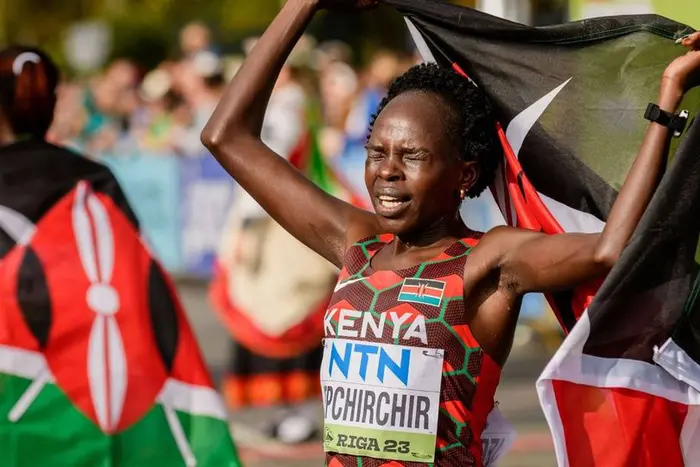
Peres Jepchirchir. IMAGES/ Pulse Sports
Kenyan Olympic champion Peres Jepchirchir has been provisionally suspended by the Athletics Integrity Unit (AIU) following an adverse analytical finding for erythropoietin (EPO), a prohibited substance associated with increased red blood cell production. The development, announced on Friday, October 23, 2026, has cast uncertainty over the celebrated marathon runner’s recent achievements, including her victory at the Sydney Marathon on August 30.
The 33-year-old athlete faces an anti-doping process that could have significant consequences for her career, competition results and standing in international athletics. However, a provisional suspension is not a final determination of guilt. The case must proceed through the established disciplinary framework, giving Jepchirchir an opportunity to respond to the allegation and exercise her procedural rights.
According to Reuters’ report on the AIU action, the adverse analytical finding came from an out-of-competition sample collected in Kenya before her Sydney Marathon victory.
Read Also: Pharmacy Board Looks to Shape Future of Pharmaceutical Practice
The timing of the sample is significant because anti-doping authorities can test athletes outside competition. A prohibited substance detected in a sample collected before a major race can trigger disciplinary proceedings even when the athlete subsequently completes the event without a reported testing violation on race day.
A sports law and athletics integrity perspective underscores the importance of procedural fairness alongside enforcement. As expressed in the expert commentary supplied for this report, “Enforcing immediate provisional suspensions upon adverse analytical findings reflects strict adherence to international anti-doping frameworks.” Protecting clean competition requires rigorous sample processing, transparent disciplinary hearings and compliance with the applicable World Athletics regulations.
EPO Finding Places Marathon Career at a Critical Point

Jepchirchir is among Kenya’s most accomplished long-distance runners. Her career includes Olympic marathon gold at the Tokyo 2020 Games, the 2025 World Athletics Marathon Championship title and victories at major international road races.
Her achievements have helped sustain Kenya’s reputation as a global powerhouse in marathon running, where elite athletes compete for championship honours, lucrative appearance fees and significant prize money.
The reported EPO finding now places those achievements under intense scrutiny, although the legal consequences will depend on the outcome of the anti-doping proceedings.
Erythropoietin is a hormone that stimulates the production of red blood cells. Increased red blood cell levels can improve the transportation of oxygen to working muscles, making EPO a substance of particular concern in endurance sports such as marathon running.
Synthetic EPO has legitimate medical applications under appropriate clinical supervision. In competitive athletics, however, its use is prohibited unless a valid therapeutic use exemption or another applicable exception permits it.
The World Anti-Doping Agency’s 2026 Prohibited List classifies EPO within category S2, covering peptide hormones, growth factors, related substances and mimetics. These substances are prohibited both in and out of competition.
The classification matters because EPO belongs to the non-specified substance category. Under the applicable anti-doping rules, an adverse analytical finding involving a non-specified substance generally triggers a mandatory provisional suspension.
That measure prevents an athlete from competing while the case is being resolved. It does not, by itself, establish that the athlete intentionally doped or determine the final sanction.
World Athletics Rules and the Potential Four-Year Ban
The legal framework governing the case includes World Athletics Anti-Doping Rules, particularly Rule 2.1, which addresses the presence of a prohibited substance or its metabolites or markers in an athlete’s sample, and Rule 2.2, which concerns the use or attempted use of a prohibited substance or prohibited method.
These are distinct anti-doping violations. The presence of a prohibited substance may establish a violation under Rule 2.1 without authorities having to prove that the athlete intended to gain an unfair advantage. Questions of intent, fault and applicable exceptions can nevertheless influence the ultimate sanction.
Rule 2.2 addresses whether an athlete used or attempted to use a prohibited substance or method. Establishing such a violation requires consideration of the evidence and the applicable rules.
A four-year period of ineligibility is a potential baseline for certain violations involving non-specified substances under the World Anti-Doping Code, particularly where intentional conduct is established under the relevant provisions. It should not be described as an automatic final punishment simply because an adverse analytical finding has been reported.
The precise sanction would depend on the charge, the evidence, the applicable version of the rules and any circumstances recognised by the regulations.
Jepchirchir’s case will therefore require more than a public announcement of a positive test. The disciplinary process must determine whether an anti-doping rule violation has been established and what consequences, if any, should follow.
The Athletics Integrity Unit’s explanation of provisional suspensions makes clear that the measure is temporary pending the relevant proceedings. The AIU is responsible for protecting the integrity of international athletics through investigations, testing-related disciplinary action and enforcement of applicable rules.
Read Also: KNEC Grade 10 Assessment 2026: Guidelines, Timelines & School Requirements
Sydney Marathon Victory Faces Possible Disqualification
Jepchirchir’s victory at the Sydney Marathon on August 30, 2026, is likely to become one of the central issues if an anti-doping violation is ultimately established.
The sample was reportedly collected before the race, making the relationship between the alleged violation and her subsequent result a key matter for the relevant authorities.
The AIU has provisionally suspended reigning World and former Olympic champion, Peres Jepchirchir, after an out-of-competition sample, collected in Kenya prior to her recent Sydney Marathon victory, returned an adverse analytical finding for EPO. 1/2 https://t.co/Y7Z82wyUyk
— Athletics Integrity Unit (@aiu_athletics) October 23, 2026
Under the applicable anti-doping framework, results obtained during a period connected to an established violation may be disqualified, subject to the relevant rules and circumstances. Such a decision can affect official finishing positions, prize money, records and the distribution of competition awards.
However, the reported suspension alone does not automatically annul her Sydney victory. Any formal decision concerning the result must follow the governing procedures and the rules applicable to the case.
If the result is disqualified, race organisers and other relevant bodies may have to revise the official standings, determine whether prize money must be returned and consider adjustments to rankings or points.
The consequences could extend beyond Sydney if an eventual decision affects other competitions within the applicable disqualification period.
The Abbott World Marathon Majors framework is also relevant because Sydney forms part of the leading international marathon circuit. Nevertheless, any claim that Jepchirchir automatically faces a lifetime ban from every World Marathon Major event, or that all her career points must be forfeited, requires confirmation against the specific regulations and an official decision. Such consequences should not be treated as established sanctions at the provisional stage.
Key Regulatory Provisions and Potential Consequences
| Regulatory pillar | Applicable rule or framework | Legal and competition impact |
|---|---|---|
| Provisional suspension | World Athletics Anti-Doping Rules and AIU procedures | Temporary exclusion from covered competitions while the case is pending |
| Presence of a prohibited substance | Rule 2.1 | Determines whether the sample establishes a presence violation under the applicable rules |
| Use or attempted use | Rule 2.2 | Addresses evidence of prohibited use or attempted use |
| Substance classification | WADA Prohibited List, category S2 | EPO is prohibited at all times and classified as a non-specified substance |
| Potential period of ineligibility | World Anti-Doping Code, Article 10 | A four-year sanction may apply under the relevant conditions, subject to the case and applicable rules |
| Sydney Marathon result | Applicable anti-doping and competition rules | Possible disqualification and prize-money adjustments if a violation is established |
| World Marathon Majors consequences | Applicable circuit regulations | Further eligibility, points or financial consequences depend on the governing rules and any final decision |
B-Sample Testing and the Right to Respond
The next stage of the case will be important in determining whether the adverse analytical finding results in a formal charge and, ultimately, a sanction.
Jepchirchir has procedural rights under the applicable anti-doping framework. These may include requesting analysis of the B-sample, receiving information about the analytical finding, presenting an explanation and challenging the evidence through the established process.
A B-sample analysis is intended to verify the analytical finding from the corresponding A-sample. The athlete or her authorised representative can exercise the applicable rights concerning the analysis and attendance procedures.
If a Notice of Charge is issued, Jepchirchir would have an opportunity to respond to the allegations and present relevant evidence. Depending on the circumstances, the case could involve questions about sample handling, laboratory procedures, medical documentation, the source of the substance or whether a therapeutic use exemption applies.
The existence of a prohibited substance in a sample and the explanation for its presence are separate matters. Anti-doping authorities must apply the rules to the evidence, while the athlete must be afforded the procedural protections provided by the governing framework.
The final outcome could range from a finding that no violation has been established to a period of ineligibility and disqualification of affected results. The precise possibilities depend on the evidence and the rules applicable to the case.
Implications for Athletics Kenya and the Sport’s Credibility
The case also raises questions about Kenya’s continuing efforts to protect the reputation of its distance-running programme.
Kenyan athletes have dominated major marathon events for decades, building the country’s international sporting profile and supporting a wider ecosystem of coaches, training camps, agents, sponsors and competition organisers.
Repeated doping controversies can undermine confidence in legitimate performances, even when allegations concern individual athletes and do not establish wrongdoing by an entire team or national federation.
Read Also: Top Comoros Official Hospitalized in Nairobi Amid Rising Tensions in Moroni
Athletics Kenya and the Anti-Doping Agency of Kenya operate within a wider system of national and international anti-doping oversight. World Athletics has also maintained enhanced monitoring and compliance requirements for federations considered to face elevated doping risks.
The implications for Athletics Kenya will depend on the findings of the case and any wider evidence that emerges. A provisional suspension involving a prominent athlete does not, on its own, establish an institutional failure or prove that other competitors were involved.
Nevertheless, the case reinforces the need for effective athlete education, independent testing, responsible medical support and reliable reporting channels. Athletes and their support teams must understand that substances prohibited during competition may also be banned during training and recovery periods.
The Anti-Doping Agency of Kenya provides information on prohibited substances and the rules governing their use. Clear communication about medication, supplements and therapeutic exemptions remains essential in a sport where international competition exposes athletes to rigorous testing.
A Defining Test for Marathon Integrity
Jepchirchir’s provisional suspension marks a serious development for one of Kenya’s leading marathon champions. The reported EPO finding could have substantial consequences if an anti-doping violation is established, potentially affecting her eligibility, Sydney Marathon result and future participation in elite competition.
The outcome will matter not only for Jepchirchir’s career but also for the credibility of international marathon competition. Clean athletes, event organisers and supporters all have an interest in a system that enforces anti-doping rules consistently while protecting the rights of those accused.
Until the proceedings are concluded, the Sydney Marathon result should be treated as under scrutiny rather than formally annulled, and any long-term sanction should be described as a potential consequence rather than a settled outcome.