
Escaping Echoes of War to Chase Whistles in Kenya

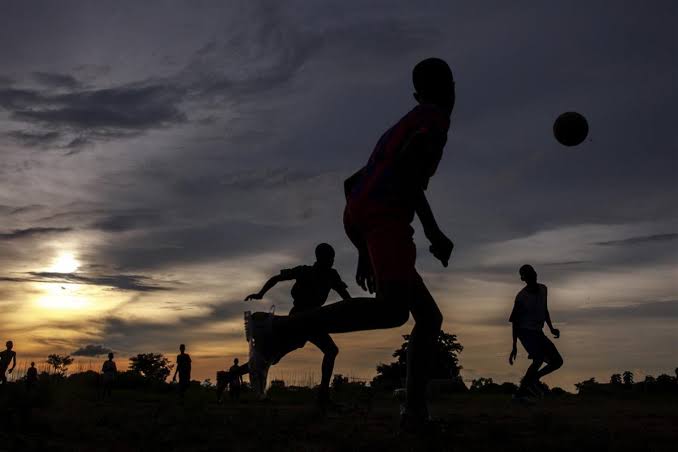
A silhouette against the evening sky, capturing the transition from struggle to hope.. Source: New African Magazine
The last thing Patrick Mbuyi wanted to leave behind was his childhood dream, but the sound of gunfire and the fear of another night of violence gradually made football feel like a luxury he could no longer afford. Born and raised in Bukavu, a city in eastern Democratic Republic of the Congo (DRC), the Congolese midfielder grew up believing that a pair of boots, a ball and enough determination could eventually carry him into professional football.
He imagined himself playing before thousands of supporters, wearing his country’s colours and helping his family escape financial hardship. Instead, the realities of war forced him to make a decision no young footballer should have to contemplate: remain close to everything he loved or leave home in search of safety and a chance to survive.
The circumstances surrounding Patrick’s journey reflect the experiences of countless people displaced by conflict in eastern Congo. Reports from the United Nations High Commissioner for Refugees (UNHCR) document how persistent insecurity has uprooted families, disrupted livelihoods and forced civilians to seek protection across neighbouring countries.
Read Also: Pharmacy Board Looks to Shape Future of Pharmaceutical Practice
For Patrick, the journey began with a painful goodbye.
Bukavu: Where the Dream Began to Fade
Football had always offered Patrick a place where the troubles of the world seemed distant. On dusty neighbourhood pitches in Bukavu, he learned to control the ball, protect possession and find teammates through narrow spaces. His friends called him a natural midfielder because he could read a game before others understood where the next pass should go.
His mother, who struggled to provide for the family, viewed his talent as more than entertainment. She saw a possible escape from poverty and a reason to believe that their circumstances might one day improve.
But the growing insecurity in eastern Congo changed the meaning of everyday life. Conversations increasingly revolved around safety, the movement of armed groups, missing relatives and the possibility of having to abandon home.
Patrick’s recollection captures the emotional weight of that period.
“I used to think my biggest problem was whether a coach would notice me. Suddenly, I was thinking about whether my family would be safe enough to wake up the next morning. Football was still in my heart, but survival had become the first priority,” he says in the account.
The conflict in the region is not simply a backdrop to a sporting story. It has caused immense civilian suffering, with fighting, destruction and repeated displacement affecting communities across North and South Kivu. Human Rights Watch’s 2026 World Report on the DRC documents serious abuses and the devastating consequences of armed violence.
For young players, the damage extends beyond interrupted training sessions. Clubs may close, pitches become inaccessible, families lose income and promising careers are suspended indefinitely.
Patrick eventually understood that remaining in Bukavu could mean abandoning the future he had spent years imagining. Leaving, however, meant separating himself from his mother, friends and the familiar streets that had shaped his identity.
He chose the uncertain road.
Rwanda: Carrying Home Inside His Heart
Crossing into Rwanda was not a triumphant moment. There was no cheering crowd, no club waiting to offer him a contract and no guarantee that the next destination would be safer or more welcoming.
There was only the relief of moving away from immediate danger and the overwhelming uncertainty of what would follow.
Patrick travelled with the hope that he could find temporary stability, continue training and eventually secure a football opportunity. Yet displacement brought practical challenges that talent alone could not solve. Food, accommodation, transport and documentation became more urgent than tactics or match fitness.
He also carried an emotional burden that remained invisible to people who saw only a young man looking for work.
Every missed call from home brought anxiety. Every conversation about the situation in eastern Congo reopened questions he could not answer. He wondered whether his family was safe, whether his old teammates were still playing and whether the life he had left behind would ever be recoverable.
“I carried my boots because I did not know what else I could hold on to. They reminded me that I was still a footballer, even when nobody knew my name and nobody could promise me a place on a team,” Patrick reflects.
Rwanda became one stage in a longer search for security and opportunity. Patrick’s next move would take him to Uganda, where the possibility of finding a football pathway continued to pull him forward.
Uganda: A New Country, the Same Unanswered Questions
Arriving in Uganda offered Patrick another opportunity to rebuild. The familiar language of football helped him connect with other players, some of whom understood the frustration of being far from home and trying to establish themselves in unfamiliar surroundings.
He searched for training sessions, approached people who knew local clubs and tried to remain physically prepared. He understood that a player who stopped training risked losing the one advantage he could still control.
Yet the football industry can be unforgiving to young players without established agents, professional networks or the money to travel between trials. A promising performance does not automatically produce a contract, and a recommendation does not guarantee that a coach will have room in the squad.
Patrick encountered the difficult space between potential and opportunity.
His experience echoes the broader challenges facing displaced footballers whose ability may be obvious but whose circumstances make it harder to access structured competition.
A real-life example of a Congolese player finding a pathway through adversity is Felicien Okanda. Okanda and his family fled conflict in South Kivu and arrived in Kenya in 2016. His journey through Kakuma United, Nzoia Sugar and Kakamega Homeboyz demonstrated how a football opportunity can help a displaced player rebuild his career.
Okanda’s documented experience is distinct from Patrick’s fictional story, but it illustrates an important truth: the right opportunity can change the direction of a player’s life.
For Patrick, Uganda was another chapter rather than the destination he had hoped to find.
Kenya: Where Hope Met the Hard Reality of Football
Kenya represented a fresh possibility. The country’s football environment offered another landscape in which Patrick could seek trials, meet coaches and demonstrate the skills he had developed before war disrupted his life.
He arrived with limited resources but considerable determination. He imagined that one convincing training session could change everything. A coach might notice his passing range, a teammate might recommend him to a club, or a local competition might become the beginning of a professional career.
The reality was more complicated.
Read Also: Pharmacy Board Looks to Shape Future of Pharmaceutical Practice
Finding a place to train was one challenge; finding a club willing and able to take him on was another. A player needed more than technical ability. Fitness, tactical discipline, registration requirements, available squad positions and the financial circumstances of individual clubs could all influence whether an opportunity became a contract.
Patrick tried to remain patient. He trained whenever he could, watched matches and studied the movement of midfielders who had established themselves in Kenyan football.
Some days offered encouragement. Others ended with unanswered calls and promises that never materialised.
“I thought arriving in Kenya would be the moment everything started falling into place. I did not understand that escaping war was only the beginning. I still had to convince people that I deserved a chance, even though I had already fought so hard just to reach that point,” he says in the fictional account.
The disappointment was especially painful because Kenya had come to represent more than another country. It was the place where he hoped the sacrifices of leaving home would finally produce something tangible.
He wanted a contract, a regular place in a team and the dignity of earning money through football. He wanted to help his family and prove that leaving Bukavu had not been an act of desperation without purpose.
But the opportunity he needed did not arrive as he had imagined.
Patrick eventually faced another difficult decision: remain in Kenya waiting for a breakthrough that might never come or continue moving in search of a club willing to give him a chance.
He chose to keep moving.
Tanzania: Another Beginning After Disappointment
Patrick’s journey eventually took him to Tanzania, where he hoped to reopen the door that had failed to open in Kenya.
By then, the excitement of crossing another border had faded. He understood that changing countries did not automatically change his circumstances. Every new destination required him to rebuild relationships, identify potential clubs and demonstrate his ability all over again.
Still, something had changed inside him.
The boy who once believed that talent alone would carry him into professional football had become more patient and realistic. He had learned to separate rejection from his sense of worth, although the distinction was not always easy to maintain.
He continued to dream of a club contract and regular competitive football. He also understood that his immediate priorities included stability, lawful residence and a sustainable way to support himself while pursuing the game.
“I have lost time, missed opportunities and spent nights wondering whether the dream was worth all the pain. But whenever I see a football pitch, something inside me tells me that I have not finished yet,” Patrick says in the dramatised narrative.
Tanzania represents the next chapter, not a guaranteed happy ending. Whether Patrick secures a contract, joins a lower-division side or eventually pursues another livelihood remains uncertain.
Beyond Football: The Human Cost of Displacement
Patrick’s fictional journey from Bukavu through Rwanda and Uganda, into Kenya and onward to Tanzania reflects a wider reality: conflict can force young people to abandon not only their homes but also the plans that once gave their lives direction.
The UNHCR’s reporting on the DRC emergency provides information on displacement and humanitarian developments across the region. Behind those figures are families separated from relatives, children whose education has been interrupted and young adults attempting to rebuild their lives far from home.
Football cannot end a war, restore every destroyed home or guarantee safety to displaced families. Nevertheless, it can offer structure, community, income and a sense of belonging when those things have been stripped away.
Clubs, academies, football associations and community organisations can make a difference by creating transparent trial opportunities, supporting integration and helping eligible displaced players navigate the administrative requirements of organised football.
Coaches can look beyond a player’s accent, passport or lack of connections and assess the ability in front of them. Supporters can also recognise that the person arriving for a trial may be carrying experiences that never appear on a team sheet.
Read Also: Top Comoros Official Hospitalized in Nairobi Amid Rising Tensions in Moroni
The whistle has not yet delivered the ending Patrick imagined. Tanzania may offer the opportunity he missed in Kenya, or his path may take another unexpected turn.
Whatever happens next, the dream that travelled with him from Bukavu remains alive.
And perhaps that is the most important part of his story: war forced him to leave home, disappointment forced him to reconsider his future, but neither has yet persuaded him to stop believing that football might offer him another beginning.