
Kimani Unveils 39-Man Emerging Stars Squad as Kenya Prepare for Côte d’Ivoire Test at Nyayo

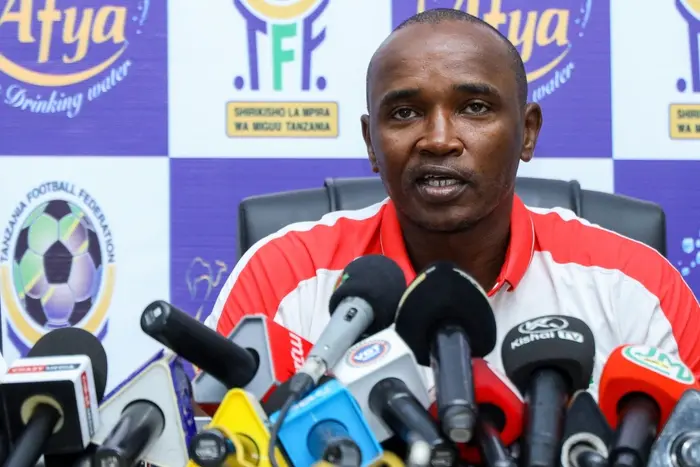
Kenya U23 coach Anthony Kimani. Image: FKF Media
Emerging Stars have begun preparations for a crucial examination of their continental ambitions after head coach Anthony Kimani named a 39-player provisional squad for the 2027 Under-23 Africa Cup of Nations (AFCON) second-round qualifying tie against Côte d’Ivoire.
The Football Kenya Federation (FKF) announced the provisional selection on October 31, 2026, with Kenya scheduled to host the first leg at Nyayo National Stadium in Nairobi on Wednesday, November 11, before travelling to Abidjan for the return encounter on November 17.
The home fixture is scheduled to kick off at 3:00 pm East African Time, while the return match will begin at 10:00 pm EAT at Stade Félix Houphouët-Boigny. The two-legged contest presents Kenya with an opportunity to move closer to its first appearance at the U-23 AFCON finals.
Kimani’s selection combines players who featured against Tanzania in the opening qualifying round with additional options across the goalkeeping, defensive, midfield and attacking departments. The squad also includes several players with experience in overseas football, increasing competition for places ahead of the Ivorian assignment.
Read Also: Pharmacy Board Looks to Shape Future of Pharmaceutical Practice
Kimani casts a wide net as squad competition intensifies
According to the Football Kenya Federation’s official squad announcement, the provisional selection contains 39 players distributed across four departments.
The inclusion of a broad group gives the technical bench an opportunity to assess fitness, tactical suitability and individual performance before determining the final matchday selection.
Among the notable names is Aldrine Kibet, whose return strengthens the attacking options after he missed the Tanzania assignment while finalising work permit matters in Spain.
Humphrey Aroko and Jackson Imbiakha are also included after missing the previous qualifying assignment through injury-related circumstances. Their availability provides Kimani with additional choices as he evaluates the team’s defensive and midfield balance.
Other names attracting attention include Kevin Wangaya, Kelly Madada, Andres Odhiambo, Brooklyn Kazungu, Dan Omalla and Lawrence Okoth.
The provisional list also features Jack Steel, Emmanuel Osoro, Javan Ochieng and Colin Akeno, giving the technical bench an opportunity to examine different playing profiles.
The final squad will need to demonstrate tactical discipline, physical readiness and the ability to handle the demands of two international fixtures.
The selection gives Kimani several alternatives in attack, particularly with the availability of players who can operate in different forward positions.
Four players face demanding national team commitments
One notable development surrounding the provisional squad is the overlap between the Emerging Stars selection and the senior Harambee Stars provisional team announced by head coach Benni McCarthy.
Caleb Kramer, Aldrine Kibet, Kevin Wangaya and Lawrence Okoth appear in both selections.
Their inclusion in the two squads creates an additional consideration for the technical departments as Kenya prepares for separate international assignments during the November FIFA international window.
The senior Harambee Stars are scheduled to face South Africa in their 2027 AFCON qualifying campaign, including a home fixture at Nyayo National Stadium on November 17.
The overlap means that coordination between the two technical benches will be important when determining player availability, travel arrangements and match preparation.
For Kimani, retaining access to the four players could strengthen the Emerging Stars, but the final arrangements will depend on the respective teams’ selection and release requirements.
Tanzania victory provides foundation for Ivorian challenge
Kenya secured its second-round qualification after overcoming Tanzania 5-4 on aggregate in the opening round.
The Emerging Stars established a 4-1 advantage in the first leg at Nyayo National Stadium before suffering a 3-1 defeat in the return fixture at Uhuru Stadium in Dar es Salaam.
Andres Odhiambo scored Kenya’s goal in the return encounter, helping the team preserve its aggregate advantage.
The qualification demonstrated the importance of maintaining concentration across both legs, particularly when playing away from home.
Côte d’Ivoire, however, presents another challenge. The West African side has a strong football development tradition and will be determined to secure its place in the final qualifying round.
Read Also: KNEC Grade 10 Assessment 2026: Guidelines, Timelines & School Requirements
Kenya will therefore need to approach the first leg with a clear tactical plan, particularly in controlling possession, protecting its defensive structure and taking advantage of opportunities in the final third.
A positive result in Nairobi could give the Emerging Stars an important advantage before travelling to Abidjan.
CAF regulations and the Los Angeles 2028 Olympic pathway
The U-23 AFCON qualification campaign carries significance beyond the continental tournament because it also forms part of Africa’s pathway towards the men’s football competition at the 2028 Los Angeles Olympic Games.
According to the Confederation of African Football (CAF), 42 nations entered the 2027 qualifying campaign, with seven places available alongside automatically qualified hosts Egypt.
The qualification programme consists of three rounds of home-and-away matches, with the final qualifying round scheduled for March 2027.
The eight-team tournament in Egypt will determine the African representatives for the Olympic pathway.
CAF’s competition framework also requires participating federations to comply with registration, eligibility and competition administration requirements.
The applicable CAF U-23 competition regulations, updated in September 2026, provide the governing framework for player registration and participation.
For Kenya, the technical team must ensure that the players selected for the final squad satisfy the relevant age and registration requirements.
The Olympic pathway should also be understood separately from the current qualification exercise. Being included in Kimani’s provisional squad does not automatically guarantee participation in the 2028 Olympics. Kenya must first negotiate the continental qualifying stages and satisfy the applicable Olympic eligibility and qualification requirements.
The International Olympic Committee’s Los Angeles 2028 qualification framework places responsibility for sport-specific qualification systems on the relevant international federations, subject to IOC approval.
The Emerging Stars campaign therefore offers young Kenyan players an opportunity to compete for continental recognition while pursuing a longer-term international ambition.
Sports Act provides framework for national team administration
The preparations also fall within the wider institutional framework established by Kenya’s Sports Act No. 25 of 2013.
The legislation provides for the administration and development of sports, establishment of Sports Kenya, creation of the National Sports Fund and regulation of national sports organisations.
Section 4 assigns Sports Kenya responsibilities that include managing and maintaining designated sports facilities, coordinating national and international sports programmes and facilitating the preparation and participation of Kenyan teams in international events.
The Sports Act No. 25 of 2013 also establishes the National Sports Fund, which provides financial support for sports persons and sports organisations within the statutory framework.
These responsibilities are relevant to the Emerging Stars because international football preparation involves more than selecting players and arranging training sessions.
It requires coordination between the federation, sports administration institutions, venue managers and government agencies responsible for supporting national representation.
However, the legislation should not be interpreted as automatically prescribing specific allowances or insurance packages for the 39 players named by FKF.
The actual financial and medical arrangements for this particular assignment require confirmation from the responsible institutions.
Nyayo Stadium preparations and match organisation
Nyayo National Stadium will provide the setting for Kenya’s attempt to secure a first-leg advantage against Côte d’Ivoire.
The facility is managed by Sports Kenya and is an important venue for national and international football fixtures.
According to Sports Kenya’s stadium information, the facility has a reported seating capacity of 30,000, a FIFA-approved standard football pitch, floodlights and an internet-enabled media centre.
The Sports Act also addresses the management, maintenance and protection of stadium facilities under Section 70.
For an international fixture, the operational requirements extend beyond the playing surface. Match organisers must coordinate security arrangements, accreditation, spectator access, medical services, team facilities and media operations.
The National Police Service has previously participated in security assessments of Nyayo and other Kenyan stadiums ahead of international competitions.
Such coordination is important in ensuring that supporters, players, officials and other match participants can access the venue safely.
FKF and the relevant stadium authorities will also need to coordinate pitch preparation and matchday arrangements in line with the applicable CAF competition requirements.
Although the stadium has hosted major international football events, each fixture requires its own operational planning and inspection.
Player welfare, insurance and allowances remain important
The welfare of players representing Kenya internationally remains an important part of national team administration.
Training, travel, accommodation, medical assessments and match preparation all require adequate financial and logistical support.
The Ministry of Sports has previously explained that national team allowances are subject to established government procedures and Salaries and Remuneration Commission oversight.
In September 2026, Principal Secretary for Sports Elijah Mwangi indicated that the government would engage the commission over possible reviews of national team allowances.
According to Citizen Digital’s report, the government said allowance rates were determined through the SRC framework, with requests for changes requiring the relevant approval.
Parliamentary records from September 2024 also indicate that the Ministry had provided national teams with travel insurance and medical cover during competitions, including arrangements intended to address injuries extending beyond the competition period.
However, no specific public confirmation has been identified detailing the insurance policy, match retainers or individual allowance rates applicable to the Emerging Stars for the Côte d’Ivoire assignment.
The federation and Ministry will therefore need to ensure that the relevant welfare arrangements are communicated and implemented before the team travels.
For young players, adequate medical protection and timely administrative support are essential to maintaining confidence and concentration throughout an international assignment.
Kenya supporters receive opportunity to back Emerging Stars
The November 11 encounter will also provide Kenyan football supporters with an opportunity to watch the next generation of national team players compete against continental opposition.
FKF has made tickets available through its official ticketing platform.
Regular seating tickets are priced at KSh200, while VIP tickets cost KSh1,000.
Supporters can purchase their tickets through the official FKF ticketing portal.
A strong home turnout could provide additional encouragement for the Emerging Stars as they seek to build an advantage before travelling to West Africa.
A defining opportunity for Kenya’s emerging generation
The Côte d’Ivoire assignment represents another important stage in Kenya’s attempt to establish itself among Africa’s competitive youth football nations.
Kimani’s 39-player provisional selection provides a broad pool from which the technical bench can identify the players best suited to the two-legged contest.
The immediate objective will be to secure a positive result at Nyayo before facing the challenge of the return fixture in Abidjan.
Read Also: Top Comoros Official Hospitalized in Nairobi Amid Rising Tensions in Moroni
Beyond qualification, the campaign offers young Kenyan footballers an opportunity to gain international experience and compete for places in future national team programmes.
Success will depend on preparation, player availability, tactical discipline and effective coordination between FKF and the institutions supporting the team.
Full Emerging Stars provisional squad
Goalkeepers
Caleb Kramer, Collins Omondi, Kevin Oduor and Bernard Jairo.
Defenders
Ian Omondi, Joseph Bate, Jackson Imbiakha, Robinson Musungu, Collins Ochieng, Baron Ochieng, Price Musebe, Wyclliffe Awiko, Bilal Otieno and Telena Ochieng.
Midfielders
Aldrine Kibet, Kevin Wangaya, Kelly Madada, Andres Odhiambo, Irad Mshindi, Humphrey Aroko, Oliver Majaka, Zachary Nyakwara, Glen Githinji, Ateek Omar, Jack Steel and Mark Kithome.
Forwards
Brooklyn Kazungu, Lawrence Okoth, Paul Osama, Jeremy Bisau, Syphas Otieno, Stephen Omondi, Dan Omalla, Emmanuel Osoro, Collins Okello, Henry Omollo, Colin Akeno, Javan Ochieng and Hassan Beja.

