
Benni McCarthy Harambee Stars Review: Match Record, Tactical Progress & AFCON 2027 Goals

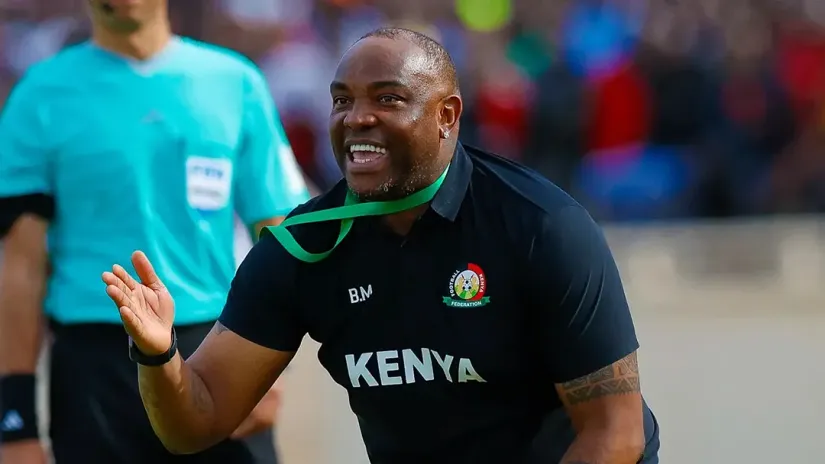
Benni McCarthy IMAGE: CAF
South African tactician Benni McCarthy faces a defining challenge as he prepares Harambee Stars for the 2027 Africa Cup of Nations (AFCON), which Kenya will co-host with Uganda and Tanzania. His assignment extends beyond preparing a competitive national team. He must establish tactical discipline, expand Kenya’s talent pool and help create a sustainable foundation for international success.
Since his appointment on March 3, 2025, McCarthy has sought to reshape Kenya’s approach to international football. His experience as Manchester United’s former first-team attack coach and his previous work in South African football raised expectations that Harambee Stars could become more organised and competitive. The Confederation of African Football’s appointment report outlined the ambitions surrounding his arrival.
However, the results have presented a mixed picture. Kenya have demonstrated the ability to compete in individual fixtures but have struggled to establish consistent performances against different levels of opposition. Recent draws and defeats have intensified questions about the team’s readiness for the continental tournament.
Read Also: Pharmacy Board Looks to Shape Future of Pharmaceutical Practice
McCarthy’s candid assessment that Kenya may need approximately a decade to become genuine AFCON title contenders has added another dimension to the debate. His immediate responsibility is to improve the national team before 2027, while the wider objective is to build structures capable of delivering success beyond his tenure.
Benni McCarthy’s Harambee Stars Match Record
McCarthy’s supervisory record requires careful examination because published figures have changed as additional fixtures have been played. Daily Nation reported that he had overseen 19 matches by October 4, 2026, recording seven wins, five draws and seven defeats. Kenya subsequently played a 0-0 friendly against Rwanda on October 5.
The figures supplied in the original brief — 22 matches, eight wins, six draws and eight defeats — should therefore be treated cautiously until reconciled with a complete match-by-match record. The distinction matters because an accurate performance assessment must account for every fixture and its result.
| Performance metric | Record or objective | Strategic significance |
|---|---|---|
| Appointment | March 3, 2025 | Beginning of McCarthy’s national-team project |
| Reported record as of October 4 | 19 matches: 7 wins, 5 draws, 7 losses | Results reported by Daily Nation |
| Subsequent friendly | 0-0 against Rwanda, October 5 | Additional match requiring inclusion in the updated tally |
| AFCON 2027 target | Reach the knockout stage | Progress beyond the group phase |
| Long-term vision | Approximately 10 years | Grassroots development, facilities and stronger player pathways |
Sources: Daily Nation’s review of McCarthy’s tenure and K24 Digital’s report on his long-term AFCON assessment.
Results alone cannot establish whether a coach’s project is succeeding. International friendlies, World Cup qualifiers and continental matches place different demands on players. Opponent strength, squad availability, preparation time and the quality of chances created all influence outcomes.
The more important question is whether Harambee Stars are becoming more difficult to break down, more efficient in attack and better equipped to manage pressure. Those qualities will determine whether Kenya can take advantage of home conditions in 2027.
Mid-Block Organisation and Tactical Discipline
One tactical approach associated with McCarthy’s project is the use of a mid-block defensive structure. Rather than pressing opponents relentlessly across the pitch, a team operating in a mid-block protects the central areas, closes passing lanes and chooses moments to press.
The system can help Kenya compete against opponents with greater technical ability. By keeping the defensive and midfield lines compact, Harambee Stars can restrict space between the lines and encourage opponents to play around the team’s defensive structure.
Successful implementation requires coordinated movement. Forwards must limit passing options, midfielders must track runners and defenders must maintain suitable distances from their teammates. Any gaps can allow technically accomplished opponents to progress quickly towards goal.
Defensive organisation must also support attacking transitions. Winning possession is only the first step; Kenya must move the ball forward efficiently, exploit available space and create meaningful scoring opportunities before opponents recover their defensive shape.
McCarthy’s challenge is to establish a tactical identity that remains effective against different opponents. A defensive structure that prevents goals but leaves the team unable to create chances will not be sufficient at AFCON 2027.
European-Based Players and Domestic Talent
Expanding the national-team player pool has become another important element of McCarthy’s approach. His selections have included emerging players based in Europe alongside established internationals and footballers competing in Kenya’s domestic league.
The CAF report on Kenya’s first squad under McCarthy highlighted his intention to combine experienced internationals with younger prospects.
The approach can improve competition for places while exposing the national team to different footballing experiences. Players competing in professional European environments may bring valuable tactical awareness, technical ability and familiarity with demanding training standards.
Nevertheless, playing abroad should not automatically guarantee selection. Players must adapt to the coach’s system, demonstrate consistency and fit the team’s collective requirements.
Read Also: Top Comoros Official Hospitalized in Nairobi Amid Rising Tensions in Moroni
Domestic football must remain an important source of talent. Kenya’s top-flight clubs provide opportunities to identify technically gifted players who understand the local game and can develop into international performers.
McCarthy’s September 2026 selection illustrated this balance. According to CAF’s report on the squad for the opening AFCON 2027 qualifiers, captain Michael Olunga led an attacking group that included players based both in Kenya and overseas.
The selection strategy will be judged by its results. A wider pool is valuable only if it produces stronger competition for places, greater squad depth and improved performances on the pitch.
AFCON 2027: Why Kenya Must Set Realistic Expectations
McCarthy’s most significant message concerns the distance between Kenya’s current capabilities and the level required to win AFCON.
In October 2026, the Harambee Stars coach argued that Kenya may need up to 10 years to become continental champions. His assessment, reported by K24 Digital, reflected the development gap separating Kenya from established African football powers.
Morocco, Senegal and Côte d’Ivoire have invested in player development, competitive structures and international pathways that help their national teams remain competitive. Kenya cannot close those gaps simply by hosting a major tournament or appointing an experienced coach.
Home advantage can nevertheless make a meaningful difference. Support from Kenyan fans, familiarity with local conditions and disciplined preparation could help Harambee Stars outperform expectations.
The distinction is between believing Kenya can compete and claiming the team is already equipped to win the tournament. McCarthy’s position challenges unrealistic expectations without ruling out the possibility of a strong campaign.
Kenya’s co-hosting status also guarantees participation at the finals, making the qualifying fixtures an opportunity to test combinations and prepare against competitive opposition. The FKF squad announcement for the opening qualifiers provides further context on the players being assessed.
Reaching the Knockout Stage Must Be the Immediate Target
Progressing beyond the group stage should be Kenya’s immediate competitive objective at AFCON 2027. Reaching the Round of 16 would give the campaign a clear benchmark, while a quarter-final appearance would represent a more ambitious achievement.
Three areas require particular attention.
First, Kenya must reduce defensive mistakes. Strong organisation can be undermined by poor clearances, lapses in concentration and unnecessary fouls in dangerous areas.
Second, Harambee Stars need greater attacking efficiency. The team must convert promising situations into goals, especially when facing opponents that may offer few clear opportunities.
Third, players must learn to manage different match situations. Protecting a lead, responding after conceding and securing points against difficult opponents require composure and tactical flexibility.
Recent results illustrate the challenge. Kenya drew 1-1 with Eritrea on September 26 before losing 1-0 to Guinea on October 1. Pulse Sports Kenya’s report on the Guinea defeat highlighted difficulties in the final third, where the team struggled to turn promising positions into goals.
Those matches underline why preparation must extend beyond defensive organisation. Kenya need to create and convert chances consistently if they are to progress through a demanding tournament.
Why Kenya Needs a 10-Year Football Development Plan
McCarthy’s long-term assessment recognises that national-team success depends on the wider football system. A coach can improve tactical discipline and select promising players, but cannot independently resolve weaknesses in grassroots facilities, coaching standards and youth development.
A credible development programme should begin with better access to football at school and community level. Young players need qualified coaches, regular competitive matches and suitable facilities to develop technical ability.
Kenya must also establish clearer progression routes from youth football into professional clubs and the senior national team. Talented teenagers require structured training and competitive exposure instead of being expected to bridge the gap to international football without sufficient preparation.
Investment in coaching education is equally important. Better-trained coaches can strengthen technical standards across age groups, helping young players arrive in the national setup with a stronger understanding of modern football.
The domestic league must contribute through competitive standards, reliable club management and opportunities for emerging talent. A sustainable pathway would allow the national team to replenish its squad without depending entirely on a small group of established internationals.
The wider hosting challenge is also significant. Reuters’ report on AFCON 2027 preparations highlighted the need for Kenya, Tanzania and Uganda to accelerate work on facilities and infrastructure ahead of the tournament.
A 10-year framework should include measurable targets, transparent funding and regular performance assessments. Without accountability, long-term ambitions risk becoming promises that disappear when administrators or coaching staff change.
Verdict: McCarthy Must Turn His Ideas Into Results
McCarthy’s tenure has opened opportunities for younger players and provided a platform for tactical rebuilding. However, inconsistent results demonstrate that Harambee Stars still have work to do before they can challenge Africa’s strongest national teams.
AFCON 2027 offers Kenya an opportunity to demonstrate progress in front of home supporters. Reaching the knockout stage would be a meaningful achievement, while a quarter-final appearance would strengthen the argument that the team is moving in the right direction.
The coach’s long-term vision is equally important. Grassroots investment, stronger domestic competition, improved facilities and clear pathways for emerging players are essential if Kenya hopes to become a genuine AFCON title contender.
Read Also: KNEC Grade 10 Assessment 2026: Guidelines, Timelines & School Requirements
Ultimately, McCarthy’s success should be measured not by promises of an immediate championship but by tangible improvements in the national team’s performances and the football structures supporting it.
The immediate mission is to make Harambee Stars competitive in 2027. The longer-term ambition is to build a Kenyan football system capable of sustaining that progress for generations.