
How Agnes Ngetich built half-marathon record through Copenhagen splits

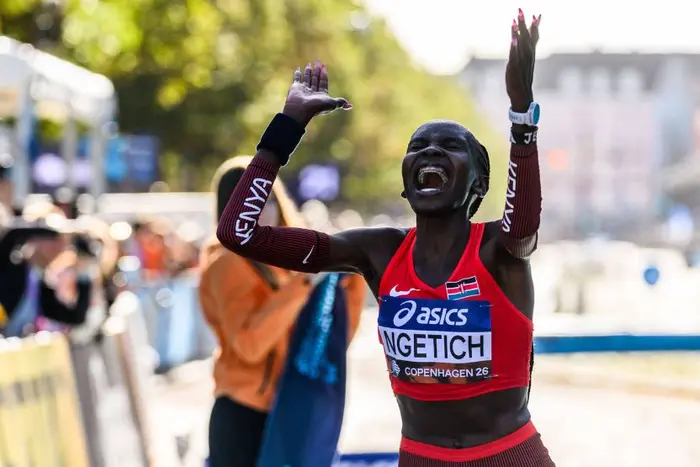
Agnes Ngetich Smashes Women-Only Half Marathon World Record in Copenhagen
Agnes Ngetich’s 1:05:15 in Copenhagen looks like a one-second world-record improvement on paper.
The splits tell a much bigger story.
Kenya’s 25-year-old did not produce the kind of half marathon where a runner sits in a pack, waits for the final kilometres and then relies on a sprint. Ngetich effectively broke the race apart from the opening five kilometres and then maintained enough consistency to turn an aggressive start into a world-record performance.
Her passage points at 5km, 10km, 15km and 20km reveal a race built around controlled damage rather than one spectacular late surge. World Athletics reported that she led from the opening stages and progressively increased her advantage before finishing 50 seconds ahead of compatriot Veronica Loleo.
Read Also: Pharmacy Board Looks to Shape Future of Pharmaceutical Practice
The 5km Split: The Race Starts at Record Pace
Ngetich reached 5km in 15:12.
That is the first important number in understanding her performance.
She was already 10 seconds clear of the field at that point. The significance was not simply that she was running quickly; it was that she was prepared to establish her own rhythm while the rest of the field was still deciding how hard to commit.
A 15:12 opening five kilometres works out at roughly 3:02 per kilometre.
That is an aggressive opening for a half marathon, particularly in a championship race where athletes normally have to balance pace with the tactical demands of the final kilometres.
Ngetich instead created separation immediately.
The first five kilometres therefore established the basic pattern of the race: Ngetich would run against the clock, while the rest of the field would run against Ngetich.
10km: The Lead Doubles
The second five kilometres tells us something even more interesting.
Ngetich passed 10km in 30:39, meaning she covered the section from 5km to 10km in 15:27.
Her pace had slowed by 15 seconds across the second five-kilometre block, but the important point is that the reduction was controlled.
She was still moving at approximately 3:05 per kilometre.
More importantly, her lead had increased from 10 seconds at 5km to 26 seconds at 10km. The chase group had been reduced to eight runners.
That is where the shape of the race became clear.
Ngetich was not simply running away because of one explosive kilometre. She was maintaining a pace that the others could not sustain.
Her first 10km average was approximately 3:04 per kilometre.
That left her with more than 11 kilometres still to run, but she had already created a cushion of almost half a minute.
15km: The Decisive Section
The most revealing split may have come at 15km.
Ngetich reached the mark in 46:17.
Her 5km split from 10km to 15km was therefore 15:38.
Again, the pace had eased slightly.
But her advantage had exploded.
She was now 53 seconds ahead of the chase group.
That is the crucial part of Ngetich’s performance. Her pace from 5km onwards gradually moved away from the extraordinary opening speed, yet the gap continued to grow.
It suggests that the performance was not based on trying to run every kilometre faster than the previous one.
PAY ATTENTION: Follow Kenya Frontline WhatsApp channel for more news
Instead, Ngetich established a sustainable rhythm after the initial attack and allowed the gap to develop as the other runners struggled to match it.
The chasing group passed 15km in 47:10, meaning Ngetich had put 53 seconds between herself and the runners behind her.
At that point, the gold medal was effectively becoming a formality.
The remaining question was whether Ngetich could hold her pace strongly enough to convert the lead into a record.
20km: The Most Important Evidence of Her Strength
Ngetich reached 20km in 1:01:56.
Her third five-kilometre block, from 15km to 20km, was 15:39.
That is remarkably close to her previous five-kilometre split of 15:38.
The progression is striking:
| Distance | Overall Time | 5km Split | Approx. Pace/km | Lead |
|---|---|---|---|---|
| 5km | 15:12 | 15:12 | 3:02 | +10 sec |
| 10km | 30:39 | 15:27 | 3:05 | +26 sec |
| 15km | 46:17 | 15:38 | 3:08 | +53 sec |
| 20km | 1:01:56 | 15:39 | 3:08 | +51 sec |
| Finish | 1:05:15 | 3:19* | 3:08* | — |
*Final segment is approximately 1.0975km.
The key feature is the stability between 10km and 20km.
Ngetich ran 15:38 and 15:39 for successive five-kilometre sections.
That is where the performance starts looking less like a gamble and more like a carefully managed championship race.
She had paid for the aggressive opening by slowing slightly, but she never experienced the dramatic collapse that can follow such a start.
In fact, the 20km split shows the opposite.
She was still running around 3:08 per kilometre deep into the race.
The Final 1.1km: Holding the Record Together
From 20km to the finish, Ngetich covered approximately 1.1km in 3:19.
That was enough to bring her home in 1:05:15.
The margin over the previous women-only world record was only one second, but that should not obscure how dominant the overall performance was.
The record was not produced by a desperate final sprint.
It was built during the first 20 kilometres.
Read Also: Top Comoros Official Hospitalized in Nairobi Amid Rising Tensions in Moroni
By 20km, Ngetich had already created a 51-second advantage. The final section was therefore about maintaining her rhythm and completing the job rather than chasing down an opponent.
She crossed the line 50 seconds ahead of Loleo, who finished in 1:06:05. Florence Niyonkuru was third in 1:06:08, with Daisilah Jerono fourth in 1:06:13.
What the Splits Say About Ngetich
The most impressive part of the Copenhagen performance is arguably not the 15:12 opening.
It is what happened afterwards.
Ngetich went from 15:12 to 15:27, then 15:38, then 15:39.
That progression shows a runner who was able to absorb the consequences of her fast start without falling apart.
The 5km-to-10km slowdown was only 15 seconds.
The next two five-kilometre sections differed by just one second.
That consistency became the foundation of the record.
There is also an important tactical distinction between Ngetich’s Copenhagen race and her difficult New York City Half Marathon earlier in 2026. World Athletics noted that she made an ambitious start in New York before fading to 13th in 1:10:25.
Copenhagen was different.
She again started aggressively, but this time the middle kilometres remained remarkably stable.
That is perhaps the most revealing aspect of the performance.
The Bigger Picture
Ngetich’s 1:05:15 is a women-only world record, while Ethiopia’s Letesenbet Gidey retains the overall women’s half marathon world record of 1:02:52, set in a mixed race in Valencia in 2021. Ngetich herself owns a 1:03:04 personal best from Valencia in 2024.
Copenhagen therefore should not be viewed simply as Ngetich finding one extraordinary day of speed.
The splits suggest something more specific: she has developed the ability to run aggressively early, settle into a highly consistent rhythm and sustain that rhythm deep into a championship half marathon.
That is why the one-second record improvement is slightly misleading.
Read Also: Kenyan marathoner remanded over Ksh8 million land fraud case
The record books will show 1:05:15 against 1:05:16.
The splits show how she got there.
Ngetich did not wait until the final kilometre to win Copenhagen.
She won the race by creating the gap early, protecting it through the middle kilometres and then maintaining enough speed to make sure that the final 1.1km did not undo the work of the previous 20.
The world record was decided long before the finish line.
The finish simply confirmed it.

