
How Lua Raised US$5.8m to Reshape Hybrid Workforce

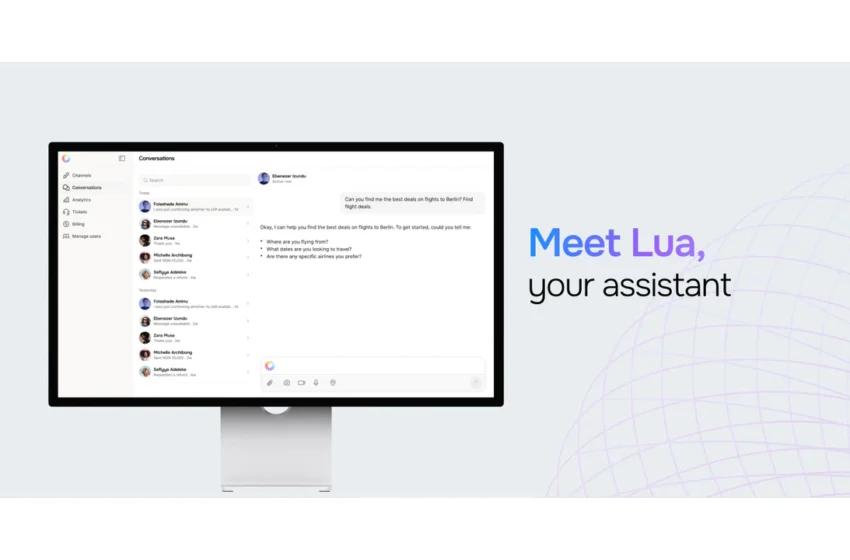
The rise of artificial intelligence in business operations is no longer limited to experimental tools or automation pilots. It is rapidly evolving into structured systems where AI agents work alongside human teams in real business environments.
One of the companies leading this shift is Lua, a hybrid workforce AI startup that recently secured US$5.8 million in seed funding. The funding marks a significant step in scaling its vision of integrating AI agents into everyday business workflows across global markets.
What Lua AI Company Actually Does in Hybrid Workforce Systems
Lua is designed to bridge human work and artificial intelligence through deployable AI agents that operate inside business systems.
Instead of replacing human teams, the platform focuses on augmenting them with digital workers that perform structured tasks.
These include:
-
Customer onboarding processes
-
Loan application handling
-
Insurance claims support
-
Client qualification workflows
-
Customer communication via messaging platforms
The agents are often deployed through familiar channels such as WhatsApp, making integration easier for businesses already using mobile-first communication.
How Lua AI Startup Raised US$5.8 Million Funding Round
Lua’s seed funding round reached US$5.8 million, signaling strong investor confidence in the emerging AI agent economy.
The round attracted several major investors across global venture capital ecosystems.
Key Investors in Lua Funding Round
| Investor | Type | Focus Area |
|---|---|---|
| Norrsken22 | Lead investor | African tech and impact startups |
| Flourish Ventures | Venture capital | Fintech and financial inclusion |
| 20VC | Venture fund | Early-stage technology startups |
| P1 Ventures | VC firm | Emerging market innovation |
| Enza Capital | Growth investor | African technology ecosystem |
| Phosphor Capital | Investment firm | Deep tech and AI |
| Y Combinator | Accelerator | Global startup scaling |
This combination of investors reflects confidence in both AI automation and emerging market scalability.
Why AI Agent Companies Like Lua Are Attracting Investment
AI agent platforms are gaining attention because they represent a shift from basic automation to intelligent task execution.
Traditional software tools require human input at every stage. AI agents, however, can:
-
Make decisions within defined parameters
-
Execute workflows independently
-
Integrate across multiple systems
-
Reduce operational delays
This shift is especially important in industries such as banking, insurance, and customer service.
Lua Hybrid Workforce Model Explained in Simple Terms
Lua’s approach is based on what is called a hybrid workforce model.
This model combines:
-
Human decision making
-
AI-driven task execution
-
Continuous workflow optimization
Instead of replacing jobs, the system redistributes repetitive tasks to AI agents while humans focus on higher-value decisions.
Comparison of Traditional Workflows vs AI Agent Workflows
| Feature | Traditional Workflow | Lua AI Agent Workflow |
|---|---|---|
| Task execution | Fully manual | AI assisted automation |
| Speed | Slower processing | Near real-time response |
| Cost efficiency | High labor cost | Reduced operational cost |
| Scalability | Limited by staff | Easily scalable |
| Error handling | Human dependent | System assisted correction |
This comparison highlights why businesses are shifting toward hybrid systems.
Why Lua AI Platform Focuses on Emerging Markets Like Kenya
Lua’s founders have experience scaling fintech operations in East Africa, which influences their strategic direction.
Emerging markets present:
-
High mobile-first adoption
-
Rapid digital financial growth
-
Large underserved customer bases
-
Strong demand for automation in banking and insurance
Kenya, in particular, is a key focus due to its advanced mobile money ecosystem and strong fintech innovation environment.
How Lua AI Agents Work Inside Real Business Systems
Lua’s AI agents are not standalone tools. They are embedded into existing enterprise systems.
They interact through:
-
Messaging apps like WhatsApp
-
Internal business dashboards
-
Customer management systems
-
Financial processing tools
This integration allows businesses to adopt AI without rebuilding their entire tech infrastructure.
Why Investors See Value in Hybrid Workforce AI Models
Investors are betting on a long-term transformation of how work is structured.
Key reasons include:
-
Rising demand for operational efficiency
-
Expansion of AI infrastructure capabilities
-
Increased adoption of workflow automation
-
Growth of digital-first business models
Lua’s model stands out because it emphasizes control and ownership for businesses rather than closed AI systems.
Lua AI Philosophy on Ownership and Control
A key differentiator in Lua’s model is its emphasis on ownership.
The company promotes a system where businesses:
-
Own their AI agents
-
Control their outcomes
-
Adjust workflows independently
-
Improve efficiency over time
This contrasts with traditional “black box” AI platforms that limit transparency.
The Future of Hybrid Workforce AI Systems
Hybrid workforce platforms are expected to reshape several industries.
Potential long-term impacts include:
-
Reduced reliance on repetitive manual labor
-
Faster customer service response cycles
-
Increased accessibility of financial services
-
Expansion of digital employment models
Lua is positioning itself within this transformation phase of AI adoption.
Also Read: Top Comoros Official Hospitalized in Nairobi Amid Rising Tensions in Moroni
Final Insight on Lua US$5.8m Funding and Market Impact
Lua’s US$5.8 million seed funding reflects a broader shift in how businesses think about artificial intelligence.
Rather than treating AI as a standalone tool, companies are now building systems where humans and AI work together in structured environments.
This hybrid model is becoming a foundation for the next phase of enterprise automation, especially in fast-growing digital economies.