
Jamaica Mixed 4x100m Relay World Record Broken At World Athletics Relays Gaborone

Elite performance metrics within international track and field disciplines are facing rapid recalculation following an unprecedented milestone in short-sprint relay execution. Breaking through long-standing chronological barriers requires a synchronized combination of raw horizontal velocity and error-free baton passing mechanics within strict transition zones. Elite athletic setups can maximize team performance and rewrite global rankings by transitionally aligning individual acceleration profiles with modern baton handoff strategies.
Navigating high-velocity handovers under intense competitive pressure demands continuous technical drills, precise out-going runner acceleration timing, and exact positioning along the track curves. Coaching staffs must analyze individual lane disciplines, curve running physics, and optimal straight-away stride frequencies to maximize collective output. Sports scientists can study these record-breaking outcomes to understand how advanced baton passing efficiency translates individual foot speed into historic team milestones.
Relay Performance Benchmarks and World Athletics Matrix
Evaluating the structural components of a historic relay performance requires tracking specific runner splits, handover mechanics, and strategic leg distributions. Technical markers redefine modern sprinting efficiency on the international stage.
| Athlete & Relay Leg Position | Primary Technical Assignment | Phase Execution Quality | Sectional Track Zone | Core Strategic Contribution |
| Ackeem Blake (Opening Leg) | Starting Block Acceleration | Aggressive Curve Driving | Initial Bend | Establishing Early Lead Positioning |
| Tina Clayton (Second Leg) | Velocity Maintenance | Composed Transition | Back Straightaway | Preserving Linear Momentum |
| Kadrian Goldson (Third Leg) | Centrifugal Force Management | Smooth Blind Exchange | Secondary Bend | Creating Clear Field Separation |
| Tia Clayton (Anchor Leg) | High-Speed Finish | Controlled Power Sprint | Final Straightaway | Securing Sub-40 Second Standard |
| Technical Support Staff | Synchronization Training | Blind Handoff Optimization | Exchange Zones | Minimizing Kinetic Energy Loss |
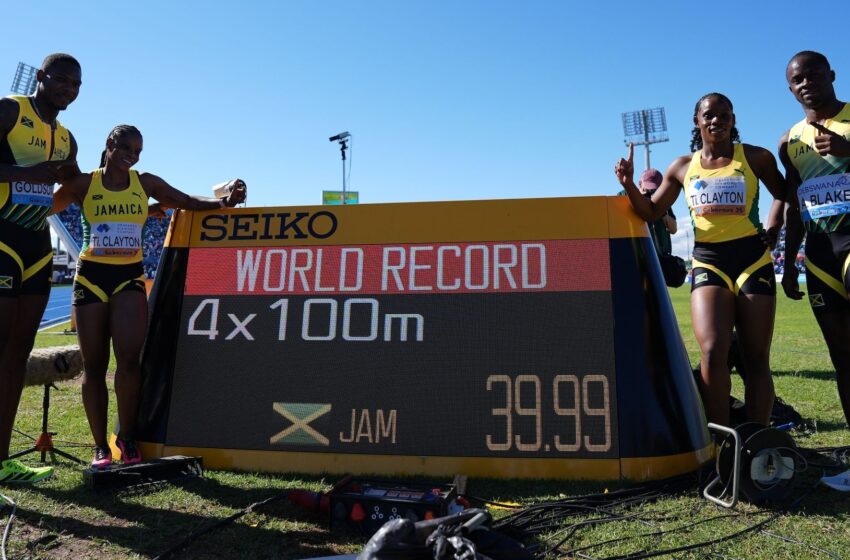
Jamaica surged into the record books at the World Athletics Relays in Gaborone with a breathtaking performance in the mixed 4x100m, becoming the first quartet ever to break the 40-second barrier. Ackeem Blake, Tina Clayton, Kadrian Goldson and Tia Clayton combined precision baton exchanges with raw speed to clock 39.99 seconds, slicing through the previous world record and setting a new global standard in a race that showcased Jamaica’s sprinting depth and technical sharpness. Performance data stood out not just for the record itself, but for how controlled and efficient the run looked from start to finish. Using the new mixed relay order of man–woman–man–woman, Jamaica delivered a near-perfect execution that maximised each athlete’s strengths across the four legs.
Blake set the tone on the opening bend, powering out of the blocks with a strong acceleration phase and ensuring Jamaica stayed level with the early leaders. His clean baton exchange into Tina Clayton was crucial, as any hesitation in a short relay like this can cost precious hundredths. Clayton responded with composure beyond her years on the second leg, holding top speed down the back straight and maintaining Jamaica’s momentum through the transition zone. Her handoff to Kadrian Goldson was smooth and aggressive, allowing him to immediately hit full stride without breaking rhythm. Goldson’s curve running was one of the most decisive phases of the race, as he helped Jamaica edge into a clear leading position before the final exchange.
Anchor leg runner Tia Clayton sealed the record-breaking run. Receiving the baton with Jamaica already slightly ahead, she powered through the final straight with a controlled but powerful sprint finish, extending the gap and ensuring the clock dipped under the historic 40-second mark for the first time in the event’s short history. What truly separated Jamaica from the rest of the field was the efficiency of their baton exchanges. Outgoing runners accelerated early into the exchange zone, allowing the receiver to reach near-top speed before taking the baton. This minimized time lost during transitions and kept their rhythm intact.
Biomechanical Shifts in Elite Relay Sprinting
Sustained velocity inside the passing zone requires total synchronization between incoming and outgoing sprinters. Moving away from safety passing patterns toward high-risk, blind aggressive handovers directly affects terminal speed readings, zone duration indexes, and final race outcomes.
Maximizing Kinetic Energy Transfer and Minimizing Deceleration
Baton passing zones represent areas of immense tactical vulnerability where minor miscalculations completely destroy linear momentum. Accelerating early into the transition box allows the outgoing sprinter to approximate the velocity of the incoming runner, creating a friction-free handoff at peak speed.
Eliminating check-steps or hesitation ensures that the plastic cylinder moves through space at a constant, uninterrupted rate of acceleration. Internal efficiency within these passing windows creates a compounding advantage over teams relying solely on individual foot speed.
Optimized Mixed Gender Ordering and Lane Line Mechanics
Structuring a mixed relay lineup demands a careful evaluation of how different athlete profiles handle unique sections of track geography. Putting explosive block starters on the initial bend allows a team to establish clean sightlines and run without the disruption of adjacent competitors.
The Tactical Evolution: International sprinting programs achieve genuine technical breakthroughs once mixed-gender running orders move from experimental combinations into highly calculated biographical deployments.
Tactical Realities and Athletic Association Guidelines
Execution of global championship performances highlights the absolute necessity of predictable, standardized lane regulations and international governing body rules. Elite quartets competing on global stages require absolute consistency regarding exchange zone boundaries, baton dimensions, and tracking sensor placements.
National athletic federations and regional training councils must move swiftly to standardize high-speed camera analysis, electronic timing triggers, and specialized track surface metrics. Creating an optimized training environment serves as the foundational step for transforming raw individual talents into a unified, record-breaking collective asset.
Furthermore, reducing external stresses, such as chaotic travel schedules and inadequate warm-up tracks at international venues, remains a vital prerequisite for peak performance. Modern athletic delegations cannot function efficiently without rapid, unrestricted access to specialized sports science facilities and physiotherapy recovery zones near the competition arena.
Strategic Asset Management and Performance Data Optimization
Independent athletic programs must implement coordinated data tracking frameworks to protect long-term performance metrics from technical errors and training regression. Establishing centralized athletic data archives shields national sprint pools from sudden coaching changes or individual availability shifts:
-
Biomechanical Video Infrastructure: Constructing independent high-speed video capture setups alongside standard track cameras guarantees continuous access to joint angle data during daily practice sessions.
-
Diversified Lineup Combinations: Blending established senior champions, versatile middle-leg specialists, and upcoming junior stars prevents performance drops when injuries disrupt primary team structures.
-
Coordinated Medical Support Contracts: Setting up direct multi-year agreements with elite sports medicine clinics, podiatrists, and recovery centers anchors physical durability and lowers seasonal injury rates.
Linking raw physical talent directly to a data-driven sports science framework builds an enduring defense against performance inconsistency and technical execution errors under international pressure.
Public Athletics Direction and Technical Accountability Goals
Resolving long-standing regional performance deficits requires a comprehensive development approach that connects grassroots talent scouting with elite-level technical coaching models. Independent track and field regulatory bodies must collaborate closely with youth sports organizations to ensure that fundamental baton handling methodologies match modern international standards.
Enforcing high training standards across regional development camps ensures that the execution quality achieved by senior national teams sets a clear precedent for upcoming junior sprinters. Clear developmental pathways foster deep structural trust, making it significantly easier to secure corporate sponsorships and government funding for expansive, cross-border training facilities in future athletic seasons.
Ultimately, achieving long-term athletic dominance depends entirely on an unyielding commitment to technical precision and collective tactical execution. Ensuring that national training systems adapt dynamically to support world-class relay pools safeguards long-term industry development, making the regional athletic program resilient, competitive, and structurally self-sustaining.