
KSh 20 Billion University Lecturers’ CBA Deal: November 2 Reopening Puts Public Universities on Road to Recovery

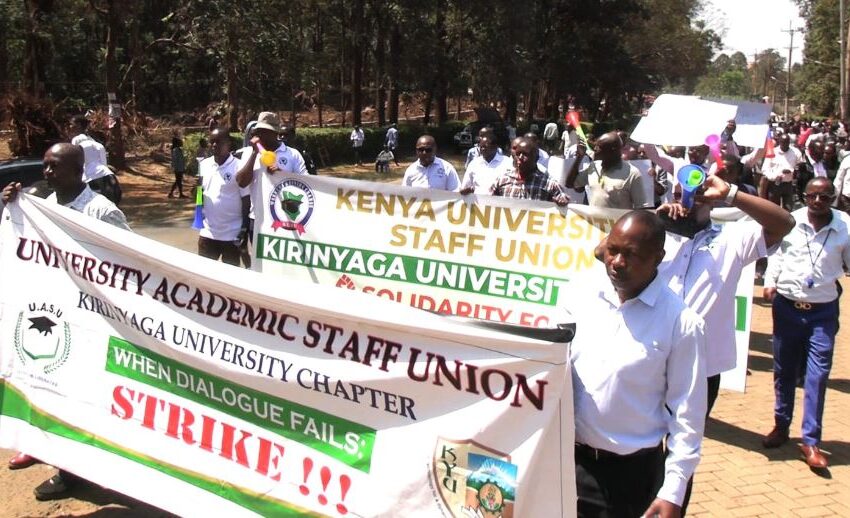
Lecturers during a past strike. IMAGE/ The Star
Public universities across Kenya are preparing to resume normal academic operations on November 2, 2026, following a reported KSh 20 billion Collective Bargaining Agreement (CBA) settlement involving the Ministry of Education, university councils and the Universities Academic Staff Union (UASU). The agreement is expected to address long-standing salary disputes, outstanding allowances and concerns surrounding the remuneration of academic staff in state-funded institutions.
The proposed settlement comes after months of uncertainty that disrupted university calendars, affected students and placed pressure on university administrations struggling to maintain teaching programmes. Lecturers have repeatedly raised concerns about salary structures, delayed payments and the implementation of negotiated employment benefits, making the latest agreement an important development for public higher education.
At the centre of the negotiations is the 2025–2029 CBA, which is intended to provide a framework for adjusting lecturers’ basic salaries and allowances over the agreement period. The KSh 20 billion allocation, if fully implemented as reported, would provide financial backing for commitments that universities have struggled to meet amid competing operational demands and budgetary limitations.
Read Also: Pharmacy Board Looks to Shape Future of Pharmaceutical Practice
Government and UASU reach breakthrough after weeks of negotiations
The negotiations reached a turning point after the government increased its financial offer from KSh 11.96 billion, which had been rejected by the unions, to KSh 20 billion over the four-year agreement period. The breakthrough followed high-level discussions involving Education Cabinet Secretary Julius Ogamba, National Treasury Cabinet Secretary John Mbadi and Interior Principal Secretary Raymond Omollo.
The agreement followed an industrial dispute that began on October 2, 2026, after negotiations over lecturers’ remuneration and employment benefits failed to produce an acceptable settlement. UASU, KUSU and KUDHEIHA were involved in the industrial action, which affected teaching and other university operations across the country.
UASU Secretary-General Constantine Wasonga confirmed that the union had reached an agreement with the government, emphasising that the financial commitment had emerged from negotiations rather than being imposed on lecturers.
“We have a deal worth Sh20bn for the 2025-2029 CBA. The Sh20 billion is for basic salary and allowances!” Wasonga stated while communicating the breakthrough to union members.
The negotiations had been complicated by the substantial difference between the employers’ financial proposals and the unions’ expectations. UASU had initially sought a package estimated at KSh 98 billion, while the government had tabled several lower offers before the eventual agreement.
The KSh 20 billion settlement therefore represents a negotiated compromise. However, the final amount should not automatically be interpreted as a complete resolution of every employment grievance raised during the strike.
What the 2025–2029 CBA means for lecturers’ salaries
The new CBA is expected to provide a four-year framework for reviewing the remuneration of academic and non-academic employees in public universities.
UASU had proposed basic salary increases ranging between 36 and 68 per cent, depending on an employee’s job grade. The union also sought a 57 per cent increase in house allowances, arguing that lecturers required improved compensation to cope with the rising cost of living.
Under the union’s proposals, the maximum basic salary for a professor would increase from approximately KSh 345,816 to KSh 580,144 by the final year of the agreement.
Senior lecturers were also targeted for adjustments, with the proposed maximum basic salary rising from KSh 238,221 to KSh 399,644.
Read Also: KNEC Grade 10 Assessment 2026: Guidelines, Timelines & School Requirements
These figures represent union proposals and should not be confused with confirmed individual salary entitlements under the final KSh 20 billion settlement. A detailed implementation schedule and approved salary bands are necessary to establish exactly what each employee will receive.
Other proposed benefits included:
-
Higher house allowances across different employment grades.
-
Commuter allowances of up to KSh 60,000 for eligible senior employees.
-
Annual book allowances ranging between KSh 65,000 and KSh 90,000.
-
Annual leave allowances of between KSh 50,000 and KSh 70,000.
-
A proposed professorial allowance of KSh 80,000.
-
Improved medical, dental and optical insurance arrangements.
The employers’ earlier proposal had included cumulative salary adjustments of 8.25 per cent over four years, based on annual increases of two per cent. An alternative proposal involving annual increases of three per cent would have delivered a cumulative adjustment of approximately 12.56 per cent.
The difference between these proposals illustrates why negotiations became difficult. Lecturers were seeking substantial improvements, while university employers had to consider the financial sustainability of institutions operating under constrained budgets.
November 2 reopening: What students should expect
The planned November 2 return to academic activities is another major development arising from the negotiations.
Students in public universities have endured uncertainty over examinations, lectures, research programmes and graduation arrangements since the industrial action began. Some institutions had already experienced significant interruptions to their academic calendars, forcing students to reconsider accommodation, transport and other education-related expenses.
Wasonga urged lecturers to prepare to return to their institutions, assuring students that lessons would resume on Monday, November 2.
University senates and academic departments are expected to play important roles in determining how interrupted programmes can be completed without compromising academic standards.
Students approaching graduation may be particularly concerned about delayed examinations, clearance processes and the issuance of academic certificates. Institutions will need to provide clear communication to prevent further uncertainty.
The November 2 date should therefore be understood as the planned resumption of learning following the settlement, rather than a guarantee that every affected academic activity will be completed immediately.
Universities Act and the legal framework governing appointments
Beyond salaries, the university dispute has brought renewed attention to governance and leadership challenges within public institutions.
The Universities Act No. 42 of 2012 provides the statutory framework for the establishment, governance and management of universities in Kenya.
Section 39 is particularly relevant because it outlines the appointment of vice-chancellors in public universities. Under the provision, a public university vice-chancellor is appointed by the Cabinet Secretary on the recommendation of the university council following a competitive recruitment process.
This framework makes university councils important in ensuring that leadership appointments follow established procedures and institutional requirements.
The presence of prolonged acting appointments has nevertheless raised questions about management continuity, accountability and the ability of university administrations to make long-term decisions.
The National Assembly’s Public Accounts Committee (PAC) has been examining these concerns alongside wider questions about university management and financial accountability.
During an appearance before the committee on October 22, 2026, Principal Secretary for Higher Education and Research Beatrice Inyangala indicated that the Ministry was working with university councils to resolve the prolonged acting vice-chancellor appointments by June 2027.
The commitment places pressure on the relevant institutions to conclude recruitment processes and establish substantive leadership structures.
PAC scrutiny puts university councils under pressure
The PAC inquiry is significant because university governance problems extend beyond the appointment of vice-chancellors. Leadership uncertainty can affect procurement decisions, staff management, financial planning and the implementation of institutional development programmes.
Acting officials may have to operate within temporary administrative arrangements while waiting for substantive appointments. The committee’s concerns therefore touch on the wider question of whether public universities have stable leadership structures capable of supporting long-term reforms.
The Ministry’s June 2027 target provides a timeframe for resolving the appointments, although the process must still comply with the recruitment and appointment requirements established under the Universities Act.
University councils will be expected to demonstrate transparency in recruitment, while the Ministry will have to ensure that the appointments are conducted within the law.
National Treasury funding and implementation challenges
The KSh 20 billion settlement also raises questions about how the government will finance the agreement without placing additional pressure on already constrained university budgets.
The National Treasury plays an important role in coordinating public expenditure through the national budgeting framework. Any salary commitments involving public institutions must be supported by credible financing arrangements and properly accounted for in government expenditure.
The Ministry of Education and university employers will also need to establish how the funds will be distributed across participating institutions.
A transparent implementation framework should identify the salary adjustments, allowances, payment timelines and financial responsibilities of each institution.
The agreement will require coordination between the Ministry, university councils, Treasury and the relevant staff unions. Without clear implementation guidelines, the settlement could face further disagreements over how the negotiated benefits are calculated and paid.
Another outstanding concern involves the KSh 7.9 billion in previous CBA arrears, which should be distinguished from the new KSh 20 billion package. The unions have continued to seek intervention over the outstanding payments.
Key provisions and implementation responsibilities
| Governance / Financial Pillar | Statutory Governing Body | Operational and Policy Impact |
|---|---|---|
| Lecturer CBA settlement | Ministry of Education, university employers and UASU | KSh 20 billion negotiated package covering basic salaries and allowances under the 2025–2029 CBA. |
| University reopening | University management, councils and staff unions | Planned resumption of academic activities on November 2, 2026. |
| Substantive VC appointments | Ministry of Education and university councils | Ministry target of resolving prolonged acting appointments by June 2027, subject to the Universities Act. |
What happens next?
The immediate priority is ensuring that the negotiated settlement translates into an orderly return to teaching and learning.
University administrations must communicate revised academic calendars, while lecturers will be expected to resume their responsibilities following the conclusion of the industrial dispute.
Read Also: Top Comoros Official Hospitalized in Nairobi Amid Rising Tensions in Moroni
The technical details of the CBA will also be important. Employees need to understand their revised salary structures, applicable allowances and the dates when adjustments will take effect.
For students and parents, the November 2 reopening offers an opportunity to regain academic momentum after weeks of disruption. However, institutions must address accumulated teaching hours and examination delays to avoid extending the disruption into subsequent academic years.
The Ministry must also work with university councils to address leadership vacancies before the June 2027 target. Stable management structures will be necessary to oversee financial commitments, academic programmes and institutional reforms.
Ultimately, the KSh 20 billion agreement is an important step towards restoring stability in public higher education. Its success will depend not only on the financial commitment but also on the government’s ability to implement the negotiated terms transparently.