
NSE Sell-Off 2026: Blue-Chip Stocks Wipe Out KSh336 Billion as Forex Reserves Hold Firm

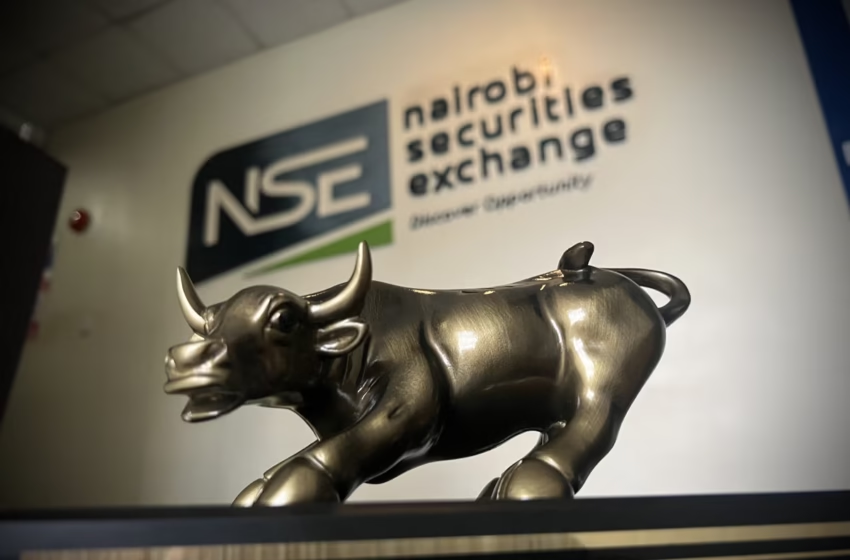
Nairobi Securities Exchange (NSE)
Kenya’s stock market has suffered a sharp September correction, wiping out about KSh336 billion in market value as investors sold some of the Nairobi Securities Exchange’s biggest blue-chip counters.
The decline has pushed NSE market capitalisation below the KSh4 trillion mark after the bourse reached a record KSh4.285 trillion on September 3, 2026. By September 16, the market had closed at about KSh3.948 trillion, according to market data reported alongside the latest Central Bank of Kenya financial markets update.
The reversal has been concentrated heavily among large, liquid companies, creating a fresh debate about the Nairobi market’s dependence on a relatively small group of blue-chip stocks.
Read Also: Pharmacy Board Looks to Shape Future of Pharmaceutical Practice
Safaricom, Equity Group, KCB Group, Co-operative Bank and Absa Bank Kenya have accounted for a significant share of the recent market-value decline, according to market data reported by People Daily. Safaricom alone lost about KSh52.1 billion in market capitalisation over the latest two trading sessions, followed by Co-operative Bank at KSh24.9 billion, Equity Group at KSh21.7 billion, KCB at KSh18.5 billion and Absa at KSh16.3 billion.
Blue-Chip Correction Hits NSE
The scale of the correction becomes clearer when compared with the rally that preceded it.
The NSE had crossed the KSh4 trillion market-capitalisation threshold during August, with major banks and Safaricom among the counters driving the advance.
Equity Group had reached KSh106 per share, KCB KSh98.55 and Co-operative Bank KSh38.55 by September 3, according to market data cited in the September 19 analysis. Safaricom had also reached KSh37.94, a multi-year high.
By September 16, the corresponding prices had fallen to KSh96 for Equity, KSh84.25 for KCB, KSh31.95 for Co-operative Bank and KSh35.20 for Safaricom.
The figures demonstrate how quickly a concentrated rally can reverse when several heavily weighted counters move lower at the same time.
The NSE market performance is particularly sensitive to these companies because large-cap stocks have a substantial influence on the overall value and major indices of the exchange.
The latest correction has therefore been broader in its effect than the individual share-price movements might suggest.
KSh336 Billion Market Wealth Dip
The latest decline has wiped out roughly KSh336 billion from the record market valuation reached earlier in September.
CBK reported that the NSE All Share Index fell 4.96 per cent during the week ending September 17. The NSE 25 Share Index dropped 5.85 per cent, while the NSE 20 Share Index declined 6.47 per cent.
Market capitalisation also fell by 4.96 per cent.
Yet trading activity moved in the opposite direction.
CBK reported that total shares traded increased by 26.46 per cent, while equity turnover rose by 44.75 per cent during the week.
That combination is significant.
A falling market accompanied by higher turnover suggests investors were actively repositioning rather than simply abandoning the exchange altogether. More shares were changing hands while prices were declining.
The market closed the week with about 178.71 million shares traded, while equity turnover reached approximately KSh9.27 billion, according to the latest market data.
Foreign Investors Lock In Gains
Foreign capital flows are an important part of the current NSE story.
Foreign investors sold a net KSh4.55 billion of Kenyan shares in August, their largest monthly outflow in 10 months. Additional net foreign outflows of about KSh1.6 billion were recorded during the first two weeks of September, according to market data cited in the latest reporting.
The selling comes after a powerful rally in large-cap stocks.
PAY ATTENTION: Follow Kenya Frontline WhatsApp channel for more news
Investors who bought shares during the earlier stages of the rally have had an opportunity to lock in substantial gains as prices climbed. Profit-taking can therefore produce significant selling pressure without necessarily meaning that investors believe individual companies have fundamentally deteriorated.
Global conditions are also part of the equation.
CBK’s September 18 bulletin noted that the US Federal Reserve raised its federal funds target range by 25 basis points to 3.75 per cent–4.0 per cent at its September 16 meeting. The US Dollar Index also strengthened by 1.14 per cent during the week.
Higher US yields can alter the relative attractiveness of frontier-market assets because global investors compare expected returns from markets such as Kenya with opportunities in major dollar-denominated markets.
Geopolitical uncertainty and inflation concerns can further encourage international investors to reduce exposure to higher-risk markets.
Local Investors Could Absorb Some Selling
Foreign selling does not automatically translate into a permanent loss of investor appetite for Kenyan equities.
Domestic institutions have increasingly become important participants in the market.
Retirement Benefits Authority data cited in recent market reporting shows that pension funds increased their listed-equity holdings by KSh130.51 billion during the six months to June, taking the value of those investments to KSh443.35 billion.
That provides an important counterweight to offshore selling.
Local institutional investors have longer investment horizons than many foreign portfolio investors and may therefore be willing to acquire shares when prices fall, particularly where valuations become more attractive.
The key issue is whether domestic demand can absorb shares being released by foreign investors without requiring prices to fall substantially further.
The answer will depend on liquidity, corporate earnings, dividend expectations, interest rates and investor confidence.
Safaricom And Banks Remain Central To Market Direction
The recent correction also exposes the concentration risk created when a small number of companies dominate market movements.
Safaricom remains one of the NSE’s largest and most actively traded companies, while Equity, KCB and Co-operative Bank are major components of the financial sector represented on the exchange.
The banking sector has played an especially important role in the 2026 rally.
Strong share-price performances in major banks helped lift overall market capitalisation, meaning a simultaneous correction across several lenders can have an outsized effect on the wider exchange.
That does not necessarily mean the companies themselves are in financial distress.
Read Also: Top Comoros Official Hospitalized in Nairobi Amid Rising Tensions in Moroni
Market capitalisation is calculated by multiplying a company’s share price by its shares outstanding. When a heavily capitalised company experiences a substantial price decline, billions of shillings can disappear from the exchange’s aggregate valuation even though no equivalent amount of cash has physically left the economy.
That distinction is important when interpreting the KSh336 billion decline.
Shilling Holds Near KSh130 Against Dollar
The stock-market correction has occurred alongside a relatively stable foreign-exchange market.
According to the CBK foreign exchange data, the Kenya shilling exchanged at KSh129.62 per US dollar on September 17, compared with KSh129.45 on September 10.
The weekly average stood at KSh129.59 per dollar.
CBK described the shilling as stable against major international and regional currencies during the week.
The currency’s stability provides a contrasting picture to the volatility seen on the equity market.
Investors therefore face two different signals: Kenyan share prices have undergone a significant correction, while the domestic currency has remained relatively steady.
The difference matters because foreign investors considering Kenyan assets must account for both share-price performance and currency movements.
A stable shilling reduces one source of uncertainty for investors measuring their returns in dollars.
CBK Reserves Provide Foreign-Exchange Buffer
Kenya’s foreign-exchange reserves provide another layer of protection.
CBK reported reserves of USD15.088 billion as of September 17, equivalent to 6.1 months of import cover. That remained comfortably above the central bank’s statutory requirement to endeavour to maintain at least four months of import cover.
The reserves, however, have moved during September.
CBK data shows reserves stood at USD14.882 billion on September 3 before rising to USD15.253 billion on September 10 and then declining to USD15.088 billion by September 17.
The latest level means Kenya retains a substantial foreign-exchange buffer even as international financial conditions remain uncertain.
The reserves can help support confidence in the country’s ability to meet external obligations and manage periods of foreign-currency pressure.
CBK has also clarified that it does not target a particular exchange-rate level for the shilling. Its foreign-exchange operations are instead designed to manage excessive volatility and support reserve objectives.
NSE Correction Versus Currency Stability
The contrast between the NSE and the foreign-exchange market is one of the most important features of Kenya’s current financial picture.
Equity prices have fallen sharply after reaching record levels, but the shilling has remained close to KSh130 per dollar. Meanwhile, foreign-exchange reserves remain above USD15 billion and provide 6.1 months of import cover.
The combination suggests that the current stock-market sell-off should not automatically be interpreted as evidence of a broader foreign-exchange crisis.
Instead, the available data points to several overlapping forces: profit-taking after a strong equity rally, foreign portfolio outflows, changing global interest-rate conditions and a correction concentrated in large-cap counters.
The coming weeks will reveal whether local institutional investors can absorb continued selling and whether the largest NSE companies can stabilise after the recent decline.
What Investors Will Watch Next
The KSh4 trillion market-capitalisation threshold is likely to remain an important psychological reference point after the NSE fell below it.
Investors will also watch whether Safaricom, Equity, KCB, Co-operative Bank and other large counters stabilise or experience additional selling.
Foreign investor flows will provide another signal.
Continued offshore selling could maintain pressure on the most liquid shares, particularly if global investors continue favouring dollar assets. Stronger domestic institutional demand, however, could provide some support if valuations become more attractive.
Read Also: Kenyan marathoner remanded over Ksh8 million land fraud case
The latest CBK figures offer a separate source of reassurance on the currency side. The shilling remains near KSh130 per dollar, while USD15.088 billion in reserves provides 6.1 months of import cover.
Kenya’s financial markets are therefore dealing with a sharp equity correction rather than a single, uniform market shock.
The immediate story is the KSh336 billion decline in NSE market value and the concentration of losses among blue-chip counters. The bigger question is whether the correction remains a profit-taking episode after a record rally or develops into a more prolonged repricing of Kenyan equities.
The distinction will become clearer through trading volumes, foreign flows, local institutional demand, corporate earnings and the behaviour of the market’s largest counters in the weeks ahead.

