
Sabastian Sawe Marathon Record London 2026 Breakthrough That Redefined Human Endurance Limits

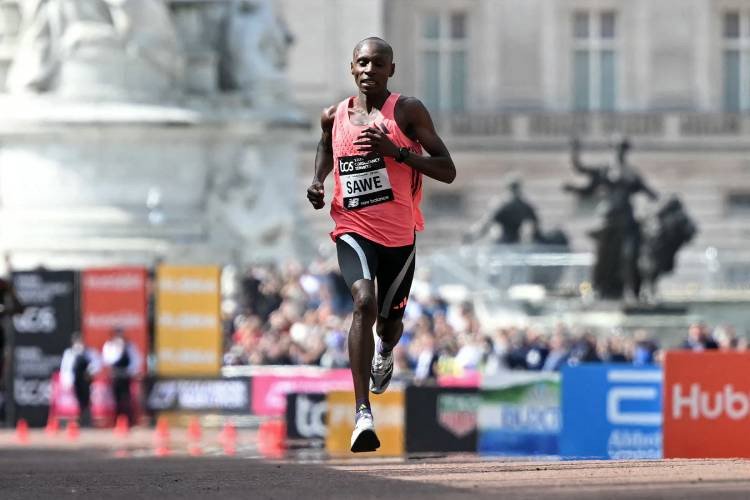
Distance running entered a new historical era at the 2026 London Marathon when Sabastian Sawe delivered a performance that fundamentally redefined what is considered possible in elite endurance sport.
The Kenyan athlete became the first runner in history to complete a fully competitive marathon in under two hours, clocking an extraordinary time of 1:59:30 in regulated race conditions.
This achievement surpassed the previous official world record of 2:00:35 and instantly reshaped expectations in long-distance athletics. While earlier sub-two-hour performances had been achieved in controlled exhibitions, Sawe’s result stands apart as a verified competitive milestone recorded in a sanctioned race environment.
The performance has already sparked widespread discussion among sports scientists, coaches, and analysts about how far human endurance limits can still be pushed.
How London Marathon 2026 Became a Turning Point in Distance Running
The London Marathon has long been regarded as one of the most competitive and strategically demanding races in global athletics. The 2026 edition elevated that reputation even further, producing one of the fastest elite fields ever assembled.
From the early stages of the race, the pace was aggressive yet controlled, reflecting a growing trend in modern marathon strategy where elite athletes rely on structured pacing groups, advanced footwear technology, and precise energy management systems.
Sawe’s approach was not built on early domination but on disciplined pacing and energy conservation, a strategy increasingly common among top marathoners.
Also Read: Rio Ferdinand To Open International Doors For Arusha Through AFCON 2027
Negative Split Strategy Behind Sawe Marathon World Record
One of the most defining elements of Sawe’s record-breaking performance was his execution of a negative split strategy, where the second half of the race is run faster than the first.
At the halfway mark, Sawe passed in approximately 1:00:29, maintaining a controlled rhythm that kept him within striking distance of the lead pack without expending excessive energy.
However, what followed was a dramatic acceleration that changed the entire outcome of the race.
Performance breakdown of Sabastian Sawe race strategy
| Segment | Time | Performance Insight |
|---|---|---|
| First 21.1 km | 1:00:29 | Controlled endurance pacing |
| Second 21.1 km | 59:01 | Accelerated finishing surge |
| Final 5 km | Elite-level speed | Peak endurance execution |
| Overall time | 1:59:30 | Historic sub-two-hour marathon |
The final kilometers showcased a level of endurance rarely seen in competitive marathon history, with Sawe sustaining elite sprint-level efficiency deep into fatigue.
Why the Sub Two Hour Marathon Was Once Considered Impossible
For decades, the two-hour marathon was regarded as a physiological boundary that no athlete could surpass under normal competition conditions.
The challenge was not just speed but sustained energy output over 42.195 kilometers while managing hydration, oxygen efficiency, and muscle fatigue.
Even after Eliud Kipchoge achieved a sub-two-hour time in 2019, it was widely acknowledged that the effort took place under controlled conditions designed specifically to optimize performance.
Sawe’s 2026 achievement is therefore viewed differently because it occurred within a competitive field where external pacing variables, competition pressure, and race dynamics were fully present.
This distinction is critical in understanding why his performance is considered a new benchmark in athletic history.
Competitive Field Pushes Marathon Limits Beyond Expectations
The London Marathon 2026 was not defined by a single athlete but by a collective elevation of performance across the elite field.
Several top competitors also delivered historic times, suggesting a broader shift in marathon racing standards rather than an isolated performance.
Top finishers London Marathon 2026
| Athlete | Finish Time | Historical Significance |
|---|---|---|
| Sabastian Sawe | 1:59:30 | First competitive sub-two-hour marathon |
| Yomif Kejelcha | 1:59:41 | Second fastest marathon ever recorded |
| Jacob Kiplimo | 2:00:28 | Third fastest time in history |
For the first time in marathon history, multiple athletes crossed the finish line under the previously impossible two-hour threshold, signaling a new era in elite distance running.
Expert Reaction to Marathon Record Breakthrough
Sports analysts and former champions have described the event as a transformational moment in athletics.
The improvement in marathon performance standards has been linked to several evolving factors including advanced training science, improved race nutrition, aerodynamic pacing strategies, and footwear innovation.
Former world record holder Paula Radcliffe emphasized that the performance has permanently shifted competitive benchmarks, noting that elite athletes will now have to reassess what constitutes world-class performance.
The sentiment across the athletics community is clear: the boundaries of endurance sport have been significantly expanded.
Training Evolution Behind Modern Marathon Performance
Modern marathon success is no longer based solely on natural talent or high mileage training. It now involves a combination of scientific monitoring, precision coaching, and performance optimization systems.
Athletes like Sawe typically undergo extensive preparation cycles that include altitude training, biomechanical analysis, and controlled pacing simulations.
A key feature of elite preparation is injury prevention and physiological monitoring, which ensures athletes peak at the right moment during major competitions.
In recent years, athletes have also embraced data-driven coaching systems that track oxygen efficiency, stride length, heart rate variability, and lactate thresholds.
Technology and the New Era of Marathon Racing
Technological innovation has become one of the most influential factors in modern distance running.
Footwear advancements, commonly referred to as supershoe technology, have significantly improved running economy by reducing energy loss during long-distance events.
In addition, wearable monitoring systems and GPS-based pacing tools have enabled athletes to maintain optimal speed distribution throughout races.
While technology does not replace athletic ability, it plays a major role in maximizing performance output and reducing fatigue accumulation.
Psychological Strength and Race Execution
Beyond physical ability, marathon success is increasingly defined by mental resilience and tactical decision-making.
Sawe’s ability to remain composed during the early stages of the race while conserving energy for a late surge demonstrates elite psychological control.
Marathon racing at this level requires precise decision-making under extreme physical stress, where even minor pacing errors can significantly affect final results.
The ability to execute a perfectly timed acceleration is often what separates world record performances from standard elite finishes.
What This Means for the Future of Marathon Running
The 2026 London Marathon has raised fundamental questions about the future of endurance sport.
If sub-two-hour performances are now possible in competitive environments, the sport may be entering a new phase where previous performance ceilings no longer apply.
Coaches and sports scientists are now expected to re-evaluate training models, race strategies, and long-term athlete development pathways.
Future competitions may increasingly feature tighter elite fields, faster pacing strategies, and more frequent record-breaking attempts.
Also Read: Rio Ferdinand To Open International Doors For Arusha Through AFCON 2027
Conclusion A New Era in Human Endurance Begins
Sabastian Sawe’s performance at the 2026 London Marathon represents more than a world record. It marks a shift in how human endurance potential is understood.
By combining disciplined pacing, advanced training methods, and exceptional finishing speed, Sawe has helped redefine what is possible in competitive marathon running.
As the sport continues to evolve, his achievement will likely be remembered as a turning point that opened the door to an entirely new era of distance running performance.