
Talanta Stadium: Why It Took Time to Reach 80% Completion

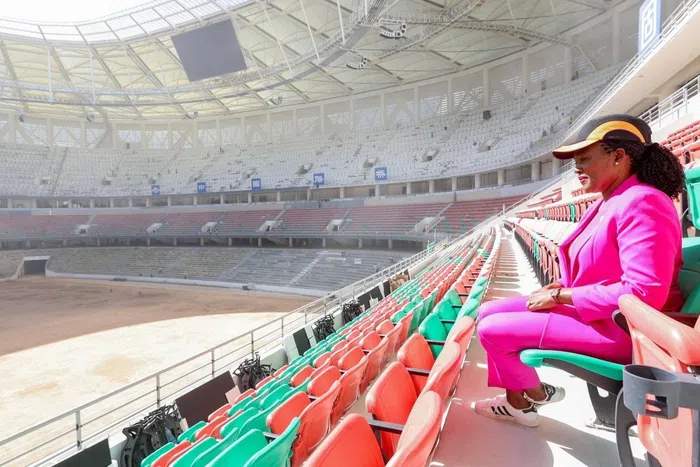
The construction of the Talanta Stadium marks a pivotal shift in East Africa’s approach to sports infrastructure, representing a move away from the basic multipurpose designs of the past toward a specialized, world-class experience.
Located at the Jamhuri Grounds off Ngong Road, this 60,000-seat arena was conceived as the crown jewel of the “Pamoja Bid,” the joint hosting effort by Kenya, Uganda, and Tanzania for the 2027 Africa Cup of Nations (AFCON).
Since the groundbreaking ceremony in March 2024, the project has moved at a significant pace, yet the timeline for completion has remained a subject of intense interest and debate among sports fans and stakeholders alike.
Engineering Excellence and Custom Design
One primary reason the project requires a meticulous timeline is the departure from traditional stadium blueprints. Most existing venues in the region, such as Kasarani or Nyayo, feature a running track that separates the fans from the pitch.
The Raila Odinga International Stadium,the name bestowed upon the facility in December 2025—is uniquely tailored for football and rugby. Eliminating the athletics track allows for a three-tier auditorium that brings the crowd closer to the pitch, but it also necessitates a more complex structural layout to ensure optimal sightlines and safety.
The architectural vision, which incorporates the motif of the Masai shield into the stadium’s spatial layout and decorative facade, involves intricate custom work. From the fully covered stands to the specific black, red, and green seating arrangements, every element is designed to meet stringent CAF and FIFA standards.
Construction by the China Road and Bridge Corporation (CRBC) under the supervision of the Kenya Defense Forces must ensure these aesthetic features do not compromise the technical requirements of a high-end international arena. Taking the time to perfect these details ensures that Kenya does not just build a stadium, but a global icon.
Scaling for a “Sports City” Legacy
Another factor influencing the duration of the build is the sheer scale of the surrounding infrastructure. The project is not limited to a single building; it is a 45-hectare development known as Talanta Sports City. This includes the integration of independent athletics fields, multiple training pitches, and parking facilities for 3,000 vehicles. Converting the former meadow at Jamhuri Park into a synchronized sporting hub requires extensive utility installation, drainage systems, and transport links to accommodate tens of thousands of visitors.
While the initial handover was targeted for early 2026, the transition toward a mid-2026 completion date reflects a commitment to the final 20% of the project, which involves sensitive technology and turf management. With a construction cost of 45.3 billion Kenyan shillings, the government is prioritizing durability and quality over a rushed delivery.
By ensuring the facility is 100% ready for the AFCON 2027 opening game and final, the project team is securing a legacy that will serve the local economy and youth sports development for generations. Ultimately, the time invested now is a deposit on a future where Kenya stands as a premier destination for world-class international competitions.