
What You Need to Know About the 2027 Election Case

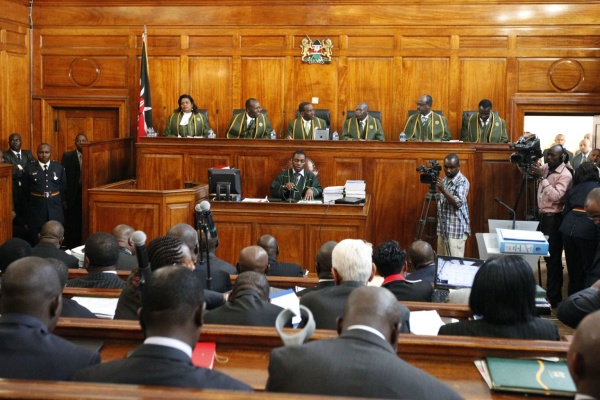
If there were hopes that Kenya’s next General Election could be brought forward to 2026, the Supreme Court has effectively dashed them after declining to order the Independent Electoral and Boundaries Commission (IEBC) to conduct a presidential election next year.
Although the court clarified how the Constitution should be interpreted regarding the timing of presidential elections, it ruled that compelling the IEBC to organise a poll in August 2026 would be impractical and could throw the country into political and constitutional uncertainty.
The decision followed a petition filed by Dr Owiso Owiso, Khelef Khalifa and Ashioya Biko, who asked the Supreme Court to declare that the next presidential election should be held on the second Tuesday of August 2026 rather than in 2027.
“Ordering the electoral commission to organise a presidential election in August 2026 would be to grant an order that is logistically impossible to implement,” the judge said.
Justice Thande noted that by the time the petition was filed in October 2025, preparations for the 2027 General Election were already underway, with the electoral commission, political parties, candidates and Kenyans generally working towards the 2027 polls.
She added that granting the orders sought would have created significant logistical challenges and risked plunging the country into unnecessary political instability.
Court Prioritises Stability
“The court had to balance enforcement of the rule of law with judicial restraint to avoid precipitating ‘unmitigable national instability’.”
The dispute centred on the interpretation of Article 136(2)(a) of the Constitution, which provides that a presidential election should be held on the second Tuesday of August in the fifth year following the previous General Election.
Justice Thande agreed with the constitutional interpretation advanced in the petition, finding that the provision requires elections to be held according to the constitutional timetable rather than based on a President serving a full five-year term.
She also declared that, by operation of Article 136(2)(a), the President’s term of office is not automatically five years.
The judge further held that neither Article 142 nor any other provision of the Constitution expressly grants the President a guaranteed five-year term.
The petitioners had argued that holding the next election in August 2027 would effectively extend President William Ruto’s tenure beyond what the Constitution contemplates.
They maintained that because the fifth year following the August 9, 2022 General Election begins on August 9, 2026, the Constitution requires the next presidential election to be held on August 11, 2026, being the second Tuesday of that month.
Why the Petition Failed
To support their case, the petitioners relied on Article 259(5)(c), which explains how periods expressed in years should be calculated under the Constitution.
They also cited previous election cycles, arguing that both former President Uhuru Kenyatta and President William Ruto assumed office before their predecessors had completed five calendar years in office, demonstrating that the constitutional election calendar takes precedence over a fixed presidential term.
Justice Thande acknowledged that constitutional timelines override any expectation that a President must serve a complete five-year period before another election is held.
She further observed that courts have a duty to intervene whenever the IEBC fails to discharge its constitutional responsibilities.
However, she distinguished between issuing a declaratory judgment and compelling immediate action by the electoral commission.
According to the judge, declaratory orders are intended to clarify the legal position and remove uncertainty regarding constitutional rights and obligations without necessarily directing an institution to act immediately.
While the court granted declarations clarifying the constitutional interpretation, it declined to compel the IEBC to organise the 2026 election because doing so would have been impractical given the advanced stage of preparations for the 2027 polls.
The ruling therefore means that despite the court’s interpretation of the Constitution, the 2027 General Election remains on course, with the IEBC expected to continue preparations for the polls under the existing electoral timetable.