Why Court Blocked Unlicensed Digital Lenders

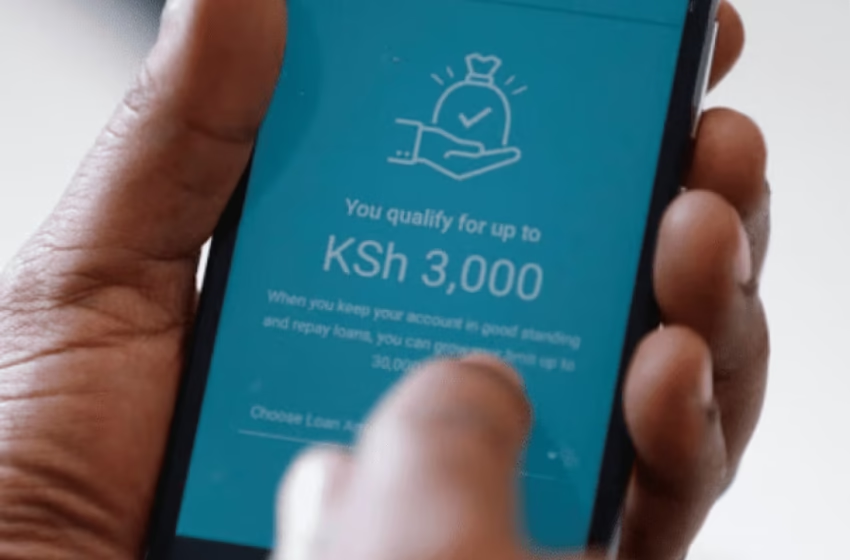
A Nairobi Small Claims Court has struck out two debt recovery suits filed by digital lenders after ruling that the companies lacked the licences required to conduct lending business in Kenya.
Resident Magistrate Gladys Kiama ruled that Tri-State Capital Limited and Mombo iCapital Limited did not have the legal capacity to enforce their loan agreements because they were not licensed by the Central Bank of Kenya (CBK).
The two lenders had separately sought to recover Sh500,000 and Sh162,297 from borrowers accused of defaulting on their loans. The court, however, did not proceed to determine whether the borrowers owed the amounts claimed.
Instead, Magistrate Kiama first examined whether the companies had the legal authority to operate as lenders and seek the court’s assistance in recovering the alleged debts.
Business Daily reported that the court found neither company had demonstrated that it was licensed as a digital credit provider by the CBK.
“The claimant has not demonstrated that it possesses the legal capacity and regulatory authority necessary to engage in the lending activities disclosed in the statement of claim,” Magistrate Kiama said in rulings dated July 17, 2026.
CBK licensing key in digital lending court cases
The ruling comes against the backdrop of regulatory changes introduced to bring Kenya’s rapidly expanding digital lending industry under tighter supervision.
A December 2021 law gave the CBK powers to license and oversee digital credit providers, bringing previously unchecked mobile lending applications under regulatory scrutiny from April 2022.
The regulator has since licensed 252 digital credit providers after receiving more than 800 applications, according to information cited by Business Daily.
The licensing regime was introduced following growing complaints from borrowers over expensive loans, aggressive debt collection practices and alleged violations of consumer privacy.
Some digital lenders have faced accusations of charging annualised interest rates of more than 100 per cent, while borrowers have also complained about lenders contacting people saved in their mobile phone address books after loan defaults.
The court said the regulatory framework was intended to protect the public from unregulated lending practices and ensure companies advancing credit operate within the law.
“It then follows that conducting lending business without such licensing amounts to an illegality and economic risk,” the magistrate said.
Section 3 of the Banking Act requires entities carrying out banking or financial business in Kenya to obtain the necessary licence from the regulator.
Magistrate Kiama said the two lenders had failed to demonstrate that they possessed the regulatory authority required to conduct the lending activities described in their claims.
The court further held that an entity conducting regulated financial activities without the required authorisation could not rely on the courts to enforce rights arising from those activities.
Allowing an unlicensed lender to continue operating and recover debts through the courts would also offend public policy, the magistrate ruled.
Tri-State sought Sh500,000 from borrower
Tri-State Capital had sued Geoffrey Mucuku over a loan it said was originally worth Sh213,500.
The lender told the court that the amount was repayable as Sh229,513 in a single instalment by April 2021. The facility was secured by a motor vehicle, but the borrower allegedly defaulted on the repayment.
Tri-State said the outstanding balance initially stood at Sh85,000 before rising to Sh500,000.
The company also told the court that the vehicle used as security had a registered caveat, meaning it could not be sold to recover the debt.
Tri-State subsequently asked the court to compel Mr Mucuku to pay the claimed amount.
The court did not, however, reach a determination on the alleged default after finding that the lender lacked the legal standing required to pursue the case.
Mombo iCapital loan rose to Sh162,297
Mombo iCapital had separately sued Florence Wawira over a loan of Sh65,000 advanced in mid-2025.
The lender said Ms Wawira was required to repay the amount within one month, together with interest of Sh13,650.
The agreement also provided for a weekly late-payment charge of 3.5 per cent if the borrower failed to settle the loan within the agreed period.
Mombo iCapital told the court that the outstanding amount had increased to Sh162,297 by October 2025.
The court again focused on the lender’s legal authority rather than the amount allegedly owed by the borrower.
Magistrate Kiama said neither claimant had shown that it was authorised by the CBK to operate as a digital credit provider.
She consequently ruled that the lenders lacked the locus standi, or legal standing, to bring the claims and seek judicial redress.
“The claimant lacks the locus standi to institute or file a suit or in any way engage the court for redress,” she said.
The two suits were therefore struck out.
The decision means the court did not make a finding on whether Mr Mucuku or Ms Wawira actually owed the amounts claimed by the lenders.
The rulings could nevertheless have wider consequences for digital lenders attempting to recover unpaid loans through Kenyan courts, particularly where their regulatory status is questioned.
Kenya’s digital lending industry has grown rapidly over the past decade, driven by the widespread use of mobile phones and the demand for quick, unsecured credit.
The number of users of mobile phone-based micro-lenders has risen to more than two million from about 200,000 in 2016.
The rapid expansion has also brought increased regulatory scrutiny, especially over the cost of borrowing, debt collection methods and the handling of customers’ personal information.
The 2021 regulatory changes required existing digital credit providers to apply for CBK licences within six months. The licensing process has been conducted in phases as the regulator reviews applications and seeks additional documentation from companies seeking approval.
The Nairobi court’s latest decision now reinforces the importance of that regulatory framework.
Digital lenders seeking to enforce loan agreements through the courts may need to demonstrate that they had the necessary authorisation to conduct lending business.
The ruling also gives borrowers a potentially important line of defence in debt recovery disputes involving lenders that cannot demonstrate compliance with CBK licensing requirements.
The decision does not mean that all digital loans are unenforceable or that borrowers are automatically relieved of legitimate debts. Its central finding is that lenders conducting regulated financial activities without the required authorisation cannot expect the courts to assist them in enforcing rights arising from unlawful lending activities.
The two cases therefore mark another significant development in Kenya’s continuing effort to bring digital lenders under stronger regulatory oversight.