
Why Gachagua keeps exposing Ruto

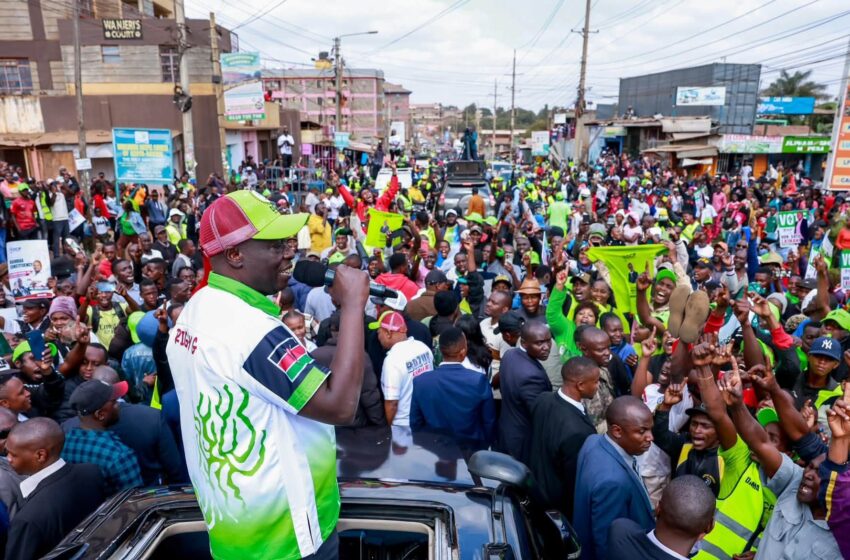
Gachagua
If political power is partly about knowing what your opponent plans before they act, Rigathi Gachagua appears determined to prove that he still has access to information deep inside President William Ruto’s administration.
The Democracy for Citizens Party (DCP) leader has, in recent months, repeatedly made claims about government operations, security plans and decisions before they are officially announced, portraying himself as a politician with an extensive network of informants within the State security machinery and State House.
His disclosures have placed the former Deputy President at the centre of an increasingly public intelligence battle with the administration, with senior government officials and security chiefs moving to discredit his claims while warning that leaks from security agencies could pose a threat to national security.
Speaking during a podcast interview with Herman Manyora on July 31, Gachagua openly acknowledged that he receives information from people working within government institutions and security agencies, saying he carefully verifies the details before making them public.
“I have asked the National Intelligence Service (NIS) and people working in parastatals to preserve my credibility because it is good for this country,” Gachagua said.
PAY ATTENTION: Follow Kenya Frontline WhatsApp channel for more news.
Gachagua’s growing claims of inside access
Gachagua said the information reaching him had allowed him to anticipate government actions while maintaining that he was conscious of the danger of releasing inaccurate information.
“I want to thank the informants. They gave me good information. I have asked people not to be defiant. I have asked them to give me credible information that is verifiable so that I preserve my relevance.”
The former Mathira MP added that he does not immediately publish everything he receives, arguing that cross-checking information is necessary to protect his credibility.
“I also have a lot of information, and I sometimes don’t rush into it. I do a lot of cross-checking because the day I mislead Kenyans, I’ll lose my credibility.”
One of the most contentious episodes emerged after the fatal shooting of psychiatrist Dr Victoria Nthunya Mutiso in Nairobi. Gachagua publicly raised questions about police involvement in the case, prompting an unusually forceful response from Director of Criminal Investigations Mohamed Amin.
Amin confirmed that investigators had made significant progress in the case but also made a counter-claim that Gachagua had communicated by phone with key suspects and a boda boda operator allegedly linked to the operation.
The exchange quickly became a political and security spectacle. Gachagua maintained that his information had forced authorities to act, while police rejected suggestions that their operations depended on information supplied by the former Deputy President.
Rather than report to police headquarters, Gachagua challenged Amin to travel to his Wamunyoro residence if investigators wanted to record his statement, signalling his refusal to treat the matter as an ordinary police summons.
His claims have not been limited to criminal investigations. Before President Ruto formally unveiled his Vision 2060 development blueprint, Gachagua publicly discussed the anticipated announcement and criticised the long-term plan before the President addressed the nation.
The former DP argued that the government should focus on immediate economic challenges, including the plight of farmers, the high cost of living and insecurity, rather than concentrating on a decades-long development framework.
The timing of his remarks strengthened his argument that people within the administration continue to provide him with information before official announcements are made. Gachagua has repeatedly claimed that some individuals close to Ruto remain his sources, including people within State House and the President’s wider political circle.
State House intelligence claims trigger pushback
Another controversial disclosure involved the renewal of the British Army Training Unit Kenya (BATUK) agreement. Gachagua alleged that senior government figures had sought a bribe from British officials during negotiations over the renewal of the agreement.
He further claimed that National Assembly Defence, Intelligence and Foreign Relations Committee chairman Nelson Koech was later sent to explain the delay in concluding the agreement.
The allegations have added to concerns within government over the former Deputy President’s ability to obtain information about sensitive state affairs.
Gachagua has also claimed that security officials attempted to obtain an advance copy of his assessment of Ruto’s administration, titled ‘Ruto at Four’. He said intelligence operatives and government officials sought to infiltrate his political network but were unable to obtain the document because it had been prepared in secrecy.
The claims have drawn sharp condemnation from the government, with Interior Cabinet Secretary Kipchumba Murkomen accusing the former Deputy President of misrepresenting the work of security agencies.
Speaking at ACK St Stephen’s Chepkoilel in Eldoret, Uasin Gishu County, in the presence of President Ruto, Murkomen dismissed Gachagua’s claim that security officers had provided him with advance information about the Vision 2060 announcement.
“Nilikuwa naona juzi mtu anasimama tu anaanza kusema ati Rais ataenda kuzindua Vision 2060 nimeambiwa na NIS, nimeambiwa na DCI na ni uwongo tupu,” Murkomen said.
Murkomen argued that details of the President’s planned address were already publicly available after Ruto announced on Facebook that he would speak about Kenya’s future.
The Interior CS accused Gachagua of using national security issues for political gain and insisted that intelligence and security agencies must remain professional and non-partisan.
He went further, describing the former Deputy President as “the most irresponsible leader” to have occupied one of the country’s highest offices, accusing him of undermining security agencies and weakening public confidence in the national security architecture.
Amin has also rejected Gachagua’s assertions, describing them as false and reckless. Speaking on August 3 during the launch of a multi-agency initiative targeting hate speech ahead of the 2027 General Election, the DCI boss defended the professionalism of officers in the National Police Service.
“Our officers are professional officers who execute their duties professionally, diligently and with utmost discipline. So let us not purport that you receive information from members of the security. That is a big lie,” Amin said.
The public confrontation has now placed an unusual question at the centre of Kenya’s political debate: how does Gachagua appear to know about some government plans before they are officially announced?
The administration maintains that Gachagua’s claims are either politically motivated or based on information already available to the public. Gachagua, however, presents the repeated disclosures as evidence that his network remains deeply embedded within the institutions he once helped oversee.
As the 2027 elections draw closer, the battle over information is likely to become even more significant. Gachagua’s ability to release details ahead of government announcements gives him a powerful political weapon, while the administration faces growing pressure to establish whether the claims stem from genuine intelligence leaks or carefully calculated political manoeuvres.
Ultimately, the former Deputy President’s public disclosures have exposed a growing contest for control of information — one unfolding not only at political rallies, but also within the sensitive corridors of Kenya’s security establishment.