
Why Kenya Airways has shaken up its top leadership as Habil Waswani takes over from George Kamal

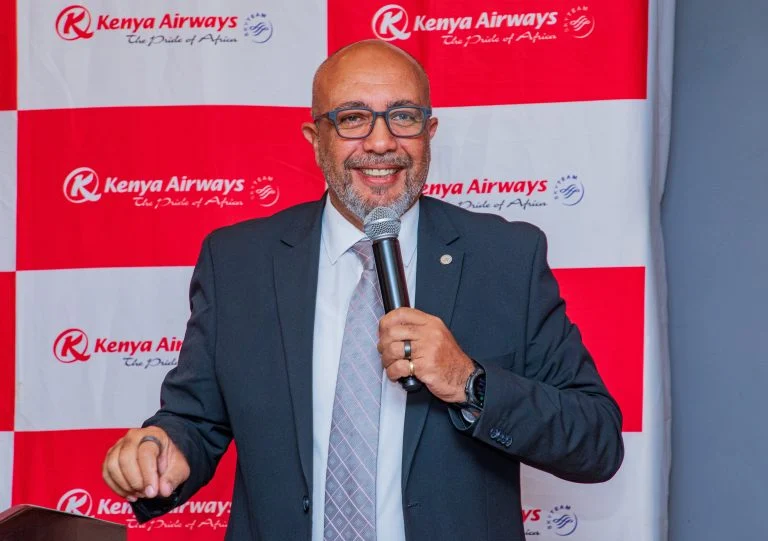
Dr George Kamal during a media editors’ briefing in Nairobi on August 19, 2026. PHOTO/@KenyaAirways/X
Kenya Airways has once again changed the person at the top of its management, adding another twist to the national carrier’s long-running struggle to return to financial stability and profitability.
The airline’s board on Tuesday removed George Kamal as acting Group Managing Director and Chief Executive Officer and appointed company secretary and head of legal Habil Waswani to take over in an acting capacity.
Kamal had occupied the interim position since December 2025, when he stepped in following the departure of Allan Kilavuka, who proceeded on terminal leave ahead of the end of his tenure in April 2026. His stint as acting chief executive lasted just over eight months.
PAY ATTENTION: Follow Kenya Frontline WhatsApp channel for more news
Kiprono Kittony, the Kenya Airways board chairman, praised Kamal’s contribution during a difficult period for the airline but did not disclose the reason behind the latest leadership change.
“During his tenure, he brought extensive aviation expertise to bear in stabilizing the airline’s operations and successfully steered the company through the most recent executive leadership transition,” said Mr Kittony in a statement.
The leadership shake-up comes at a particularly difficult moment for Kenya Airways, which continues to deal with heavy financial losses, high operating costs, capacity constraints and a significant debt burden.
Waswani is scheduled to begin his tenure as acting chief executive on September 15. His appointment is temporary, with the board already beginning the search for a substantive Group Managing Director and CEO.
The development is likely to attract attention from passengers, employees, investors and the wider aviation industry as the national carrier attempts to chart a more sustainable path.
Why George Kamal Was Removed
Kamal’s departure from the acting CEO position marks another change in the airline’s executive leadership.
He joined Kenya Airways in March 2023 as Chief Operating Officer after building extensive experience in the aviation sector. Before moving to KQ, he worked at Iraqi Airways, where he served as chief executive and chief operating officer.
He had also previously served as head of operations at Air Arabia, giving him experience in managing airline operations across different markets.
His appointment as acting CEO in December 2025 came as Kenya Airways was already dealing with serious financial and operational challenges.
Although the board did not publicly provide a reason for removing him, Kittony acknowledged the contribution Kamal made during his time at the helm.
The leadership transition also comes as KQ attempts to balance operational demands with the need to control costs and improve its financial performance.
It remains unclear whether Kamal will return to his previous position as chief operating officer or take up another role within the airline.
His next move will likely be watched closely given his experience and the central role he has played in the airline’s operations since joining the company.
Habil Waswani Takes Over
Waswani brings a different professional background to the chief executive position.
He joined Kenya Airways in March 2021 as company secretary and director of legal services and regulatory compliance. Before joining KQ, he worked at the National Bank of Kenya in a similar capacity.
Much of his career has been built in the financial services sector, including senior legal and corporate governance positions at Diamond Trust Bank and Kenya Reinsurance Corporation.
His experience in corporate governance could become particularly important as Kenya Airways continues to navigate complex financial obligations, regulatory requirements and government-backed efforts to stabilize the airline.
Kittony highlighted Waswani’s professional background while announcing his appointment.
“His career spans senior corporate governance roles across leading banking and insurance institutions. He is also a multiple recipient of the prestigious Legal 500 GC Powerlist East Africa Awards since 2004,” said Mr Kittony.
The new acting CEO will now have to oversee the airline’s operations while the board searches for a permanent holder of the position.
His background is heavily weighted towards legal, governance and financial services rather than airline operations, making the transition an interesting one for an aviation company facing major operational pressures.
Waswani will have to deal with aircraft availability, fuel costs, passenger demand, staffing, route profitability and competition across the increasingly competitive African aviation market.
Kenya Airways Still Battling Heavy Losses
The leadership change comes against the backdrop of another difficult financial period for Kenya Airways.
In the six months to June 2026, the airline’s losses increased by 32 percent to Sh16 billion, compared with Sh12 billion during the same period the previous year.
The figures underline the scale of the challenge awaiting both the acting CEO and the eventual permanent chief executive.
Kenya Airways has been relying on increased demand for air travel in Kenya and international markets as it seeks to grow revenue.
However, higher passenger demand has not been enough to offset the carrier’s rising expenses.
Fuel costs remain a major concern for airlines globally, while capacity constraints have limited Kenya Airways’ ability to fully capitalize on opportunities in the market.
The airline is also carrying a significant debt burden. Years of losses have weakened its balance sheet and contributed to a deep negative equity position.
The Kenya Civil Aviation Authority continues to oversee the country’s aviation regulatory framework as airlines operate within a highly regulated environment.
Kenya Airways’ financial difficulties have also made government support an important part of its survival strategy.
The government has continued providing financial assistance to the national carrier while efforts to bring in a strategic investor remain unresolved.
A strategic investor could potentially provide additional capital and expertise, but the search has yet to produce the long-term solution Kenya Airways needs.
What the Next CEO Must Deliver
The search for a substantive CEO is now one of the most important responsibilities facing the Kenya Airways board.
The incoming leader will inherit an airline with a strong brand, an established international network and opportunities created by growing demand for air travel.
At the same time, the next CEO will face significant financial and operational obstacles.
The board says the recruitment process has already started and is expected to conclude soon.
The successful candidate will be expected to execute a turnaround strategy aimed at moving Kenya Airways away from persistent losses and towards profitability.
That strategy will need to go beyond increasing passenger numbers.
The airline will have to improve operational efficiency, manage fuel and other costs, maximize aircraft utilization and strengthen revenue generation while addressing its debt obligations.
Customer confidence will also remain crucial. Kenya Airways competes with several international and regional carriers, meaning passengers have numerous alternatives when choosing airlines for both business and leisure travel.
A reliable service, competitive fares and an efficient network will therefore be important components of any successful turnaround plan.
A New Chapter Begins
Waswani’s appointment provides the board with time to complete its search for a permanent CEO while ensuring that the airline has executive leadership during the transition.
His tenure begins on September 15, but the bigger challenge will be preparing Kenya Airways for a more sustainable future.
The airline’s financial figures show that the problems facing the national carrier cannot be solved through leadership changes alone.
The next permanent CEO will need to make difficult decisions on costs, operations, fleet utilization, revenue and the airline’s broader strategy.
The board will also face pressure to find a leader capable of restoring investor confidence while working with the government on the airline’s financial future.
Kamal’s eight-month period as acting CEO has now come to an end, but the issues confronting Kenya Airways remain.
Waswani will temporarily occupy the top seat as the search for a permanent chief executive continues.
The next appointment could ultimately determine whether Kenya Airways can turn years of financial difficulties into a sustainable recovery and reclaim its position as one of Africa’s leading national carriers.