
Waterfront Karen Mall Exit: Assessing Muguku Family’s Multi-Billion Property Disposal

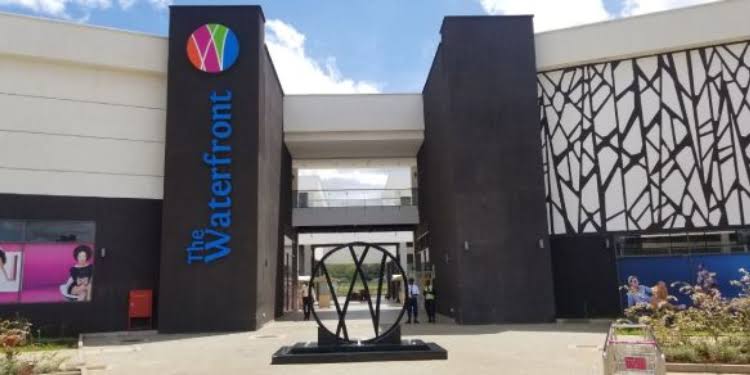
The family of the late billionaire businessman and poultry magnate Nelson Muguku is preparing to part with one of Nairobi’s most recognisable shopping destinations in what could become one of Kenya’s biggest commercial property transactions in recent years.
The Muguku family is in the final stages of negotiations to sell The Waterfront Karen Mall, with people familiar with the discussions indicating the deal could fetch as much as Sh9 billion if concluded.
The planned sale marks a significant shift for a family that, over a decade ago, invested heavily in real estate after gradually exiting the Nairobi Securities Exchange to diversify its wealth beyond banking and agribusiness.
Read Also: Kenyan marathoner remanded over Ksh8 million land fraud case
People close to the negotiations say talks have progressed considerably, although the transaction remains subject to several conditions that must be met before the deal can be completed.
The move comes at a time when Kenya’s retail property market is undergoing significant changes, with investors increasingly rethinking their exposure to large shopping malls as consumer behaviour evolves and rental returns come under pressure.
“We have been in the market and we believe we have a serious buyer on the table. There are some covenants that the buyer needs to meet to confirm the transaction is ongoing,” said Ken Obimbo, the property’s manager.
Changing Retail Landscape Drives Strategic Shift
Obimbo declined to reveal the identity of the prospective buyer or provide further details about the negotiations, citing confidentiality agreements signed during the ongoing discussions.
Although the Waterfront management has remained tight-lipped about the finer details, industry sources say the sale has been under consideration for several months as the family reviews its long-term investment strategy.
The Waterfront officially opened in 2018 with an estimated valuation of Sh3 billion and was positioned as one of Nairobi’s premium retail destinations.
Located in the affluent suburb of Karen, the development sits on approximately 13 acres within a larger 50-acre parcel, offering investors substantial room for future expansion.
The shopping centre spans about 200,000 square feet and currently counts Naivas Supermarket as its anchor tenant following the departure of South African retail giant Shoprite.
Plans for the remaining land initially envisioned a mixed-use development featuring luxury apartments, office blocks and a hotel, transforming the site into one of Nairobi’s largest integrated commercial developments.
However, sources familiar with the property say a significant portion of the land includes a man-made lake and surrounding swampy areas, reducing the amount available for future construction.
“Utility of the land is dependent on the existing mall and the fact that there is a man-made lake and swampy area,“ said a source familiar with the property.
Marketing documents prepared for potential investors several years ago nevertheless described the undeveloped acreage as one of the property’s biggest attractions.
The documents highlighted the scarcity of large parcels of land within Karen, describing the remaining acreage as a prime opportunity for high-end residential, commercial and recreational developments.
A Family Empire Built Beyond Poultry Farming

The proposed sale also reflects broader changes within Kenya’s commercial real estate sector.
During the past decade, developers invested heavily in shopping malls to cater for a rapidly expanding middle class with growing disposable income.
That construction boom saw several major retail centres open across Nairobi, including Garden City Mall, Greenspan Mall, Mountain Mall and Thika Road Mall.
Market conditions have changed considerably since then.
New retail developments have increased competition for tenants, while changing consumer preferences have shifted demand towards neighbourhood shopping centres rather than destination malls.
Knight Frank, one of Kenya’s leading real estate firms, recently reported that occupancy across prime retail properties under its management stood at 78 percent, highlighting the challenges facing large shopping centres.
According to the property consultancy, future growth is expected to favour mixed-use developments and community-based retail centres rather than traditional regional malls.
Supermarket chains have also adjusted their expansion strategies, increasingly opening outlets in middle-income estates instead of concentrating on premium shopping destinations.
The Waterfront itself has already adapted to those market dynamics by replacing Shoprite with Naivas after the South African retailer exited Kenya.
The mall continues to serve one of Nairobi’s most affluent neighbourhoods, but investors are becoming increasingly selective about long-term returns from retail property.
Nelson Muguku’s Lasting Legacy
The proposed sale represents another chapter in the evolution of the Muguku family’s investment portfolio.
Nelson Muguku built one of Kenya’s most successful business empires from modest beginnings as a poultry farmer in Kikuyu.
His success in agribusiness eventually expanded into banking, property and other investments, making him one of the country’s wealthiest entrepreneurs.
When he died in 2010 at the age of 78, his estate was estimated to be worth around Sh10 billion.
Much of that fortune came from Muguku Poultry Farm, one of Kenya’s leading hatcheries, and his sizeable investment in Equity Bank, where he ranked among the lender’s largest individual shareholders.
Read Also: Pharmacy Board Looks to Shape Future of Pharmaceutical Practice
At the time of his death, Muguku owned 6.08 percent of Equity Bank, making him the institution’s biggest individual shareholder.
The family has since disposed of that stake.
Analysts estimate the shares would today be worth more than Sh22 billion had they been retained.
Beyond poultry farming and banking, Muguku also assembled an extensive property portfolio that included prime commercial buildings on Nairobi’s Mfangano Street, substantial holdings in Kikuyu Town, Stanbank House on Moi Avenue and Cross Roads Shopping Centre.
The Waterfront became one of the family’s flagship real estate investments after they shifted capital from listed equities into property.
Now, more than a decade after embracing real estate as a key pillar of the family’s wealth, the planned disposal of the Karen mall signals another strategic shift as changing market realities reshape investment decisions.
Should the transaction be completed, it would rank among Kenya’s largest commercial property deals and underline how even the country’s wealthiest investors are reassessing their portfolios in response to evolving economic conditions.

