
Why President Ruto pushed Tata Chemicals out of Lake Magadi

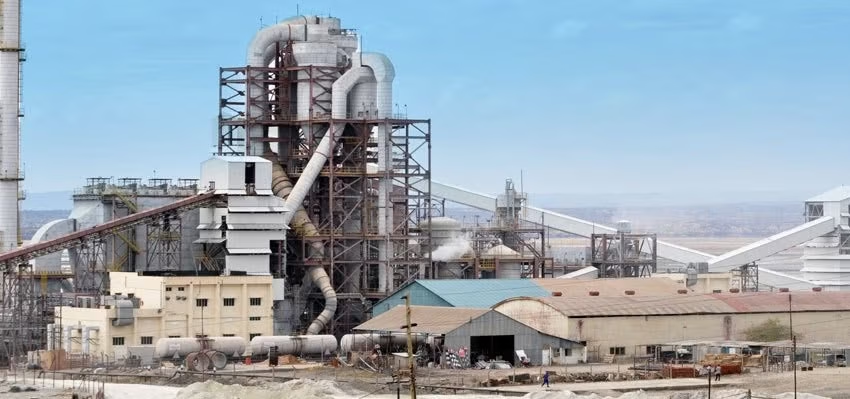
Tata Chemicals
A century of uninterrupted soda ash mining at the heat-shimmering basin of Lake Magadi has come to an abrupt, definitive end. President William Ruto, addressing residents during a developmental tour in Oloiren, Kajiado County, confirmed that the government directed multinational firm Tata Chemicals Magadi Limited to pack up its operations and vacate the region.
Beneath the blinding white crust of Lake Magadi lies one of the world’s richest natural deposits of trona, a mineral constantly replenished by geothermal springs and processed into natural soda ash. Millions of tonnes of this critical industrial material have crossed the globe to power manufacturing hubs in Asia, Europe, and the Middle East for over 100 years.
The surrounding landscape in southern Kenya, however, tells a remarkably different story. Local residents have watched heavy trucks rumble past dusty homesteads for decades while basic infrastructure, industrial employment, and domestic value creation remained stagnant.
President Ruto drew a firm line in the sand regarding this long-standing extraction model. Addressing the public in Kajiado, the Head of State noted that holding an exclusive extraction license for over a century without building processing factories or creating meaningful local jobs is an economic injustice the current administration will no longer accommodate.
Shipping unprocessed minerals out of African soil to build manufacturing capacity thousands of miles away undermines national development. The directive marks a high-stakes standoff between the Kenyan state and one of its oldest multinational operators, shifting the national conversation from traditional corporate extraction to strict resource sovereignty.
The groundwork for the exit began earlier when Mining, Blue Economy, and Maritime Affairs Cabinet Secretary Hassan Joho ordered an immediate suspension of TCML’s operations under powers granted by the Kenya Mining Act. The ministry cited years of statutory non-compliance, including unresolved royalty reconciliations, inadequate export reporting, weak Community Development Agreements (CDAs), and the total absence of a local mineral beneficiation strategy.
The company submitted extensive regulatory documentation to the ministry asserting full compliance and highlighting its social responsibility programs in water, education, and healthcare. The government responded by clarifying that community philanthropy cannot replace structural industrialization and statutory compliance.
The Mandate for Local Processing and Value Addition
Moving forward, the state plans to award the coveted soda ash mining license to a new investor under non-negotiable operational conditions. Any firm stepping into the vast salt flats of Magadi must establish a major glass manufacturing plant and a dedicated chemical production facility directly within Kajiado County.
Soda ash is an essential raw material in manufacturing container glass, flat architectural panels, detergents, and specialized industrial chemicals. Forcing domestic processing keeps the most profitable stages of the industrial value chain inside Kenya, turning local trona into finished consumer products.
Building a domestic glass plant in Kajiado offers immediate advantages. Expanding local manufacturing capabilities supplies regional construction, pharmaceutical, and beverage industries directly—drastically reducing Kenya’s heavy reliance on imported glass products.
Breaking the Legacy of Unprocessed Exports
The decision to sever ties with a legacy operator sends a clear signal to the entire extractive sector across East Africa. Developing nations have historically suffered from the resource curse—a cycle where raw minerals leave unrefined while host communities manage environmental impacts without receiving lasting economic benefits.
Insisting on local factories ensures that host communities derive tangible, permanent assets from the natural wealth right in their backyards. The policy aligns with the economic framework outlined in the Kenya National Development Plan, prioritizing local content enforcement, industrial self-reliance, and rigorous regulatory oversight.
Attention now shifts to the Ministry of Mining as it manages the transition and reviews incoming proposals for the Lake Magadi concession. Safeguarding the livelihoods of hundreds of local workers and contractors during the transition remains a top priority for county and national leadership.
The conclusion of TCML’s 100-year run represents a historic turning point for the people of Kajiado. The expectation is clear: the white waters of Lake Magadi must finally power local factories, permanent employment, and genuine industrial progress for the community that lives alongside them.