
AFCON 2027 Stadium Deadlines: CAF Inspection Mandate, Kasarani Turf Overhaul & Talanta Arena Progress

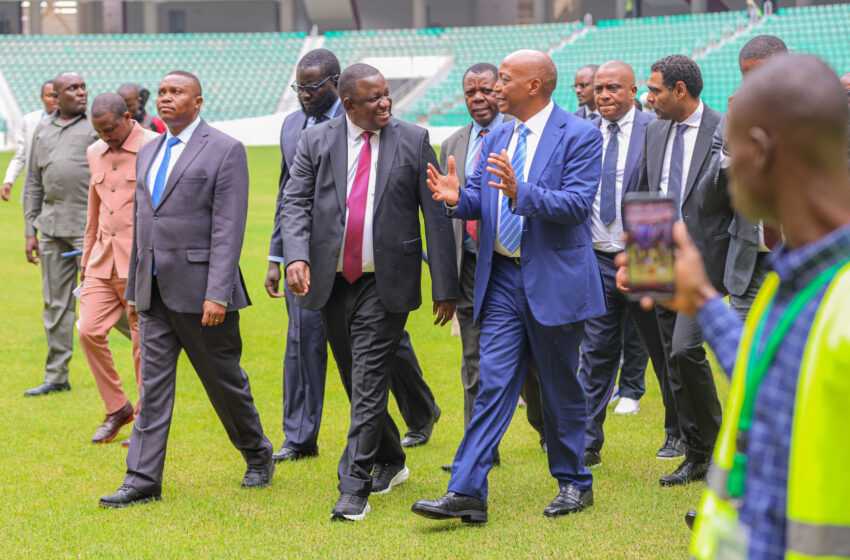
Kenya’s preparations for the 2027 Africa Cup of Nations have entered a decisive phase, with CAF inspections shifting attention from construction progress to whether stadiums can actually operate at tournament level.
The deadline is becoming clearer. CAF President Patrice Motsepe has said the three East African co-hosts — Kenya, Uganda and Tanzania — need to start using their stadiums for testing from January 2027, meaning the key facilities must be substantially operational before the end of 2026.
The tournament is scheduled to run from June 19 to July 17, 2027, giving organisers less than nine months from the latest September 2026 inspections to move from construction and refurbishment into full operational testing.
Read Also: Pharmacy Board Looks to Shape Future of Pharmaceutical Practice
Kenya’s position is built around several facilities, with the Raila Odinga International Stadium at Talanta, Moi International Sports Centre Kasarani and supporting training venues forming a major part of the country’s infrastructure programme.
The latest inspection by Motsepe has therefore placed renewed focus on what remains to be completed — and whether the venues can be tested early enough to identify and correct problems.
CAF Testing Window Puts 2026 Deadlines Under Pressure
CAF’s approach goes beyond checking whether a stadium has seats, floodlights and a football pitch.
The continental body has been conducting technical assessments covering pitches, safety, security and infrastructure, while its wider inspection programme also examines training venues, hotels, airports, transport and other tournament-support systems.
A CAF delegation completed an eight-day inspection across Kenya, Uganda and Tanzania in September, with Kenya’s newly constructed Talanta Stadium among the facilities assessed. The delegation included officials responsible for competitions, safety and security, transport, marketing, media, television and logistics.
That breadth matters because AFCON readiness is not simply a construction exercise.
A stadium can be structurally complete but still require testing of ticketing systems, broadcast infrastructure, security arrangements, player facilities, media operations, lighting and pitch performance.
Motsepe’s September visit reinforced that distinction.
After meeting President William Ruto in Nairobi, the CAF president visited Talanta and Kasarani. CAF said he was impressed by progress at Talanta but provided feedback on work that still needed to be completed at Kasarani.
The next stage is therefore less about unveiling buildings and more about demonstrating that the facilities can function under match conditions.


AFCON 2027 Kenya Stadium Progress at a Glance
| Venue Name | Seating Capacity | Primary Work Scope | Target Completion Window |
|---|---|---|---|
| Talanta Stadium (Ngong Rd) | 60,000 | New construction, structural framework & broadcast hubs | Late 2026 |
| Kasarani Stadium (MISC) | 45,000* | Hybrid Bermuda turf, VAR systems, VIP redesign | December 2026 |
| Kipchoge Keino (Eldoret) | 15,671 | Capacity expansion, track relaying, modern changing rooms | Late 2026 |
*Recent reporting varies on Kasarani’s capacity depending on whether the figure refers to its established configuration or planned upgrade. Current reports describe substantial expansion and refurbishment.
Kasarani Stadium Hybrid Turf Upgrade Becomes Central
Kasarani represents a different challenge from Talanta because the Nairobi facility is an existing stadium undergoing extensive rehabilitation rather than a completely new build.
The playing surface has become one of the most technically important components.
Recent reports indicate that the old pitch has been removed as engineers work on the underlying layers, drainage and grading before installation of a hybrid Bermuda-grass surface. Sports Kenya technical officials have been overseeing grading and preparation work aimed at achieving appropriate levels, base-course depth and drainage gradients.
Read Also: Top Comoros Official Hospitalized in Nairobi Amid Rising Tensions in Moroni
The pitch is not being treated as a cosmetic replacement.
A modern international football surface has to manage heavy rainfall, intensive use and drainage requirements while providing a consistent playing surface. That makes the work below the grass almost as important as the grass itself.
Recent updates have also outlined several other improvements at Kasarani, including 2,000-lux floodlighting, animation screens, VAR infrastructure, automated ticketing, upgraded changing rooms and improved media facilities.
The spectator canopy has also been reported as nearing completion, while VIP and VVIP hospitality areas are being upgraded.
These changes show why Kasarani’s AFCON preparation cannot be measured simply by looking at the pitch.
The venue has to operate as an integrated matchday environment.
Ticketing must work. Broadcast areas must support international television production. VAR infrastructure must be integrated into match operations. Dressing rooms must meet required standards. Spectator movement and hospitality areas must function safely.
That is why the December 2026 window is significant.
Talanta Stadium Moves From Construction to Commissioning
Talanta Stadium, officially known as the Raila Odinga International Stadium, represents the other major side of Kenya’s AFCON infrastructure programme.
The 60,000-seat facility at Jamhuri Grounds along Ngong Road has been designed as a new multi-purpose sporting venue rather than a renovation of an older stadium.
The State Department for Sports reported in June that the project was roughly 91% complete, with the main structure, seating bowl and roofing substantially advanced. Workers were then focusing on ICT and broadcast systems, spectator facilities, fencing and landscaping, while the hybrid pitch was undergoing turf management.
The CAF inspection in September provided another important checkpoint.
CAF specifically confirmed that its delegation inspected the newly constructed 60,000-capacity Talanta Stadium as part of the wider assessment of Kenya’s tournament infrastructure.
That means the project’s remaining stages are increasingly about finishing and operational readiness.
Broadcast systems are particularly important because an AFCON venue must accommodate international television production, media operations and communications infrastructure.
The stadium also needs reliable spectator access, security systems, medical facilities, team areas and hospitality operations.
Government officials have repeatedly linked Talanta’s development to the wider objective of leaving Kenya with a major sporting venue after AFCON 2027.
Its usefulness will therefore extend beyond the tournament if the facility can sustain football, athletics, concerts and other large-scale events.
Talanta’s Long-Term Value Depends on What Happens After AFCON
The most obvious measure of Talanta’s success will be whether it is ready for AFCON.
Its longer-term value, however, will depend on what happens after the tournament.
A 60,000-seat stadium requires regular maintenance, professional management, commercial programming and sustained investment.
The same applies to Kasarani.
The AFCON deadline provides the immediate reason for upgrading both facilities, but the infrastructure is expected to serve Kenyan sport for years.
Talanta’s broadcast and hospitality facilities could support international football and athletics, while Kasarani’s renovation could improve the country’s ability to host major competitions.
That makes the commissioning phase important beyond June 2027.
Kipchoge Keino Stadium Adds Eldoret to the Infrastructure Plan
The third venue in the supplied infrastructure matrix is Kipchoge Keino Stadium in Eldoret.
The facility is being upgraded from its previous 9,248-seat configuration to 15,671 seats, alongside new concrete grandstands, a spectator canopy, VIP improvements, a tartan athletics track and an upgraded football pitch.
The project is also intended to provide modern changing rooms and other supporting facilities.
Kipchoge Keino is particularly important because it gives Eldoret a modern sporting venue capable of supporting both athletics and football.
Recent reports have placed the project’s completion target in September 2026, although earlier project documentation had pointed to a longer construction window extending towards the end of 2026.
That difference illustrates why completion dates should be treated as project targets until the facility has been handed over, tested and cleared for its intended use.
The stadium’s role in the AFCON programme is also different from that of the main Nairobi venues. It is being developed as a training facility rather than necessarily serving as one of the principal match venues.
Testing Will Be the Real Measure of Readiness
Kenya’s stadium programme has reached a point where construction percentages tell only part of the story.
CAF’s September inspection included specialists from several operational departments, demonstrating the number of systems that have to work together before the tournament.
The January 2027 testing window mentioned by Motsepe effectively means that the major construction and rehabilitation tasks must leave enough time for commissioning.
That process can reveal problems that are difficult to identify during construction.
Floodlights have to perform consistently.
Broadcast systems must support live international production.
Ticketing and turnstiles need to handle large crowds.
VAR equipment has to integrate with match operations.
The pitch needs to withstand competitive football and weather conditions.
Security and emergency systems must also function as planned.
The same principle applies outside the stadium.
Read Also: Kenyan marathoner remanded over Ksh8 million land fraud case
CAF’s inspection programme has already included training venues, hotels, airports and other infrastructure.
Kenya therefore has to think about AFCON readiness as an interconnected system rather than three stadium projects.
What Salim Mvurya’s Updates Mean for the Countdown
Sports Cabinet Secretary Salim Mvurya has remained closely involved in the infrastructure programme, including inspections of Talanta.
Kenya News Agency reported in June that Mvurya said the country had moved beyond paying the hosting fee and was focused on delivering the infrastructure required for the tournament.
CAF’s latest inspection gives those government updates an external technical checkpoint.
The significance is not simply whether officials report that a project is progressing.
The important question now is whether the facilities can pass CAF’s technical and operational assessments before the tournament.
That distinction should shape the final months of preparation.
Kenya’s AFCON Countdown Has Entered Its Most Technical Phase
Kenya’s preparations have moved considerably since CAF technical teams began inspections earlier in 2026.
The continental body first identified Kasarani, Nyayo, Talanta and training sites for inspection in February.
By September, CAF had returned for another detailed assessment, while Motsepe personally inspected Talanta and Kasarani.
PAY ATTENTION: Follow Kenya Frontline WhatsApp channel for more news
The message from CAF is therefore becoming increasingly operational: the venues must not only be built, but tested and made ready for international competition.
Kenya’s immediate priorities are clear — complete outstanding construction, finish the Kasarani pitch and technical systems, commission Talanta’s infrastructure, finalise training facilities and allow enough time for testing and corrections.
The FKF Premier League venue allocation debate also provides useful context on why stadium standards matter beyond AFCON, particularly around ground certification, safety and matchday infrastructure. FKF Premier League venue coverage on Kenya Frontline
Kenya’s national-team preparations will also provide another operational test, with the Harambee Stars AFCON 2027 qualifier schedule already mapped out for the September 2026 international window and subsequent FIFA windows. Harambee Stars AFCON 2027 qualifier coverage on Kenya Frontline
The decisive period is now the transition from construction to certification.
Talanta, Kasarani and the supporting facilities have to move from being projects under development to functioning football venues.
That is the standard CAF will ultimately assess — and the reason why the final months of 2026 could prove more important than the construction milestones that came before them.

