
How Linda Mwananchi tour exposed Homa Bay stalled road network

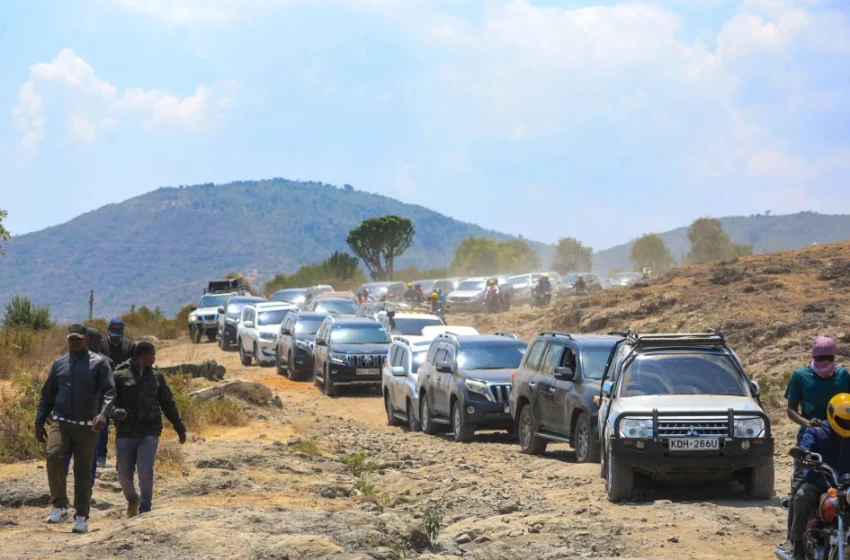
IMAGE: Courtesy
Sometimes official administration updates out of Homa Bay County paint a picture of rapid infrastructural modernization, but real-world conditions on the ground tell a completely different story.
Press briefs showcase heavy earthmovers, statistics highlight hundreds of kilometers of newly opened rural access roads, and high-profile launches promise bitumen-standard highways connecting agricultural hubs to Lake Victoria’s economic ports. Yet, the day-to-day reality for residents remains defined by neglected earthworks, endless dust, and broken timelines.
That sharp contrast was exposed when the opposition-aligned Linda Mwananchi movement brought its countrywide accountability tour to Homa Bay.
PAY ATTENTION: Follow Kenya Frontline WhatsApp channel for more news
What was intended to be a smooth political traversal across the county quickly turned into a physical test of endurance against neglected infrastructure. As the motorcade rolled across key sub-counties—eventually making its way into Sindo in Suba South—the reality of Homa Bay’s road network came into clear, unfiltered view.
The Promises on Paper

Under both national government programs and local administration development frameworks, Homa Bay has seen numerous road projects tendered and launched. Major corridors, including rural connectors like the Nyabera–Nyatoto–Junction Koguta road and various ring roads across Suba and Ndhiwa, were slated for upgrades.
State agencies such as the Kenya Rural Roads Authority (KeRRA) continuously advertise tenders for routine maintenance, spot improvement, and drainage structures meant to keep these critical arteries passable year-round.
On paper, millions of shillings are funneled into earthworks, grading, and compaction. Local leadership points to expanding access to markets, schools, and health facilities as proof of progress.
However, residents living along these stretches feel progress has been agonizingly slow. Many projects stall shortly after earthmovers clear the topsoil, leaving vast stretches of unpaved, uncompacted murram exposed to the elements. During rainy periods, the routes collapse into impassable mud tracks; during dry spells, they turn into choked corridors of heavy, blinding dust.
The Exposure in Motion
When the Linda Mwananchi convoy entered the county, the physical realities of these incomplete projects immediately caught up with the narrative. Navigating towards Sindo, the convoy encountered long stretches of dusty, broken terrain that severely tested vehicle suspensions and slowed the tour’s itinerary.
Rather than sweeping past on smooth tarmac, leaders and accompanying media spent hours kicking up thick dust plumes on routes that were supposed to be nearing completion or active maintenance.
Footage captured during the journey showed high-clearance vehicles fighting rough ruts and uneven grading—a daily ordeal for local matatus, bodaboda operators, and traders attempting to move agricultural produce to market centers.
The tour did more than highlight structural discomfort; it provided a platform for frustrated local residents. As the convoy passed through rural trading centers, crowds gathered along the roadside—not just to witness the political spectacle, but to point at the very roads under their feet.
The dusty conditions served as a tangible backdrop to widespread grievances regarding delayed contractor handovers, poor drainage installation, and questionable workmanship on roads that had supposedly received funding allocations.
The Sindo Entrance and The Reality Check

By the time the motorcade reached Sindo, where a mammoth crowd had assembled to receive the leaders, the road issue had become a central theme of the visit. The physical toll of the journey was evident on every vehicle in the convoy, coated in layers of reddish county dust.
Addressing the massive gathering in Sindo, leaders—including Nairobi Senator Edwin Sifuna—capitalized on the journey’s ordeal to call out local and national authorities over stalled infrastructure. The condition of the road leading directly into the trading center served as exhibit A of what locals endure every day: high transport costs, damaged vehicles, and severe respiratory strain from persistent dust clouds.
In Homa Bay, the Linda Mwananchi visit pulled back the curtain on the gap between project planning and ground execution. While administrative portals continue to list projects as active or ongoing, the dusty motorcade drive into Sindo proved that ordinary citizens only consider a road complete when it is paved, durable, and usable.
Until then, the contrast between official reports and rural reality remains as stark as the dust left in the wake of the passing convoy.