How Safaricom deal left Sh14 billion hole in public pockets

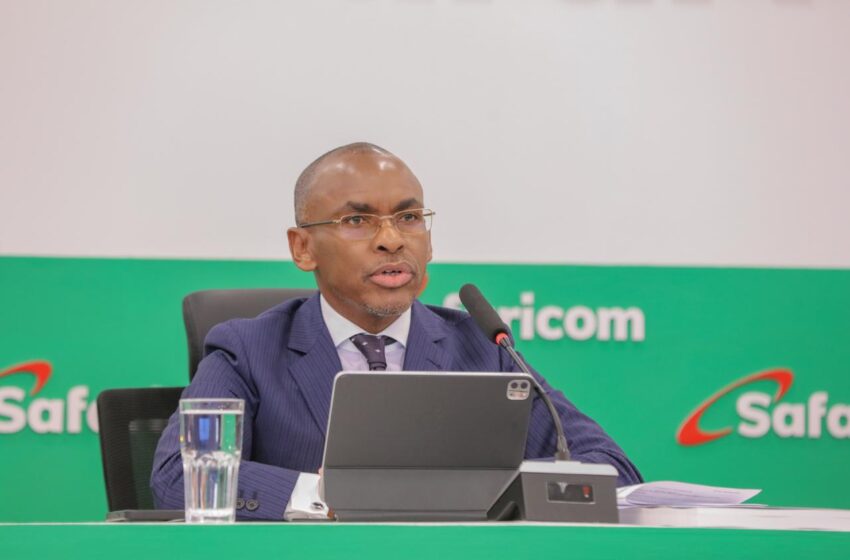
The Chief Executive Officer of Safaricom Group PLC is Dr. Peter Ndegwa (CBS)
Sometimes the most expensive lessons in public finance are written in the quiet margins of parliamentary reports that nobody was supposed to interrogate too closely. When the Kenya National Treasury and the National Assembly decided to offload a massive 15 per cent stake in Safaricom PLC to Vodacom Group, official rhetoric framed the transaction as a masterstroke of pragmatic asset optimization.
Government communicators promised that the immediate cash infusion would unlock critical capital for national infrastructure projects without expanding the public debt burden. Beneath the polished press releases and carefully staged parliamentary approvals lies a starkly different narrative—one where expert technical advice was systematically buried to expedite a deal that shortchanged Kenyan taxpayers by at least Sh14.3 billion.
The mechanism of this financial shortfall was surprisingly straightforward. When the state prepares to divest from its crown jewel assets, statutory protocol calls upon the Kenya Institute of Public Policy and Research Analysis (KIPPRA) to conduct an exhaustive valuation.
Established by law to bridge scientific economic analysis and executive policymaking, KIPPRA evaluated the proposed divestiture of over six billion shares. Their rigorous economic modeling produced a firm recommendation: the government should set a baseline minimum selling price of Sh36.38 per share, while simultaneously leveraging competitive tender processes to push that figure higher.
Instead of treating KIPPRA’s technical guidance as a sacred baseline for public asset stewardship, executive and legislative authorities closed ranks around a significantly lower figure. The joint committee overseeing the deal adopted an offer price of Sh34 per share negotiated directly with Vodacom. That seemingly modest gap of two shillings and thirty-eight cents per share instantly wiped away Sh14.3 billion in potential public revenue, reducing total sale proceeds from Sh218.3 billion to Sh204 billion.
“Based on KIPPRA and other available valuations by investment banks, the National Treasury can consider setting the minimum selling price at Sh36.38 and negotiating for a higher selling price or subjecting the process to a competitive bidding,” the state think-tank explicitly warned lawmakers in a memorandum submitted during stakeholder engagements as per Nation.
Yet, when the joint committee of the National Assembly delivered its exhaustive 122-page final report recommending approval of the transaction, KIPPRA’s name had vanished entirely. The institutional think-tank that had provided the primary scientific valuation for the state was omitted from the listed list of consulted stakeholders. Its warnings regarding pricing, long-term fiscal exposure, and procedural transparency were completely airbrushed out of the parliamentary record.
The Phantom Trade-Off
To justify bypassing open market dynamics, official channels argued that direct negotiations with Vodacom preserved market stability and eliminated execution risks. Treasury Cabinet Secretary John Mbadi publicly defended the transaction layout, emphasizing Vodacom’s existing footprint within the telecommunications giant.
“The proposed buyer was a long-standing investor in Safaricom, holding approximately 40 per cent through Vodafone Kenya, and had deep regional experience and a track record in capital investment,” Treasury Cabinet Secretary John Mbadi stated, arguing that consolidating Vodacom’s position would guarantee long-term operational continuity.
While political leadership championed immediate execution speed, independent analysts pointed out that bypassing competitive bidding fundamentally undermined price discovery. Under Section 34(b) of the Privatisation Act, public share disposals are structured to invite competing international tenders precisely to maximize taxpayer returns. By restricting the transaction to a private room negotiation with an existing insider shareholder, the state surrendered its strongest bargaining leverage.
Financial implications extend far beyond the immediate Sh14.3 billion haircut on the principal sale price. Safaricom is not a struggling state enterprise requiring a taxpayer bailout; it is an extraordinary cash generator that underpins Kenya’s broader digital economy. By surrendering 15 per cent of its equity, the state is permanently severing a vital stream of annual dividend inflows that have historically bolstered the national exchequer.
“The forgone dividends would be much higher than the Sh204 billion,” KIPPRA warned in its suppressed technical paper, pointing out that over the next three decades, the government stands to forfeit upwards of Sh1.2 trillion in recurring dividend payments.
Historical data underscores the weight of this warning. Over the preceding decade, Safaricom maintained an average earnings per share growth rate of 8.7 per cent, alongside an aggressive dividend payout ratio averaging 77.8 per cent. At current dividend rates alone, the sold stake contributed over Sh7.2 billion annually toward budget operations. Over a 30-year horizon, even conservative projections show foregone revenues compounding to Sh121.89 billion in the first decade, Sh280.72 billion in the second, and a staggering Sh745.92 billion between 2045 and 2055.
Macroeconomic Ripples and Currency Vulnerability
Erosion of future fiscal space is only one half of the structural risk profile. Transferring a larger equity chunk to a foreign entity introduces severe, long-term foreign exchange pressures. Prior to the transaction, Vodacom’s effective 40 per cent stake generated roughly Sh19.2 billion in annual dividend outflows. With its stake expanding to 55 per cent, that dividend allocation leaps to approximately Sh26.4 billion annually.
“The foreign currency-related pressure may devalue the Kshs,” KIPPRA observed in its technical notes, highlighting that repatriating vastly expanded dividend volumes requires converting billions of local currency into foreign denominations year after year.
Currency devaluation carries immediate consequences for Kenya’s sovereign debt management. With nearly 60 per cent of the nation’s external debt denominated in US dollars, any sustained weakening of the shilling forces the Treasury to allocate significantly more domestic tax revenue simply to service interest and principal obligations on foreign loans. The short-term windfall obtained to fund infrastructure projects today may ultimately trigger far higher debt-servicing costs tomorrow.
Minority Shareholders Left in the Dark
Equally troubling is the treatment of over 533,000 retail and institutional minority investors who collectively hold nearly a quarter of Safaricom’s equity. Rather than employing a phased public offering model that would offer equal participation, price transparency, and fair notice to the broader market, the transaction was concluded behind closed doors.
“While the Safaricom transaction preserves minority shareholders’ legal and economic rights, it falls short of best practice standards on procedural fairness, predictability and equal access,” KIPPRA noted in its evaluation.
Public strategic assets carry an implicit trust factor. Safaricom isn’t merely a corporate entity; it powers M-Pesa, processing over Sh111 billion in daily financial transactions and controlling nearly 90 per cent of Kenya’s mobile money ecosystem. When state custodians dispose of key stakes in such foundational infrastructure without explicit, itemized public reporting on where every shilling will be spent, public confidence inevitably erodes.
Capital markets thrive on transparency, institutional rigor, and predictability. When state organs actively ignore their own scientific think-tanks to fast-track undervaluation deals, the immediate balance sheet might look balanced for a single fiscal quarter. In the broader accounting of national trust and long-term economic stability, however, the real cost of disregard is always paid by the public.