
‘I Don’t Need a Medal to Prove That’- Akani Simbine on Redefining Success in Athletics

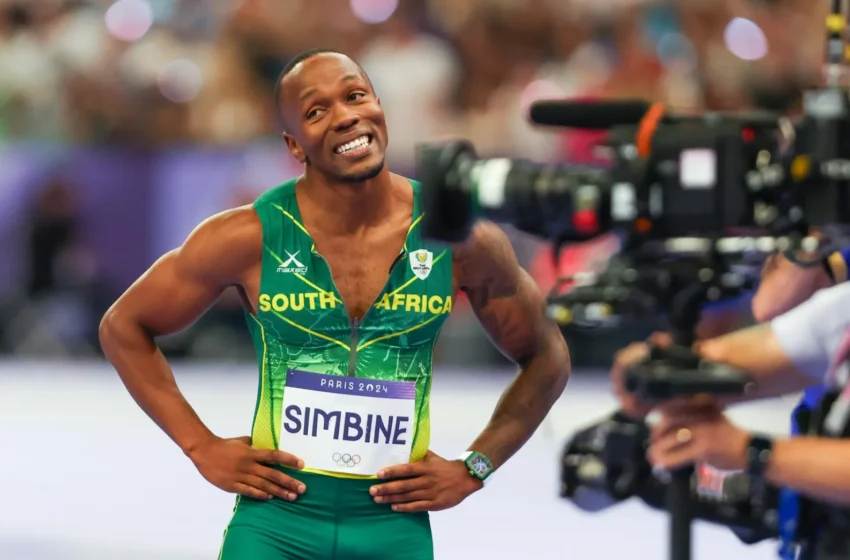
South African sprint star Akani Simbine has long been the standard-bearer for a continental revolution that has fundamentally shifted the perception of African athletics.
Since 1940’s the world has associated African running strictly with the grueling endurance of marathon legends from the Rift Valley. Simbine changed that narrative, proving that the cradle of humankind could produce explosive power to rival the best in the Caribbean and North America.
Journeying through the ranks, his career is not merely defined by a single race or a solitary moment of glory, but by an unprecedented decade of elite performance. While many sprinters flicker brightly for a season or two before fading due to injury or inconsistency, Simbine has remained a permanent fixture in global finals.
Such a relentless presence has turned him into the foundational pillar upon which the current “golden age” of African sprinting,featuring stars like Ferdinand Omanyala and Letsile Tebogo,is built.
The true weight of his career was recently encapsulated by South African Sports Minister Gayton McKenzie, who highlighted a record that even the greatest of all time could not match.
“In April 2025, in Gaborone, Akani became the only athlete in the history of this sport to run under 10 seconds in the 100m for 11 consecutive years. The record he broke belonged to Usain Bolt, who managed 10. That is how we talk about Akani Simbine now. He is the King of Consistency. And if the 2026 season goes the way his career tells us it will, he will make it 12,” he said as per Daily Maverick.
Why is a 12-season streak considered legendary?
Running sub-10 seconds for 12 consecutive seasons requires a level of professional discipline and physical maintenance that is almost alien to the sport. Simbine’s 50 sub-10 performances are a testament to a man who refuses to decline. Even at 32, an age where many sprinters transition into retirement, he continues to lower his own national records, as seen with his blistering 9.82 seconds at the Paris 2024 Olympics.
Beyond the digital clock at the finish line, Simbine’s impact stretches into the realm of mentorship. Evidence of this transition from competitor to pioneer was seen during the inaugural Simbine Classic held in April 2026. Bringing Olympic champions like Andre De Grasse to Pilditch Stadium in Pretoria allowed him to create the infrastructure he once lacked, ensuring the next generation of South African speedsters has a world-class platform on home soil.
Younger athletes like Bayanda Walaza view him not just as a teammate, but as a selfless mentor who actively seeks to be surpassed by his pupils.
“What I like about him is he’ll never make you feel like you are lower than him. Even when you’re with him, he won’t act bigger than you. He makes you feel like you’re on the same level. He’ll tell you, ‘Whatever I’ve done, I want you to do more.’ He wants us to achieve even the dreams he couldn’t.”
How can an athlete define success without a solo gold?
Humility remains the most defining trait of the “Sub-10 King.” Despite the heartbreak of finishing fourth in multiple Olympic and World Championship finals—often by the thinnest of margins—Simbine has rejected the “nearly man” label. He views his career through a lens of gratitude and global standing rather than just silverware.
In his own words, the absence of a solo major gold medal does not diminish the reality of his status as one of the fastest humans to ever live.
“Having that tag as the nearly man, it’s noise at the end of the day. I don’t see it like that. I see it as never giving up on trying to be the best. I always show up. I get disappointed, but my family says being disappointed with fourth in the world is a bit crazy – because you are the fourth fastest person alive.”
Simbine continues to lead the South African relay teams to podium finishes, including silver at the 2026 World Relays, ensuring his legacy is secure. He remains the bridge between the past and the future, a game-changer who proved that for an African sprinter, the finish line is only the beginning of a much larger story.

