
Justin Gatlin Analyzes Micro-Margins of Letsile Tebogo’s Night in Gaborone

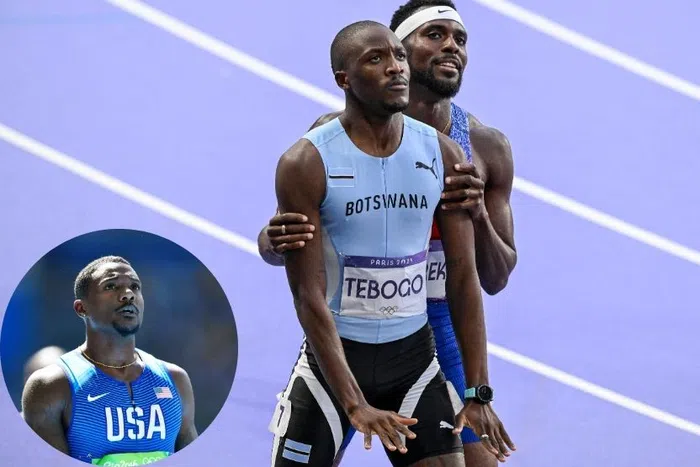
American sprint legend Justin Gatlin believes that if Letsile Tebogo had solely focused on the men’s $4\times400$m relay at the World Athletics Relays in Gaborone, Botswana, then the world record would have been shattered.
The assessment comes in the wake of a historic performance on home soil where the Botswana quartet of Lee Eppie, Letsile Tebogo, Bayapo Ndoro, and Collen Kebinatshipi sent the Gaborone National Stadium into a frenzy.
Clocking a championship record time of 2:54.47, the team claimed top honors and cemented their status as global powerhouses, yet they remained a tantalizing 0.18 seconds shy of the all-time mark.
The current world record of 2:54.29 has stood for over three decades, established by the formidable United States team of Andrew Valmon, Quincy Watts, Butch Reynolds, and Michael Johnson during the 1993 World Championships in Stuttgart. For thirty-one years, that time has been viewed as nearly untouchable.
Botswana 4x400m Relay World Record Analysis
However, the performance in Gaborone suggested that the “untouchable” was finally within reach. Gatlin, a man who understands the nuances of peak performance better than most, points to the heavy workload carried by Botswana’s star athlete as the deciding factor that kept the record in American hands.
Just before competing in the men’s $4\times400$m relay final, Letsile Tebogo was fresh from competing in the men’s $4\times100$m relay heats. In that preliminary round, the reigning Olympic 200m champion displayed his versatility and raw speed by anchoring his team to a national record time of 37.96 seconds.
“If Tebogo did not have to prepare for the 4×1 and still ran on this relay team, we would have probably seen a world record. And it’s that close…2:54.47 to 2:54.29, just like that. So, if that’s the case, they are poised to break a world record. They know that,” Justin Gatlin said on the Ready Set Go podcast as perPulse Sports.
While the effort secured a place for the shorter relay team, it required an explosive output of energy that Gatlin argues was vital for the grueling 400m distance later that evening. In the subsequent $4\times100$m final, Botswana finished a distant sixth in 38.35 seconds,a race in which Tebogo did not participate,likely to preserve his legs for the $4\times400$m showdown.
However, Justin Gatlin believes that even the exertion from the $4\times100$m heats was enough to take the “edge” off Tebogo’s performance in the longer relay. The $4\times400$m final saw Botswana push the limits of human speed, fending off fierce competition from South Africa and Australia, who finished in 2:55.07 and 2:55.20 respectively.
Gatlin posits that had Tebogo entered the final with completely fresh legs, untaxed by the 100m anchor leg, those missing 0.19 seconds would have been easily found.
A Legacy of Speed: Gatlin’s Own Records
Justin Gatlin is no stranger to the pressure of the clock. Throughout his storied and often debated career, he established himself as one of the fastest men in history.
His personal best of 9.74 seconds in the 100m (set in 2015) and 19.57 seconds in the 200m remain among the quickest times ever recorded.
Gatlin famously claimed the Olympic 100m gold in 2004 and secured multiple World Championship titles, most notably defeating Usain Bolt in the Jamaican’s final individual 100m race in 2017.