
Kenya Creative Rights Framework 2026: Live Broadcast Licensing, CMO Royalty Audits & Digital Content Copyright Enforcement

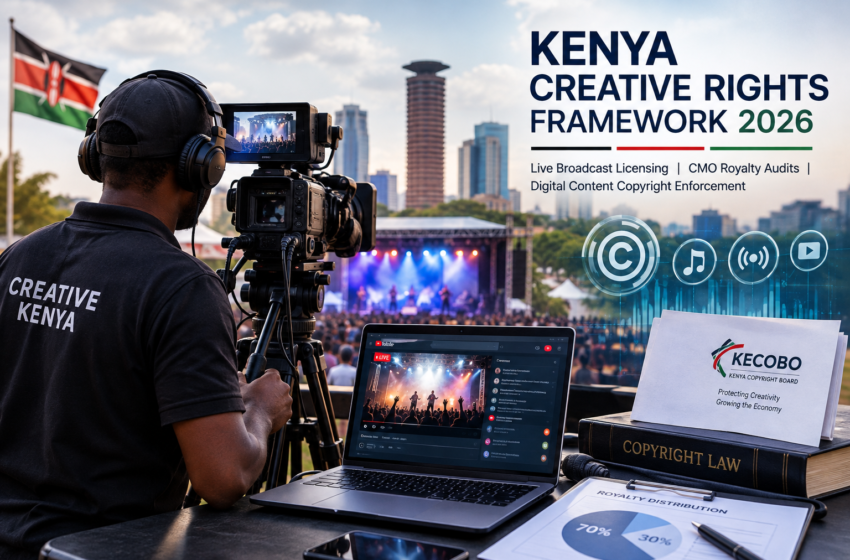
Kenya’s creative economy is increasingly operating online, making copyright compliance an important consideration for musicians, filmmakers, broadcasters, influencers, independent journalists and digital content creators.
The Kenya Copyright Board (KECOBO) remains responsible for administering copyright and related rights, including licensing and supervising Collective Management Organizations (CMOs). The Copyright Act gives creators exclusive rights over important uses of their works, including reproduction, communication to the public and broadcasting.
For creators and online media outlets, the copyright framework is particularly relevant to live event streaming rights in Kenya, music licensing, royalty collection and the protection of digital productions.
At the same time, the regulation of CMOs has placed greater emphasis on financial accountability, royalty distribution and the use of digital systems to monitor copyrighted works.
Read Also: Pharmacy Board Looks to Shape Future of Pharmaceutical Practice
CMO Revenue Audit Standards and Royalty Accountability
Collective Management Organizations play a central role in Kenya’s copyright system because they collect royalties from users of protected works and distribute the money to rights holders.
KECOBO has regulatory powers over CMOs, including monitoring their operations and requiring financial and other information relating to their activities.
The Kenya Copyright Board has also promoted digital systems for CMO royalty management, including licensing, media monitoring and distribution functions. The system is intended to improve the tracking of copyrighted works and the distribution of royalties to rights holders.
This makes Kenya Copyright Board CMO audits in 2026 an important issue for artists and other creators who depend on collective licensing arrangements.
The audit process is not simply about determining how much money was collected. It can also involve examining records, royalty distribution, membership information, administration costs and the systems used to identify and monitor copyrighted works.
KECOBO has previously required CMOs to accept forensic audits and submit information relating to their financial and operational activities.
The 70:30 Royalty Distribution Requirement
One of the most important issues in Kenya’s CMO system is the 70:30 royalty distribution framework.
KECOBO licensing conditions have required CMOs to set aside 70 percent of collected funds for distribution, subject to the applicable regulatory requirements and approved administrative budgets.
The framework is intended to ensure that a substantial portion of money collected from users of copyrighted works reaches the artists and other rights holders rather than being absorbed by administrative expenses.
KECOBO has also required licensed CMOs to use approved ICT systems for collections, licensing, media monitoring and royalty distribution.
For creators searching for information about digital creator royalty payouts in Nairobi and across Kenya, this is an important part of understanding how collective rights management is supposed to operate.
Digital and Live Streaming Copyright Compliance
The growth of Facebook Live, YouTube, TikTok and other digital platforms has created new copyright challenges for Kenyan media outlets and independent creators.
A live stream may appear to be an original production because the camera operator is producing the video. However, music, performances, video clips, photographs, graphics and other material incorporated into the production can belong to different copyright owners.
KECOBO’s official copyright in streaming guidelines explain that streaming involves copyright rights including distribution and making works available to the public.
This means a creator filming a live concert, sporting event, conference or public performance needs to consider more than ownership of the camera footage.
The music playing at the venue may belong to a composer, performer or producer. A performance may involve performers’ rights. Recorded material played during an event may involve sound-recording rights.
The event organizer may also have contractual restrictions concerning recording or retransmission.
For Kenyan online publishers, this creates an important distinction between owning footage and owning every copyright embedded in that footage.
A media organization can record its own live video while still needing permission for third-party music or other protected material incorporated into the production.
What Digital Creators Need to Check Before Going Live
Creators preparing a live production should establish who owns the material being used before the broadcast starts.
This is particularly important where a production contains commercial music, recorded performances, television footage, sports broadcasts, film clips or other third-party content.
A creator should keep evidence of licences, permissions and contracts where those rights have been obtained.
Read Also: Top Comoros Official Hospitalized in Nairobi Amid Rising Tensions in Moroni
This can become important if a platform removes the content or a rights holder later challenges its use.
Creators should also distinguish between material they have permission to use and material that happens to be publicly accessible.
A song available on a streaming platform, for example, is not automatically cleared for incorporation into a commercial live broadcast simply because the creator can listen to it online.
The same principle applies to video clips downloaded from social media. Public availability does not by itself transfer copyright ownership.
Media organizations looking at commercial use of music can also review Kenya Frontline’s guide on KECOBO tariffs, CMO licensing rules and venue compliance, which examines the current copyright licensing framework and 2026–2028 tariff structure.
Digital Enforcement and Takedown Notices
Kenya’s copyright framework provides mechanisms for dealing with online infringement.
A creator whose protected work is uploaded online without authorization can use the applicable copyright enforcement mechanisms to seek removal of infringing material.
This is increasingly important for musicians, photographers, filmmakers, journalists, YouTubers and other independent creators whose work can be copied and redistributed across several platforms within a short period.
The digital environment has therefore made copyright enforcement more complex than traditional cases involving physical copies.
A creator may have to identify where the material was uploaded, who controls the platform, what rights have been infringed and which legal mechanism is available for requesting removal.
Keeping original files, publication dates, licensing agreements and other evidence can help establish ownership when a dispute occurs.
Creator Registration and Digital Proof of Ownership
Independent creators can also use the Kenya National Rights Registry to record copyright works. The registry is operated under KECOBO and allows rights holders to register works including music, video, spoken word and literary works.
For a young creator producing music videos, podcasts, documentaries, photography, written content or other digital works, maintaining evidence of authorship and ownership can become important when negotiating commercial arrangements or responding to disputes.
The National Rights Registry provides a central repository containing information concerning ownership of copyright works. Rights holders can register their works and obtain copyright certificates through the platform.
Creators should also retain original project files, contracts, publishing agreements, licensing documents, dated drafts and other evidence showing how and when a work was created.
The KECOBO National Rights Registry FAQ also provides guidance covering registration of literary, audiovisual and artistic works.
What the 2026 Framework Means for Gen Z Creators
Kenya’s expanding digital economy means many young creators are becoming copyright owners before establishing formal media companies.
A TikTok producer may create an original video. A YouTuber may develop a documentary. A musician may release a song independently. A photographer may build a commercial image library. A podcaster may produce original interviews and sound recordings.
Copyright protection can therefore become relevant from the beginning of a creator’s career.
The challenge is making sure that ownership is not lost through poorly drafted contracts.
Creators should pay attention to agreements covering ownership, licensing periods, territories, reproduction rights, broadcasting, digital distribution and monetisation.
Read Also: Kenyan marathoner remanded over Ksh8 million land fraud case
A contract that grants another party permission to use a video does not necessarily mean the creator has permanently transferred every possible right. The actual wording of the agreement determines the scope of the arrangement.
This is particularly relevant as creators increasingly work with brands, media companies, music publishers, event organizers and digital platforms.
Creators involved in professional audiovisual productions should also understand that copyright compliance is separate from other forms of content regulation. Kenya Frontline’s guide to Kenyan film classification and licensing for online content creators examines the separate regulatory role of the Kenya Film Classification Board.
A More Accountable Digital Creative Economy
Kenya’s copyright system is operating in an increasingly digital environment where content can be created, distributed and monetised within minutes.
For CMOs, the regulatory direction places greater emphasis on financial records, royalty reporting, digital collection systems and demonstrable distribution to rights holders.
KECOBO’s royalty-management framework includes a National Rights Registry alongside licensing, media monitoring and distribution systems. The stated purpose includes improving royalty collection, tracking use of works and facilitating payments to rights holders.
For broadcasters and online publishers, the key issue is understanding that live digital transmission can involve several layers of copyright and related rights.
For independent creators, maintaining evidence of ownership, securing appropriate permissions and understanding contracts can help protect income generated from creative work.
The Kenya Creative Rights Framework 2026 is therefore not limited to traditional broadcasting. It increasingly covers the practical realities of a creator economy where music, video, live events and digital platforms overlap.
As online content production expands, the ability to identify rights, obtain appropriate licences, document ownership and account for royalties will remain central to Kenya’s growing creative sector.

