
Olympian makes stunning return 4 months after wheelchair ordeal


Great Britain’s sprinting ace Daryll Neita
British sprinter Daryll Neita arrived at the European Championships carrying more than just the expectations that come with being an Olympic medallist.
Four months earlier, she had been in a wheelchair, uncertain about when she would compete again after suffering a serious foot injury. Now, she was back on the track, wearing spikes and racing against some of Europe’s best.
Her return did not end with a place in the 100m final. Neita clocked 11.34 seconds in her semifinal, finishing sixth and missing out on the final alongside fellow Briton Imani Lansiquot. The performance was well below the level she has established throughout her career, but the circumstances surrounding it made the race far more significant.
Neita broke her foot on April 4, an injury that threatened to derail her season completely. Instead of allowing the setback to define her year, the British sprinter embarked on a demanding rehabilitation journey that eventually brought her back to a major championship.
“This is crazy because I’ve obviously just run 11.3 in a semifinal at the European Championships. Not my usual standard, but it’s not my usual circumstance! I broke my foot on the 4th of April, and it’s amazing to even be here. Like, I can’t sit here pretending that I’m upset because I’m not, I’m actually proud of myself (laughs).”
“I can’t sit here and say that I’m upset because I’m not. I’m really proud of myself.” @daryllneita talks through coming back from a broken foot on April 4 to running 11.34 in the semi-finals of the 100m at the European Athletics Championships 🇬🇧
— AW (@AthleticsWeekly) August 10, 2026
She states that she escaped… pic.twitter.com/PjSB1MV2QL
That pride was earned through months in which even the most ordinary movements became difficult. Neita recalled days when walking in a protective boot was painful. Her legs became swollen, while the uncertainty surrounding her recovery created another battle away from the track.
There was also the knowledge that her injury could have been considerably worse.
Neita revealed that she escaped surgery by just 1mm, underlining how serious the damage was and how easily her recovery could have taken a completely different direction. For an athlete accustomed to training, travelling and competing at the highest level, suddenly being forced to slow down presented a huge mental challenge.
Yet she refused to let the injury take away the remainder of her season.
“I feel like I could’ve easily been like, ‘Oh, I’m going to just come back next year,’” she said. “But now, I’m a fighter. I’m gonna give what I can.”
That decision changed the way Neita approached her recovery. Rather than simply waiting for another season, she began working towards a return that many might have considered unrealistic only weeks earlier.
The journey was gradual.
First came the wheelchair. Then came the boot. Rehabilitation followed, bringing with it the physical and emotional demands of rebuilding strength. Eventually, Neita was able to train again before taking the biggest step of all — returning to competition.
By the time she walked onto the European Championships track, the result had almost become secondary.
The 100m semifinal was never going to be a straightforward test of Neita’s sprinting ability. It was a measure of how far she had travelled since April. Every stride represented months of rehabilitation, uncertainty and hard work.
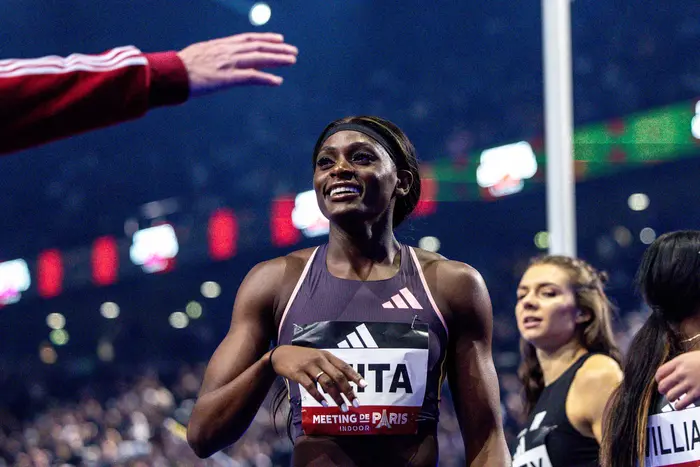
Her 11.34 seconds may not have matched the performances that have made her one of Britain’s leading sprinters, but it provided something more valuable: proof that she could compete again.
Neita has spent years operating at the highest level of international athletics. She was part of the Great Britain team that won Olympic silver in the women’s 4x100m relay at the Paris Olympics and has collected medals at Olympic, World, European and Commonwealth level.
Those achievements have been built on speed, consistency and resilience. But the latest chapter of her career has demanded another quality — patience.
Her comeback was also strengthened by watching other athletes overcome their own setbacks. Rather than viewing injury as an isolated struggle, Neita drew motivation from competitors who had already experienced the frustration and uncertainty of rehabilitation.
“I was very inspired by a lot of teammates that I have and people that I know on the circuit,” she said.
Among those athletes were Brittany Anderson and Trayvon Bromell, both of whom had endured serious injuries and returned to elite competition.
“I just had them in the back of my mind,” Neita added. “If they have done it, so can I.”
That belief became an important part of her recovery. On the difficult days, the examples of other athletes provided a reminder that setbacks do not necessarily mark the end of a career or a season.
Neita’s European Championships campaign may therefore be remembered differently from the races in which she has won medals. There was no final appearance and no podium celebration. Instead, there was something quieter but equally meaningful.
She came back.
Four months after breaking her foot, Neita stood on a major championship starting line again. She had gone from a wheelchair to a boot, from rehabilitation to training, and finally back to racing.
For an athlete who had spent much of the season wondering whether she would compete again, crossing the finish line in 11.34 seconds was not the failure the stopwatch suggested.
It was a statement.
Neita did not need a medal to prove that she had won something at the European Championships. Her victory had already begun months earlier, when she chose to fight her way back instead of waiting for another year.
The road ahead may still require patience, but Neita has already shown that she is willing to take it one step at a time.
And after everything she has been through, simply being back on the track was a victory in itself.