
Rigathi Gachagua Leadership Framework on Public Resource Protection

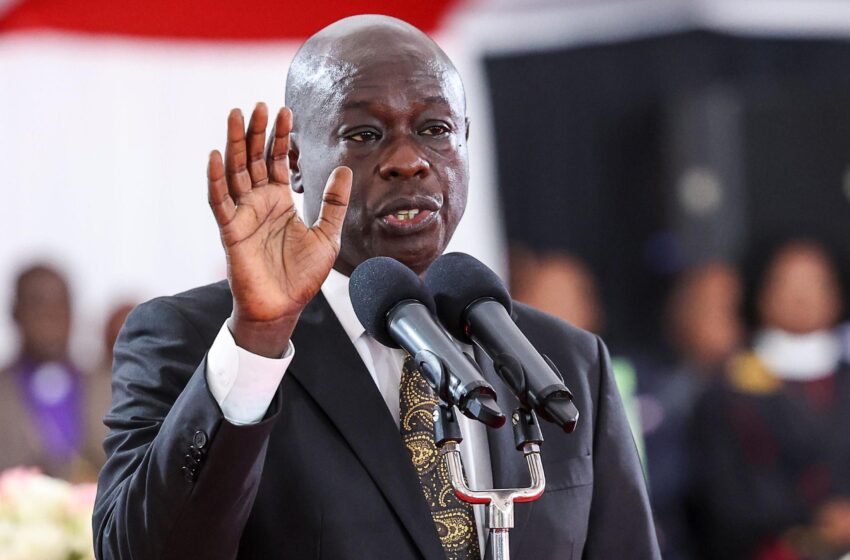
Former Deputy President Rigathi Gachagua’s recent political messaging signals an attempt to define a governance framework centered on institutional accountability, economic restoration, and structural reform. Framed around the idea of a future “United Alternative Government,” the narrative moves beyond routine political positioning and instead engages with long-standing debates about how the Kenyan state manages public resources, enforces justice, and delivers services.
What stands out in this framing is not just the policy direction being suggested, but the underlying diagnosis: that Kenya’s governance challenges are structural rather than episodic, and therefore require systemic correction rather than incremental adjustment.
A Shift From Political Rhetoric to Governance Framing
Rather than presenting isolated policy promises, the framework attributed to Gachagua appears to be built around a broader interpretation of state failure and institutional inefficiency. It positions governance reform as the central mechanism for correcting economic imbalance and restoring public confidence in leadership.
This approach reflects a growing trend in Kenyan political discourse where leaders increasingly tie legitimacy not only to electoral outcomes but also to the perceived effectiveness of state institutions. In this context, governance is no longer viewed purely as administration, but as a performance-based system where accountability and delivery determine public trust.
However, translating political messaging into operational governance systems requires more than narrative framing. It demands institutional alignment, legal reinforcement, and sustained administrative capacity.
Economic Accountability as a Structural Reform Tool
A central theme within the proposed governance direction is economic accountability. The argument presented is that long-term economic stability depends on how effectively a state manages public resources and prevents systemic leakage through corruption or inefficiency.
Rather than treating corruption as isolated misconduct, this framing treats it as a structural constraint that affects national productivity, fiscal sustainability, and service delivery. The implication is that economic recovery is not only a matter of increasing revenue collection but also of improving the integrity of expenditure systems.
In practical governance terms, this would require stronger audit institutions, transparent procurement systems, and consistent enforcement of financial regulations. Without these safeguards, economic restoration efforts risk being undermined by the same inefficiencies they seek to address.
The broader policy debate reflected here is not unique to Kenya; many developing economies face similar tensions between revenue expansion and governance quality. The effectiveness of reform therefore depends on whether institutional checks can operate independently of political influence.
Governance, Trust, and the Problem of Institutional Confidence

One of the less explicit but important themes in the framework is institutional trust. Public confidence in government systems is often shaped by perceived fairness, consistency of law enforcement, and equitable access to public services.
Where trust is weak, even well-designed policies struggle to achieve compliance or legitimacy. This makes governance not only a technical exercise but also a psychological and social contract between the state and citizens.
The emphasis on integrity and reform suggests an attempt to address this trust deficit. However, trust is not restored through messaging alone—it is rebuilt through consistent institutional behavior over time.
Land Ownership as a Long-Standing Governance Fault Line
Land remains one of the most politically sensitive and economically significant issues in Kenya’s governance landscape. Historical disputes, administrative weaknesses, and competing land use pressures have made property rights a recurring source of tension.
Within the broader reform narrative, land justice is presented as a corrective mechanism aimed at addressing historical grievances and restoring legal ownership structures. This includes addressing illegal acquisitions and strengthening enforcement of property rights.
The importance of land reform extends beyond legal ownership. Secure land tenure is directly linked to investment confidence, agricultural productivity, and urban development planning. Where land systems are unclear or contested, economic activity tends to slow due to uncertainty and legal risk.
For this reason, land governance is often considered both a social justice issue and an economic development priority.
Security, Rule of Law, and Political Stability
Internal security is another key pillar in the governance framework being articulated. The emphasis placed on eliminating politically motivated violence and strengthening institutional authority reflects broader concerns about the role of informal power structures in destabilizing democratic processes.
In stable governance systems, the rule of law functions as the primary mechanism for resolving disputes and enforcing accountability. Where enforcement is weak or inconsistent, political and economic uncertainty tends to increase.
Strengthening legal institutions, therefore, is not only about maintaining order but also about creating a predictable environment in which economic and social activity can function effectively.
This connection between governance stability and development outcomes is well established in comparative political analysis, where institutional strength is often correlated with investment confidence and long-term economic performance.
Infrastructure Delivery and the Question of Public Equity
Infrastructure development remains a visible and politically significant indicator of governance performance. Roads, transport systems, and public utilities are often used by citizens as practical measures of whether government policy is effective.
Within the reform narrative, infrastructure is framed not as a political favor but as a public entitlement. This distinction is important because it shifts expectations from discretionary delivery to systematic planning and equitable distribution.
In rapidly expanding urban and peri-urban regions, infrastructure gaps often become more pronounced, affecting mobility, trade efficiency, and access to services. Addressing these gaps requires long-term planning, consistent funding mechanisms, and insulation from political cycles.
The broader implication is that infrastructure should be treated as part of national productivity strategy rather than short-term political competition.
Political Context and the Emerging 2027 Debate
Although framed in governance terms, the ideas associated with this agenda inevitably sit within the broader political environment leading up to the 2027 election cycle. Political narratives at this stage often serve dual functions: articulating policy direction while also shaping voter perception and coalition dynamics.
The emphasis on accountability, economic restoration, and institutional reform aligns with broader national debates about cost of living, corruption, and service delivery. These issues remain central to voter concerns and are likely to continue shaping political competition in the coming years.
However, the transition from political articulation to governance implementation remains the defining challenge. Many reform agendas in similar contexts face difficulties not in design, but in execution within complex institutional environments.
A Reform Narrative Still in Definition
The governance framework associated with Rigathi Gachagua reflects an attempt to position accountability and institutional reform at the center of national political discourse. It combines economic, legal, and administrative themes into a broader narrative of state restoration.
However, the effectiveness of such a framework ultimately depends on institutional capacity and sustained political commitment rather than rhetorical clarity alone. Issues such as corruption, land governance, infrastructure delivery, and public trust are deeply structural and require long-term, coordinated reform strategies.
Kenya continues to navigate its political and economic challenges and such narratives contribute to an evolving debate on what effective governance should look like in practice—and how it can be achieved within existing institutional realities.

